
Some words are accidents.
Others are cultural fossils.
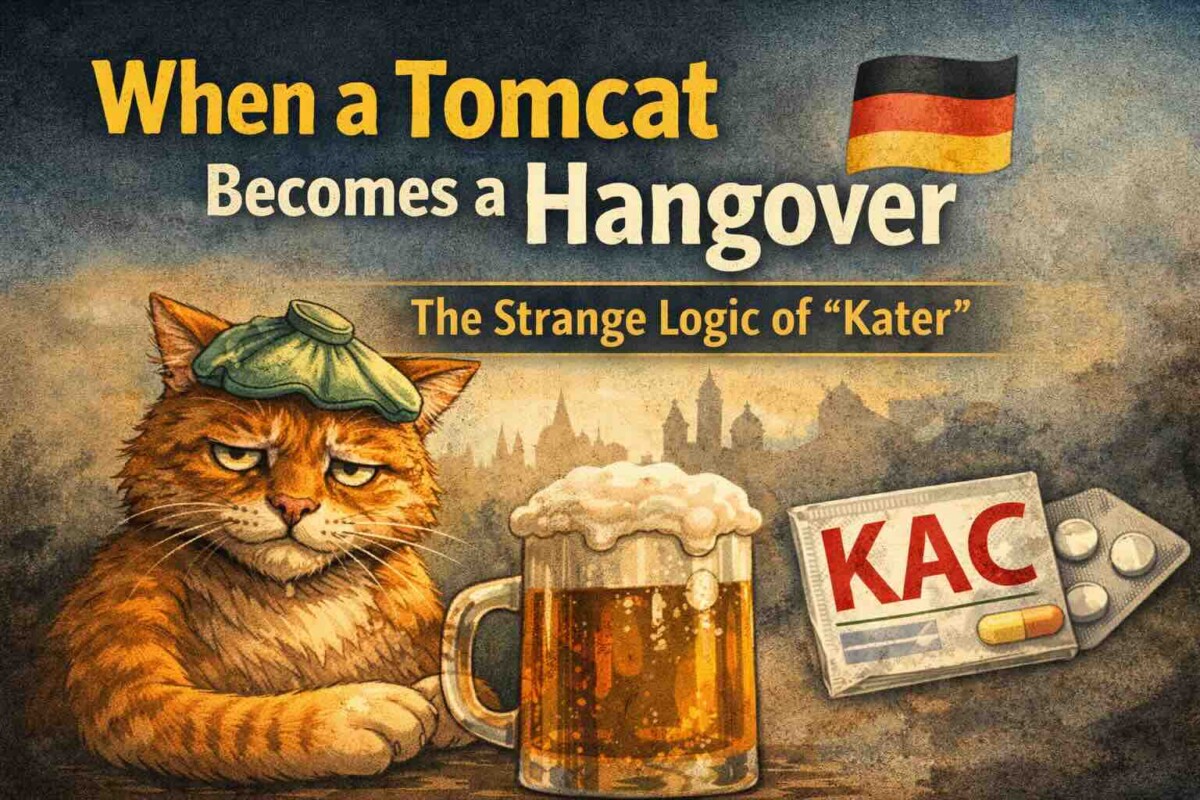
German Kater is both.
It means a male cat.
It also means a hangover.
And the more you think about it, the more disturbing — and brilliant — that connection becomes.
The Word That Refuses to Stay in One Meaning
In German:
- der Kater — tomcat
- einen Kater haben — to have a hangover
In Polish:
- kac — hangover
In English:
- hangover
In Russian and Ukrainian:
- похмелье / похмілля
Only German keeps the animal alive inside the symptom.
That is not random.
Language does not create metaphors by mistake.
It preserves perception.
Why a Cat?
A tomcat is:
- territorial
- loud at night
- unpredictable
- stubborn
- independent
- sometimes aggressive
Now imagine the morning after excess.
Head pounding.
Light unbearable.
Mood irritable.
Body refusing cooperation.
A hangover is not just physical pain.
It is a personality shift.
And German decided that this personality resembles a tomcat.
Not a kitten.
Not a neutral “cat.”
A Kater.
Masculine.
Rough.
Unapologetic.
Language encodes gender and temperament inside metaphor.
Polish “Kac” — The Sound Without the Animal
Polish removed the cat — at least visibly.
But phonetically, the echo remains:
kac.
Short. Sharp. Almost onomatopoeic.
It sounds like something unpleasant.
The metaphor fossilized differently, but the sound stayed close.
This is how languages diverge without fully separating.
The Cultural Layer Beneath the Grammar
German is famous for precision.
But precision does not mean literalness.
When a German says:
“Ich habe einen Kater.”
They are not describing an animal.
They are acknowledging weakness.
And here is the cultural nuance:
German speech rarely dramatizes emotion.
It minimizes it.
A hangover is not theatrical suffering.
It is a state you “have.”
Almost like a possession.
Almost like a pet.
There is something dry, almost ironic in that structure.
You don’t become destroyed.
You have a tomcat.
Animals and Human Excess
English says:
- drunk as a skunk
- drunk as a pig
Russian says:
- пьяный как свинья
- пьяный как сапожник
Ukrainian says:
- п’яний як чіп
Why animals?
Because we outsource our loss of control.
When we overstep, we turn into something instinctive.
Something less restrained.
German simply extended the metaphor into the morning after.
The animal remains.
When Words Teach More Than Grammar
You can memorize:
- Kater = hangover
Or you can understand:
- metaphor
- cultural psychology
- projection
- emotional framing
If you understand why Germans chose a tomcat,
you understand something about German thinking.
If you understand why English chose “hangover,”
you understand something about physical imagery.
If you understand why Polish kept “kac,”
you see how sound travels across borders.
Language learning is not vocabulary accumulation.
It is pattern recognition across cultures.
If you want to explore how German logic works beyond declensions and cases, explore it where metaphor hides.
At Levitin Language School, we don’t just teach words.
We teach why they exist.
Global Learning. Personal Approach.
Author: Tymur Levitin
Founder, Director and Lead Teacher
Levitin Language School
© Tymur Levitin