

Before choosing a language to learn, explore all available options here:
https://levitintymur.com/#languages
In recent years, a new idea has become extremely popular among language learners.
It sounds simple and attractive:
“You don’t really need a teacher anymore. There are apps for that.”
Thousands of advertisements repeat the same promise.
Download the app. Practice a few minutes a day. Learn a language naturally.
For many people this sounds like a dream solution.
No schedule.
No teacher.
No commitment.
Just a phone and a few minutes of practice.
Unfortunately, the reality of language learning is far more complex.
Where the Idea Comes From
Language apps became popular because they solve one real problem.
They make language exposure easily accessible.
A person can:
- learn vocabulary
- review phrases
- practice spelling
- train basic listening skills
This is useful.
But usefulness is not the same as completeness.
Apps provide tools, not education.
What Language Apps Actually Teach
Most language-learning applications focus on three elements:
Vocabulary
Users learn isolated words and simple phrases.
This helps recognition but rarely creates deep understanding.
Pattern repetition
Apps rely heavily on repetition.
Learners see similar structures again and again.
This builds familiarity, but it does not necessarily build flexibility in real communication.
Gamification
Points, streaks, levels, and daily goals keep users engaged.
This motivates people to continue practicing.
But motivation alone does not guarantee mastery.
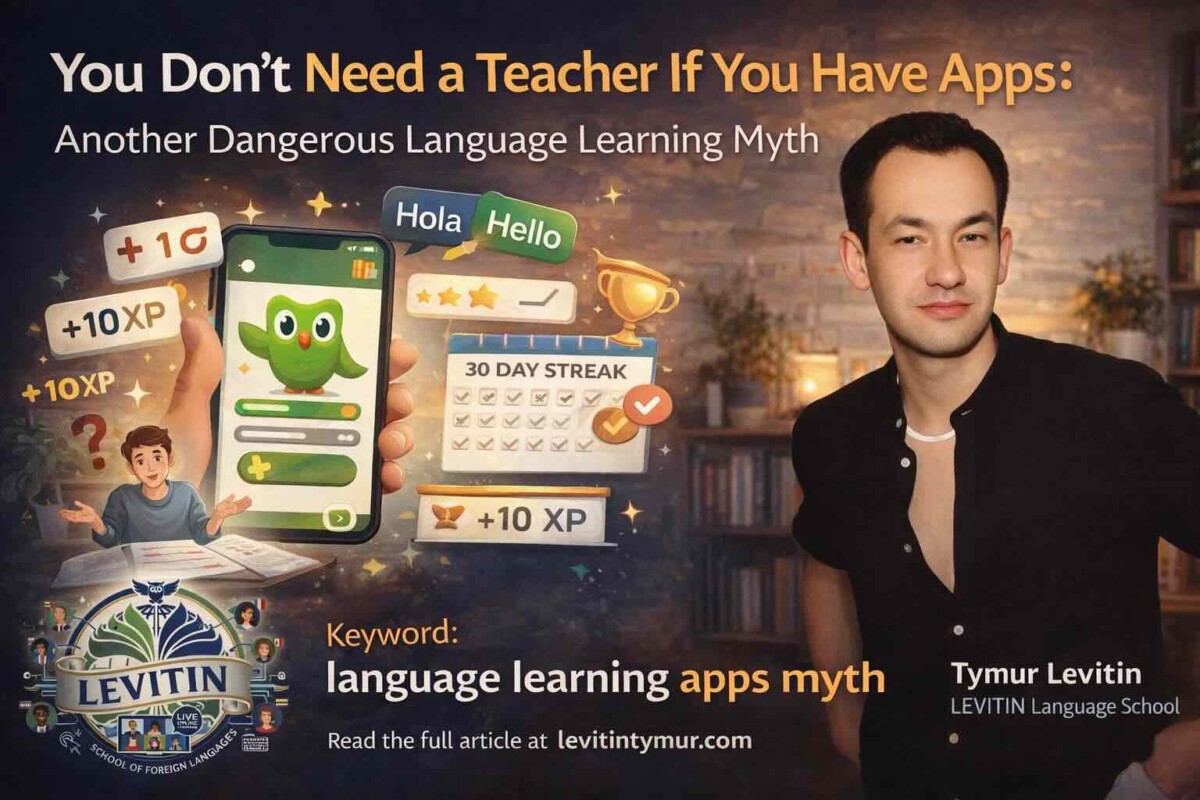
What Apps Cannot Replace
Despite their usefulness, apps cannot perform several essential functions of real teaching.
1. Understanding mistakes
Apps usually accept only predefined answers.
If a learner makes a mistake, the program often simply marks it as wrong without explaining why.
Real language learning requires understanding patterns, not just guessing correct answers.
2. Real conversation dynamics
Human communication includes:
- hesitation
- interruptions
- accents
- informal speech
- emotional tone
Apps simulate conversation, but they rarely capture its unpredictability.
3. Cultural nuance
Language is inseparable from culture.
Expressions that seem grammatically correct may sound unnatural, outdated, or even rude in real life.
Understanding these nuances usually comes from guided learning and real interaction.
The Illusion of Progress
One of the biggest problems with language apps is psychological.
Learners often feel they are progressing faster than they actually are.
Completing lessons and earning points creates a sense of achievement.
But when learners attempt real conversation, they often discover that passive knowledge does not automatically become active communication.
This moment can be frustrating.
Why Teachers Still Matter
A teacher does more than explain grammar.
A teacher:
- adapts explanations to the learner
- identifies recurring mistakes
- connects new knowledge with existing knowledge
- creates structured progression
Most importantly, a teacher guides learners through situations where language behaves unpredictably.
Apps cannot do that.
The Best Role for Apps
Instead of replacing teachers, language apps work best as support tools.
They are excellent for:
- reviewing vocabulary
- reinforcing patterns
- maintaining daily exposure
- practicing listening
When used alongside structured learning, they become extremely powerful.
When used alone, their effectiveness is limited.
The Real Question
The question is not whether apps are good or bad.
The real question is how they are used.
If learners expect them to replace real instruction, disappointment often follows.
If learners use them as part of a broader learning strategy, they can accelerate progress significantly.
Final Thought
Technology has changed language learning dramatically.
But it has not changed one fundamental truth:
Languages are human systems.
They are shaped by people, culture, context, and interaction.
No algorithm can fully replace the role of human guidance in understanding them.
© Tymur Levitin
Author: Tymur Levitin
Founder and Director
Levitin Language School
Global Learning. Personal Approach.