

Choose your language:
https://levitintymur.com/#languages
A Ship Is Not Just Machinery — It Is a Conversation
When people imagine ships, they think of engines, navigation systems, radar, and steel.
But ships do not operate on technology alone.
They operate on communication.
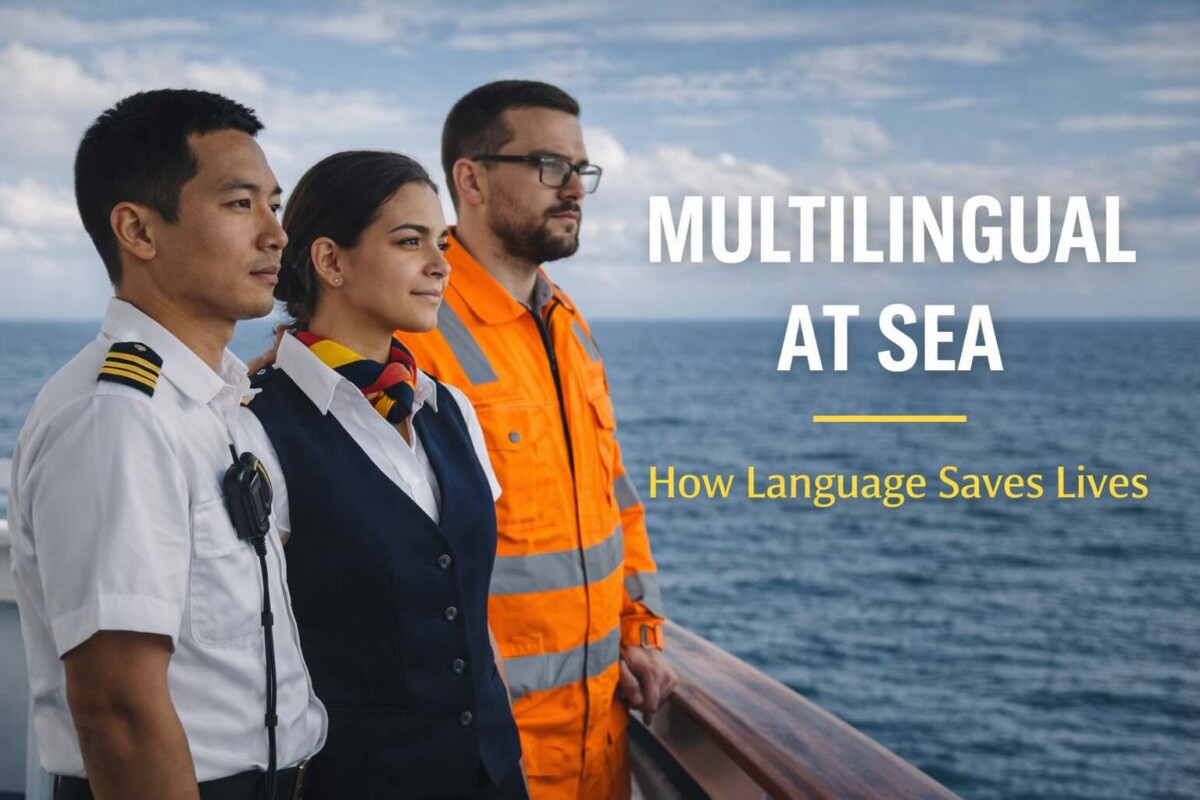
A vessel is a moving community where officers, engineers, service staff, technicians, and passengers interact constantly. Often these people come from five, ten, or even twenty different countries.
Language becomes the invisible infrastructure that keeps the entire system functioning.
The Reality of Multinational Crews
Modern ships rarely operate with crews from a single country.
A typical vessel might include:
- officers from Europe
- engineers from Asia
- service staff from Latin America
- logistics teams from different regions
In this environment, communication must remain clear, calm, and precise.
Misunderstanding a technical instruction can slow an operation.
Misunderstanding a safety command can endanger lives.
Language competence is therefore not an academic skill.
It is an operational requirement.
English — The Core Maritime Language
English serves as the international maritime standard.
It is used for:
- radio communication
- navigation reporting
- safety procedures
- international port coordination
Without English, cooperation between vessels and ports would become chaotic.
This is why Maritime English exists as a structured professional system rather than casual conversation.
Explore English programs:
https://levitintymur.com/languages/english/
Why Additional Languages Still Matter
Even though English is the international standard, multilingual crews often rely on other languages during daily work.
Spanish is widely used in hospitality roles and passenger interaction.
German appears in European shipping and technical documentation.
Polish, Ukrainian, and other languages frequently appear in engineering and logistics teams.
Learning additional languages strengthens teamwork and reduces friction.
Explore language options:
https://levitintymur.com/#languages
Language as a Safety Tool
Clear communication improves:
- emergency response coordination
- navigation accuracy
- technical maintenance instructions
- teamwork under pressure
When communication is structured, decisions become faster and safer.
Many maritime incidents historically involved not mechanical failure — but misunderstanding.
Language discipline reduces this risk.
The Human Side of Maritime Communication
Beyond safety and operations, language shapes the human atmosphere on board.
A ship is also a temporary home.
When crew members understand each other, cooperation improves.
Respect grows naturally.
Conflicts become easier to resolve.
Language builds trust between people who may otherwise share nothing but the ocean around them.
Learn the Languages That Move the World
Seafaring has always connected continents.
Today it also connects languages.
The more clearly people communicate at sea, the safer and more effective maritime work becomes.
Language is not just a skill.
At sea, it is part of navigation.
Author: Tymur Levitin
Founder, Director, and Head Teacher
Levitin Language School
Global Learning. Personal Approach.
Main website:
https://levitintymur.com/
U.S. site:
https://languagelearnings.com/
© Tymur Levitin