

Introduction
Clinical research is one of the most international environments in modern science.
A single clinical study may involve:
- research centers in several countries
- pharmaceutical sponsors
- regulatory authorities
- hospital investigators
- data monitoring committees
All these participants must communicate using a shared professional language.
This language combines medicine, statistics, regulatory law and project management.
Understanding how clinical research actually communicates is essential for doctors, researchers, pharmaceutical professionals and anyone working in global healthcare.
Clinical Research Is an International Collaboration
Modern clinical trials rarely happen in a single country.
Large studies often involve:
- dozens of hospitals
- thousands of patients
- international regulatory authorities
- multiple research organizations
Because of this complexity, clinical research has developed a specialized communication system.
Researchers must discuss:
- study protocols
- patient enrollment
- safety monitoring
- statistical outcomes
- regulatory reporting
Without a common professional language, such coordination would be impossible.
The Language of Clinical Trial Design
Every clinical study begins with a clinical trial protocol.
This document defines how the research will be conducted.
Important terms include:
clinical trial protocol
A detailed plan describing how the study will be carried out.
study endpoint
The measurable outcome used to evaluate treatment effectiveness.
randomized controlled trial (RCT)
A study design where patients are randomly assigned to treatment groups.
patient enrollment
The process of recruiting participants for a clinical study.
Example:
Patient enrollment must follow strict inclusion and exclusion criteria.
Communication Between Researchers and Regulators
Clinical research operates under strict international regulations.
Regulatory authorities review every stage of the process.
Key expressions include:
regulatory submission
The documentation submitted to authorities for approval.
ethics committee approval
Authorization confirming that patient rights are protected.
adverse event reporting
The process of reporting unexpected medical effects during a study.
post-marketing surveillance
Monitoring drug safety after market approval.
Example:
All adverse events must be reported according to regulatory guidelines.
Data and Statistics in Clinical Research
Clinical research relies heavily on statistical analysis.
Researchers often discuss:
clinical data analysis
Evaluation of medical results collected during a study.
statistical significance
Evidence that results are unlikely to occur by chance.
interim analysis
Evaluation of trial data before the study is completed.
real-world evidence (RWE)
Data collected outside controlled trials, often from clinical practice.
Example:
The interim analysis showed statistically significant improvement.
The Language of Research Collaboration
Large clinical studies involve many partners.
Common collaboration terms include:
contract research organization (CRO)
A company that manages clinical trials for pharmaceutical sponsors.
principal investigator
The lead researcher responsible for conducting the study.
site monitoring
Regular oversight of clinical research centers.
data monitoring committee
An independent group reviewing trial safety.
Example:
The CRO coordinates site monitoring across multiple countries.
Why Clinical Research English Matters
Many researchers can read medical publications in English.
However, international research projects require more than reading skills.
Participants must discuss:
- regulatory compliance
- statistical interpretation
- patient safety
- study coordination
- international collaboration
This communication requires a specialized vocabulary that differs significantly from everyday English.
Language as Infrastructure in Global Science
Clinical research is often described as a scientific process.
In reality, it is also a communication system.
Thousands of professionals across different countries must exchange information quickly and precisely.
Professional language therefore becomes the invisible infrastructure supporting modern medical innovation.
Understanding this language means understanding how global medical research actually works.
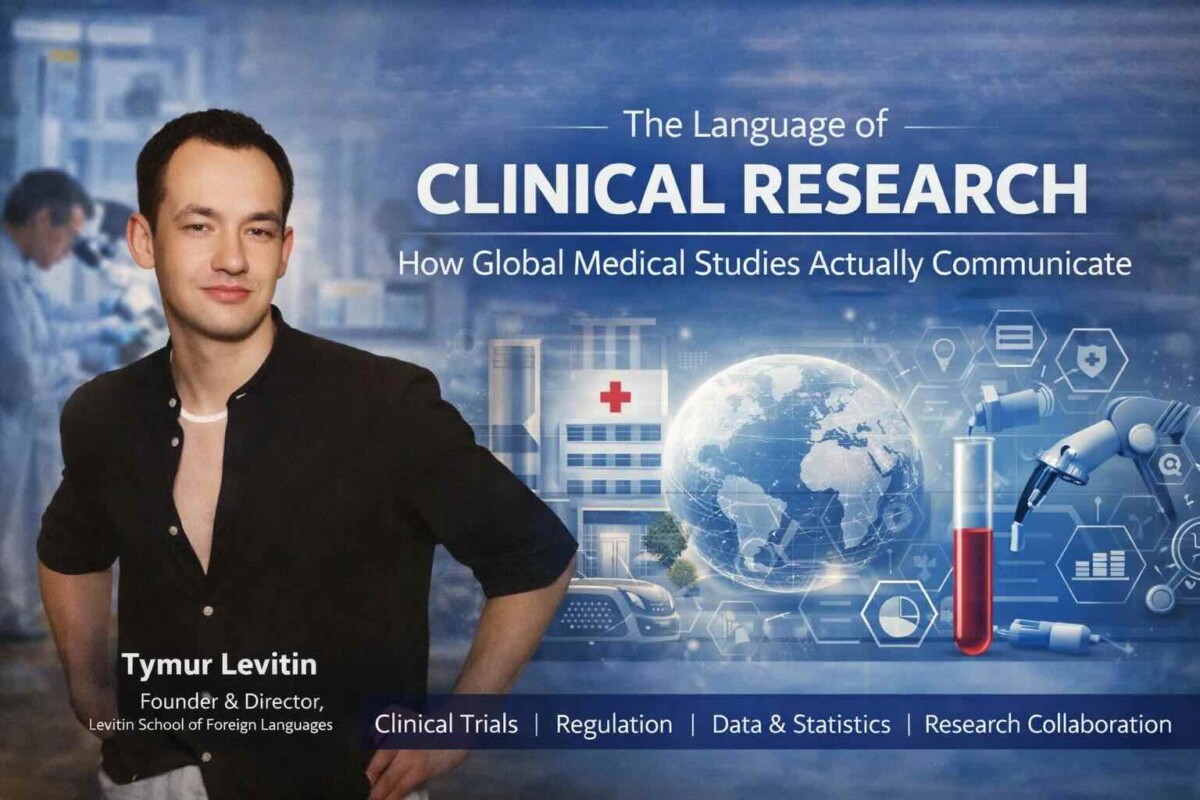
Author: Tymur Levitin
Founder & Director
Levitin School of Foreign Languages
© Tymur Levitin, Levitin Language School.
All rights reserved.
Unauthorized copying or reproduction without permission is prohibited.