
Why advanced language learners still struggle to write clearly
Many students believe that academic writing is a vocabulary problem.
They think:
- “I need more advanced words.”
- “My vocabulary is not academic enough.”
- “If I learn more formal phrases, my writing will improve.”
But vocabulary is rarely the real issue.
Most academic writing problems are structural.
And structure has nothing to do with memorizing words.
It has everything to do with how you think.
Vocabulary Is Decoration. Structure Is Architecture.
You can write a paragraph full of sophisticated vocabulary and still say nothing.
You can use complex terminology and still confuse the reader.
Because academic writing is not about sounding intelligent.
It is about organizing thought.
Structure means:
- knowing what your main claim is
- separating argument from explanation
- distinguishing example from proof
- building logical progression
- avoiding emotional shortcuts
Without structure, vocabulary becomes camouflage.
With structure, even simple language becomes powerful.
Why Students Overfocus on Vocabulary
There are three common reasons.
1. Language insecurity
Students who write in a second language often feel exposed.
They try to compensate by using “bigger” words.
But insecurity cannot be solved with adjectives.
It can only be solved with clarity.
2. Educational conditioning
Many education systems reward complexity over clarity.
Students are taught that:
- longer sentences = better writing
- more terminology = more academic
- more references = stronger argument
But academic strength comes from coherence, not length.
3. Fear of simplicity
Clear writing feels simple.
And simplicity feels risky.
But clarity is not simplification.
Clarity is discipline.
What Academic Structure Actually Means
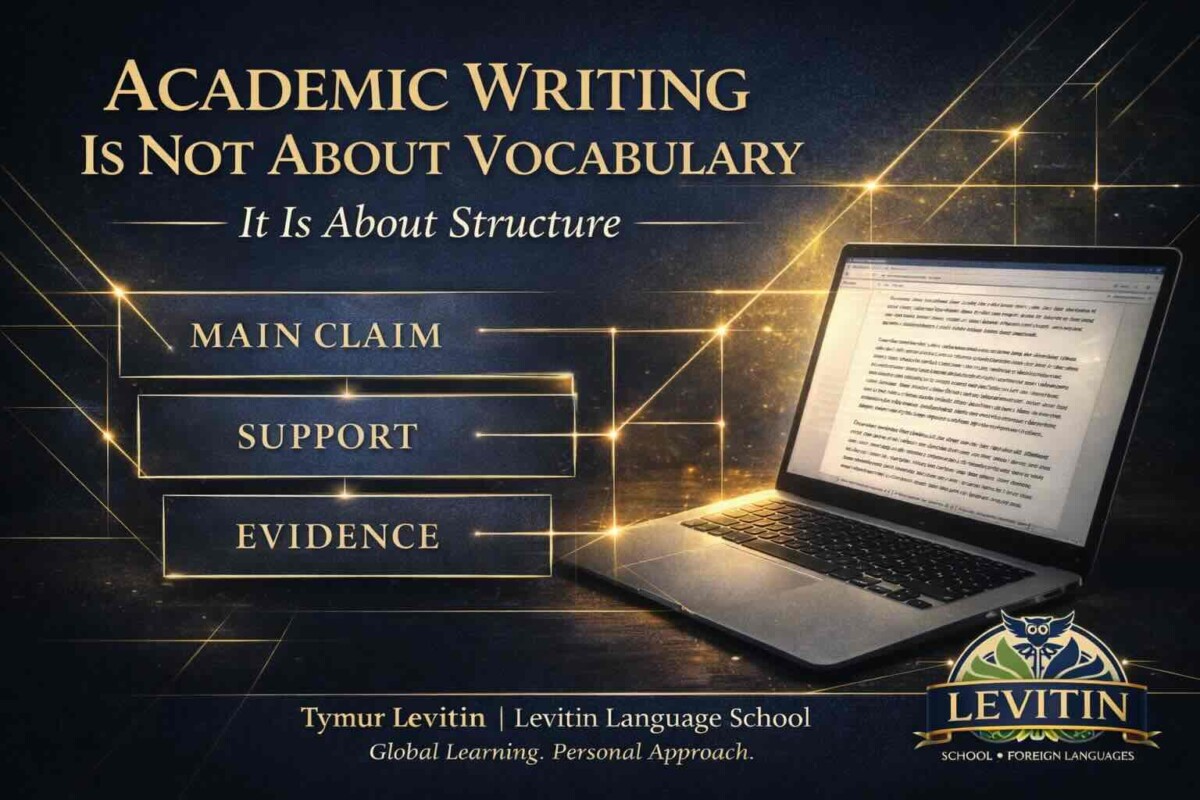
Academic structure is built on hierarchy.
Every text must answer three structural questions:
- What is the main claim?
- How is it supported?
- Why does it matter?
If any of these are unclear, vocabulary will not save the text.
Structure requires:
- logical paragraph flow
- internal consistency
- conceptual precision
- defined terms
- controlled transitions
Academic writing is controlled thinking on paper.
Multilingual Students Face a Hidden Challenge
Students who move between languages — English, Ukrainian, German — face an additional layer of difficulty.
Each language has its own structural expectations.
For example:
- English academic writing prefers direct thesis statements.
- German academic tradition often builds toward the conclusion.
- Ukrainian academic writing emphasizes hierarchical clarity and formal tone.
If a student copies structural habits from one language into another without awareness, the result feels “wrong” — even if grammar is correct.
This is not a vocabulary issue.
It is a structural transfer issue.
That is why academic writing must be trained consciously.
Structure Prevents Plagiarism
There is a connection between structure and integrity.
When students do not know how to structure their ideas, they feel stuck.
When they feel stuck, they look for ready-made formulations.
When they look for ready-made formulations, they risk copying.
Plagiarism is often not laziness.
It is structural insecurity.
If a student understands how to:
- build an argument step by step
- paraphrase without distorting meaning
- integrate sources logically
- distinguish voice from citation
Then academic integrity becomes natural.
Structure protects originality.
Academic Writing Is Intellectual Responsibility
Academic writing is not about impressing the reader.
It is about respecting the reader.
Respect means:
- not hiding weak arguments behind complex language
- not manipulating through ambiguity
- not overstating conclusions
- not confusing emotion with evidence
Academic writing demands intellectual honesty.
And intellectual honesty requires structural clarity.
How We Approach Academic Writing
At Levitin Language School, we do not teach academic writing as a list of formal phrases.
We teach it as:
- logical construction
- argument architecture
- multilingual awareness
- structural discipline
Students learn to:
- outline before drafting
- define before arguing
- support before concluding
- revise for coherence, not just grammar
Because writing is visible thinking.
And academic writing is structured thinking under responsibility.
The Real Shift
When students stop chasing vocabulary and start mastering structure, something changes.
They:
- write shorter but clearer
- argue more confidently
- reference more responsibly
- think more precisely
Academic writing becomes less about performance —
and more about control.
And control is what creates intellectual independence.
Academic writing is not a vocabulary competition.
It is the architecture of thought.
And structure is what holds that architecture together.
Author: Tymur Levitin
Founder & Director, Levitin Language School
Global Learning. Personal Approach.
© Tymur Levitin