

Plagiarism is rarely about dishonesty. It is usually about fear.
In academic discussions, plagiarism is often treated as a moral failure.
Universities publish strict policies.
Students sign integrity declarations.
Software checks every submission.
But despite all these measures, plagiarism continues to exist.
Why?
Because plagiarism is rarely a question of ethics alone.
More often, it is a question of structure, language insecurity, and academic pressure.
The Hidden Cause: Structural Insecurity
Many students simply do not know how to build an argument.
They may understand the topic.
They may have read the sources.
They may even agree with the main ideas.
But when they sit down to write, something collapses.
They ask themselves:
- Where should the argument begin?
- How should the sources be integrated?
- How do I express the same idea without repeating the original text?
Without structural confidence, writing becomes chaotic.
And chaos invites shortcuts.
Language Pressure in Multilingual Education
For students writing in a second or third language, the pressure is even greater.
Imagine the situation:
A student understands the concept in their native language.
But now they must express it in English, German, or Ukrainian academic style.
This creates three simultaneous challenges:
- Translating meaning
- Maintaining academic tone
- Structuring argumentation
When all three happen at once, cognitive overload appears.
At this moment, copying begins to feel like a solution.
Not because the student wants to cheat.
But because the student feels incapable of reproducing the structure independently.
Plagiarism as a Survival Strategy
Under academic pressure, plagiarism becomes a survival strategy.
Students fear:
- failing the assignment
- losing scholarships
- disappointing teachers
- appearing incompetent
In such conditions, copying a sentence or paragraph feels like protection.
The student tells themselves:
“I will adjust it later.”
But later rarely comes.
And the problem becomes disciplinary instead of educational.
What Most Academic Systems Ignore
Many institutions focus only on punishment.
They detect plagiarism.
They penalize plagiarism.
They document plagiarism.
But they rarely teach how to prevent the conditions that create plagiarism.
Those conditions are structural.
Students must learn:
- how to build an outline before writing
- how to distinguish ideas from wording
- how to paraphrase without distorting meaning
- how to integrate sources into their own argument
These skills are not intuitive.
They must be trained.
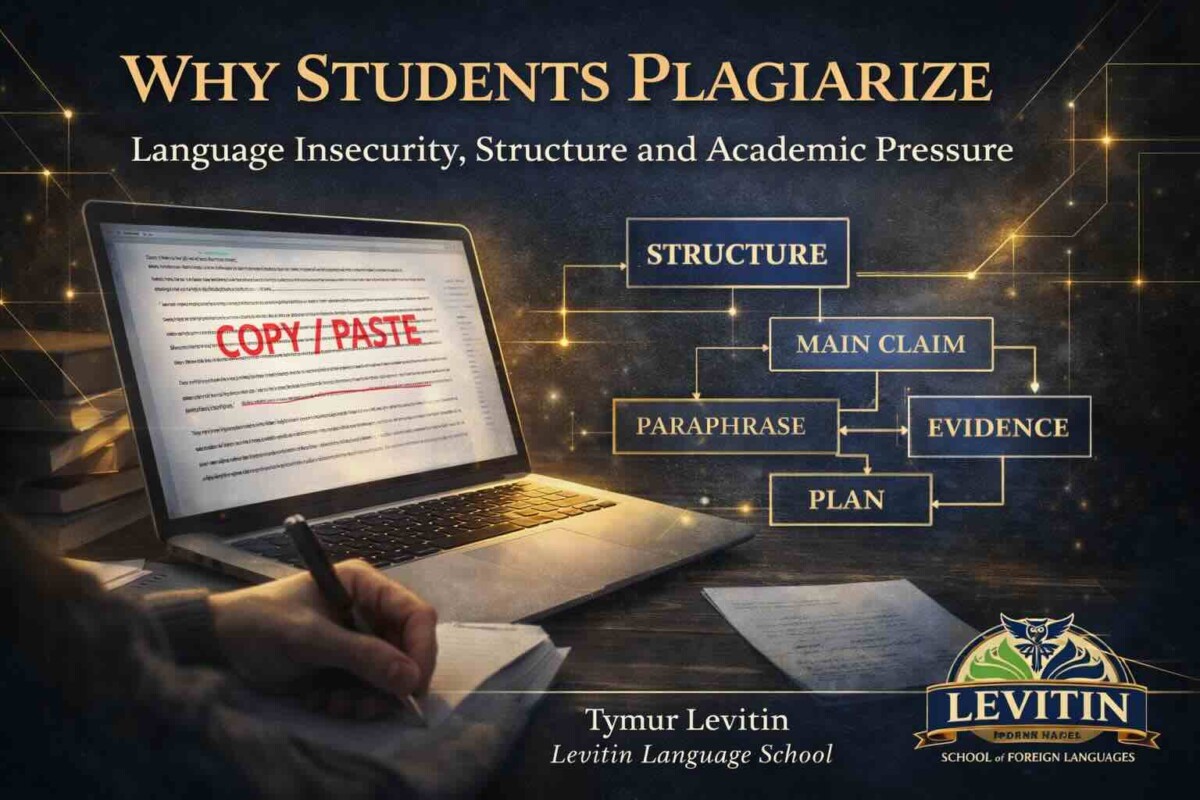
Structure Makes Originality Possible
Original writing does not begin with originality.
It begins with structure.
If a student knows how to organize a text, they can always express an idea differently.
For example:
Instead of copying a paragraph, the student can:
- identify the core idea
- restate the concept in their own words
- connect it to their argument
- cite the source appropriately
This process requires thinking.
But thinking requires structure.
Academic Integrity Is a Skill
Integrity is often described as a value.
But in academic writing, integrity is also a skill.
Students must learn:
- intellectual ownership
- responsible citation
- argument independence
- critical reading
When these abilities develop, plagiarism disappears naturally.
Not because the student fears punishment.
But because copying becomes unnecessary.
A Different Educational Approach
At Levitin Language School, academic writing is taught as structured thinking.
Students learn to:
- map arguments before writing
- analyze sources before citing them
- distinguish voice from quotation
- construct paragraphs around logical progression
This approach reduces plagiarism not through surveillance — but through competence.
Because a student who can think clearly has no reason to copy.
The Real Goal of Academic Integrity
The goal of academic integrity is not to produce perfect essays.
It is to produce independent thinkers.
Independent thinkers:
- question sources
- evaluate evidence
- construct arguments
- accept intellectual responsibility
Integrity is therefore not a rule.
It is a consequence of intellectual maturity.
And maturity begins with structure.
Author: Tymur Levitin
Founder & Director, Levitin Language School
Global Learning. Personal Approach.
© Tymur Levitin