
When students first see Future Continuous, they usually reduce it to a formula:
will be + verb-ing
Technically correct.
Conceptually insufficient.
Because Future Continuous is not about grammar mechanics.
It is about viewing the future from inside a specific future moment.
That perspective changes everything.
The Core Idea: A Future Moment as a Frame
Future Simple expresses a decision or prediction.
Future Continuous expresses what will be in progress at a certain future time.
But more importantly —
it creates a mental frame.
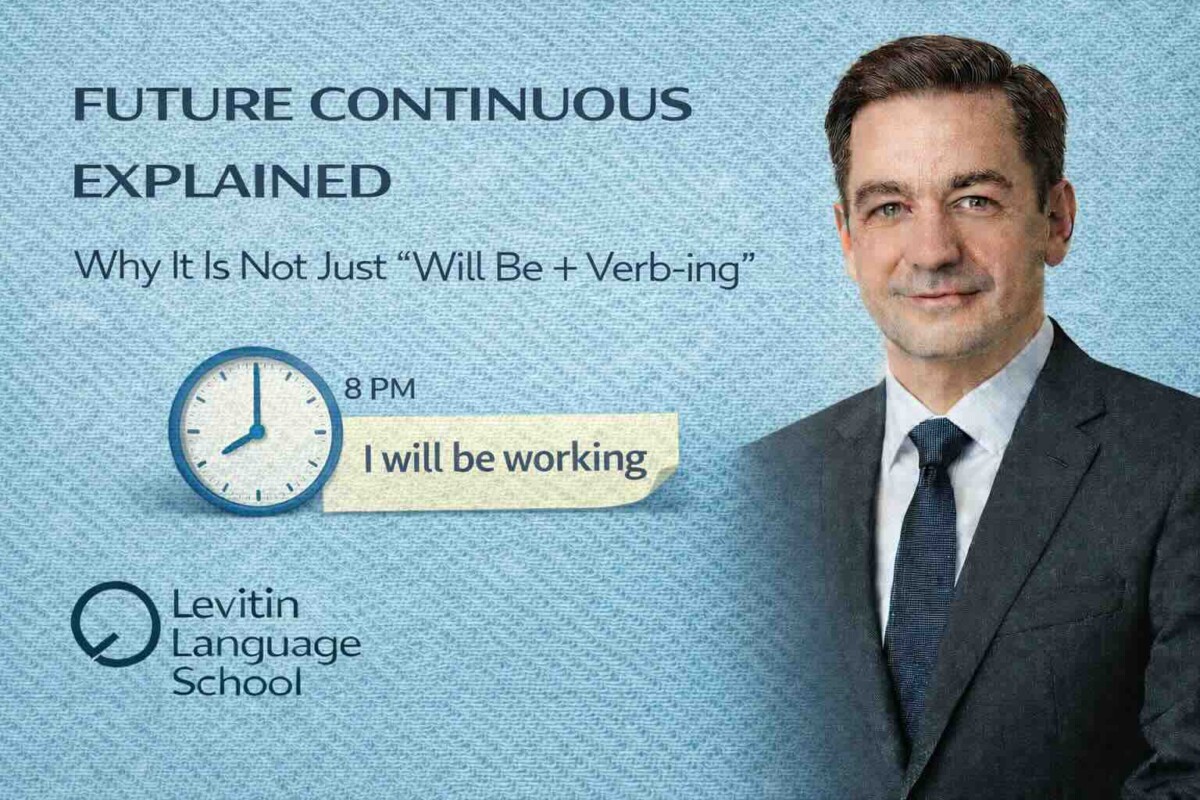
At 8 PM tomorrow,
I’ll be working.
You are not talking about “working” in general.
You are stepping into tomorrow at 8 PM
and describing what is happening then.
The tense moves your viewpoint forward.
Not About Duration — About Perspective
Students often think:
“Continuous = long action.”
Not necessarily.
The key question is:
Are you describing the action itself
or the situation at a future moment?
Compare:
I’ll call you at 8.
I’ll be calling you at 8.
The first = decision.
The second = scheduled activity in progress.
The difference is subtle but structural.
The Politeness Effect
Future Continuous often sounds softer.
Will you use my laptop tomorrow?
Will you be using my laptop tomorrow?
The second feels less direct.
Because it assumes the action might already be planned.
It reduces pressure.
That is not grammar —
that is pragmatics.
The “Normal Course of Events” Meaning
Future Continuous often describes something that is expected to happen naturally.
Don’t call me at 10.
I’ll be sleeping.
This does not emphasize decision.
It emphasizes a predictable state.
It sounds neutral.
Less emotional than “I’ll sleep.”
Structural Formula
will be + verb-ing
But the deeper structure is:
future reference point → action in progress
You are not announcing the action.
You are describing the situation at that time.
Compare the Future System
| Form | Focus |
|---|---|
| Will | Decision / promise |
| Going to | Prior intention / evidence |
| Present Continuous | Fixed arrangement |
| Future Continuous | Future situation in progress |
Each form answers a different structural question.
Future Continuous answers:
“What will be happening then?”
Why Learners Avoid It
Because it feels complex.
But in reality, it is often more natural in context.
Instead of saying:
I’ll work tomorrow at 8.
Native speakers often say:
I’ll be working at 8.
It sounds smoother.
More contextual.
Less abrupt.
The Perspective Shift
Future Continuous allows you to:
- project yourself forward
- describe background action
- soften requests
- imply routine
It is less about action.
More about environment.
Final Insight
Future Continuous is not just “will be + ing.”
It is a lens.
You move your perspective into the future
and observe what is happening there.
Once you see that shift,
the tense stops feeling technical.
It becomes visual.
And grammar becomes structure —
not memorization.
Author: Tymur Levitin
Founder & Director, Levitin Language School
Global Learning. Personal Approach.
© Tymur Levitin