

If you are learning German, you have probably been told that ja means “yes.”
Technically, that is correct.
Functionally, it is often wrong.
In real communication, ja can signal agreement, politeness, impatience, acknowledgment, irony, soft contradiction — and sometimes it does not mean agreement at all.
This article continues our German communication series and explores why learners misunderstand agreement signals in German — even when the grammar is perfect.
When “Ja” Is Not Confirmation
Many learners assume:
- Ja = yes
- Nein = no
But in real-life German conversation, agreement is not always literal.
Example:
A: Du kommst morgen, oder?
(You’re coming tomorrow, right?)
B: Ja, klar.
Clear agreement.
Now compare:
A: Du weißt ja, wie das ist.
(You know how it is.)
Here, ja does not mean “yes.”
It signals shared knowledge.
It means something closer to:
- “as you know”
- “you’re aware”
- “we both understand this”
It is a discourse marker, not a response.
The Hidden Function of “Doch”
One of the most misunderstood German words is doch.
Learners translate it as:
- “however”
- “but”
- “yes”
None of these are fully accurate.
Example:
A: Du kommst nicht.
(You’re not coming.)
B: Doch!
This does not mean “but.”
It means:
“Yes, I am — and you are wrong.”
Doch contradicts a negative statement.
It is a correction signal.
This is why learners often sound hesitant or unclear. They know the grammar — but they do not use the agreement system naturally.
When “Genau” Is Not Precision
Another trap is genau.
Learners love it. It feels safe.
But in real German speech, genau does not always mean “exactly.”
It often means:
- “Right.”
- “That’s it.”
- “Correct.”
- “I follow you.”
It is conversational alignment.
If you overuse it mechanically, you sound rehearsed.
If you use it with the wrong intonation, it sounds impatient.
Agreement in German is not only lexical. It is melodic.
Why Foreigners Misread German Reactions
Here is the cultural layer.
In some languages, agreement is often softened:
- “Maybe.”
- “I think so.”
- “Probably.”
- “Kind of.”
- “I guess.”
German tends to reduce vagueness.
When a German says:
- Ja.
- Nein.
- Stimmt.
- Nicht ganz.
- Doch.
The signal is often precise — not emotional.
Foreign learners sometimes interpret this as:
- cold
- abrupt
- rude
But what they are hearing is structural clarity.
Agreement Is a System, Not a Word
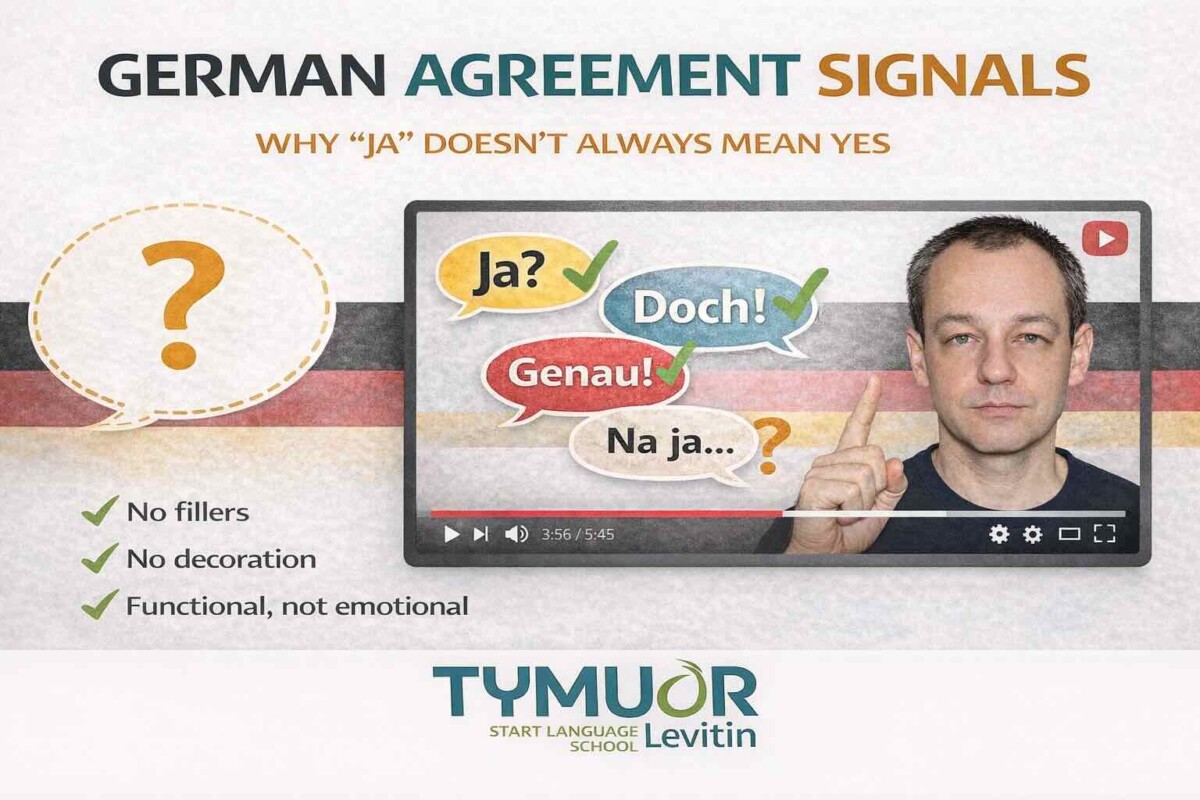
Let us look at typical German agreement signals:
- Ja. – yes / acknowledgment
- Doch. – correction of a negative
- Genau. – alignment
- Stimmt. – that’s correct
- Richtig. – factually correct
- Eben. – exactly (with closure)
- Na ja. – partial agreement / hesitation
Each carries nuance.
Each carries tone.
Each carries pragmatic weight.
If you translate them one-to-one into English or any other language, you lose the system.
The Real Problem: Learners Focus on Vocabulary
Most students memorize:
- verbs
- cases
- word order
- modal particles
But they do not study:
- interaction signals
- conversational structure
- response patterns
As a result:
- sentences are correct
- reactions are unnatural
And communication feels slightly off.
Why This Matters in Real Life
Agreement signals affect:
- job interviews
- professional meetings
- negotiations
- daily interactions
- conflict resolution
Misusing doch can change the tone of a conversation.
Overusing genau can make you sound insecure.
Avoiding direct agreement may make you sound uncertain.
Precision in German includes response precision.
Final Thought
Grammar makes you understandable.
Agreement makes you credible.
If you want to sound natural in German, you must learn not only how to build sentences — but how to respond inside them.
Language is not only structure.
It is positioning.
And German positions agreement very clearly.
Author: Tymur Levitin
Founder & Director
Levitin Language School
Global Learning. Personal Approach.
© Tymur Levitin
Learn German with analytical depth:
https://levitintymur.com/languages/learning-german/
For international programs:
https://languagelearnings.com/
Explore more articles in the German communication series on our blog.