

When students first hear about the Past Perfect Continuous, they are usually told something like this:
“It describes a long action that happened before another action in the past.”
This explanation sounds logical.
It is also incomplete.
Past Perfect Continuous is not about “longer past.”
It is about visible process before a past reference point.
If you understand this, you stop memorizing rules — and you start seeing structure.
The Real Question: What Are We Looking At?
Every tense answers a structural question.
- Past Simple → What happened?
- Past Continuous → What was in progress?
- Past Perfect → What had already been completed?
- Past Perfect Continuous → What had been developing?
That difference — completed vs developing — changes everything.
Compare the Structures
Let’s look at a situation:
She was tired.
Now we add background.
1️⃣ Past Perfect
She was tired because she had worked all day.
This focuses on completion.
The work was finished before we observe her tired state.
It is a fact.
2️⃣ Past Perfect Continuous
She was tired because she had been working all day.
Now we see the process.
We feel duration.
We imagine effort.
We understand why the result exists.
The difference is not grammar.
The difference is perspective.
Timeline Is Not Enough
Many textbooks draw timelines.
They show:
Past → earlier past → result.
That is correct, but incomplete.
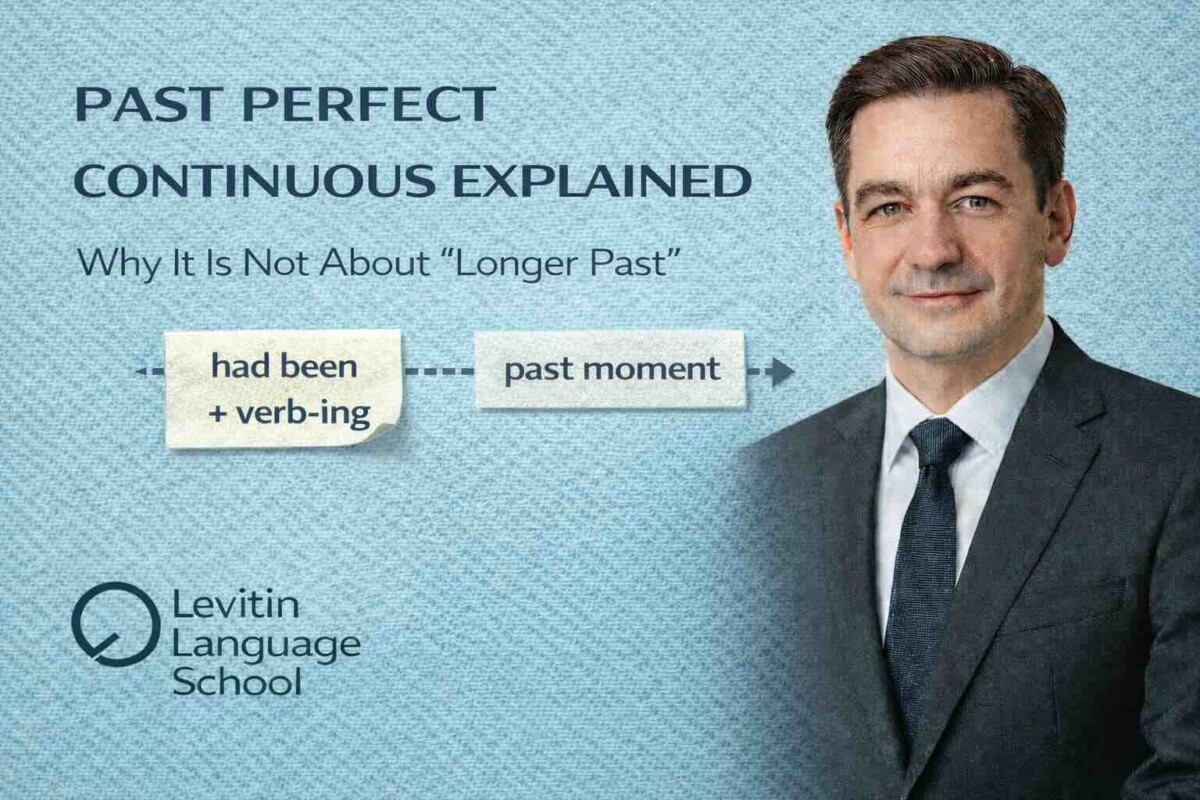
Past Perfect Continuous does not simply show “earlier past.”
It shows process leading into a past moment.
The past moment is the anchor.
The process is the lens.
Why Duration Alone Is Not the Point
Students often think:
“If it’s long, I use continuous.”
That is not how the system works.
Duration is visible — but it is not the core.
The core question is:
Do I want to show completion
or do I want to show development?
Compare:
- He had lived there for 10 years. → fact, completed stage
- He had been living there for 10 years. → lived experience, ongoing process before change
Both are grammatically correct.
They are not psychologically identical.
Cause and Evidence
Past Perfect Continuous often explains visible evidence in the past.
She was angry.
She had been waiting for two hours.
We do not just report the waiting.
We explain the emotional state.
The tense becomes causal.
The Structural Formula
had + been + verb-ing
But structure without meaning is empty.
The real formula is:
past reference point + visible prior process
When you see that, you do not need a rule.
You see the logic.
Common Mistake
Students mix it with Past Continuous:
❌ When I arrived, she had been cooking dinner.
This is possible — but only if cooking started long before arrival and continued up to that moment.
If we simply describe what was happening at arrival:
✔ When I arrived, she was cooking dinner.
Past Continuous = background at that moment.
Past Perfect Continuous = process that led into that moment.
Different lens.
Different narrative function.
Why This Matters
Language is not about time alone.
It is about viewpoint.
Past Perfect Continuous allows you to:
- show buildup
- express emotional background
- explain visible results
- highlight duration as experience
It is one of the most expressive past forms in English.
Not because it is “advanced.”
But because it shows depth.
Stop Memorizing — Start Seeing
If you memorize “long action before another action,”
you hesitate.
If you understand “visible process before a past anchor,”
you choose naturally.
And that is the difference between knowing grammar
and thinking in English.
Author: Tymur Levitin
Founder & Director, Levitin Language School
Global Learning. Personal Approach.
© Tymur Levitin