
Sometimes English grammar seems strange until we look at the real reason behind it.
Students often ask the same question:
Why does English change the tense when we report what someone said?
For example:
Direct speech:
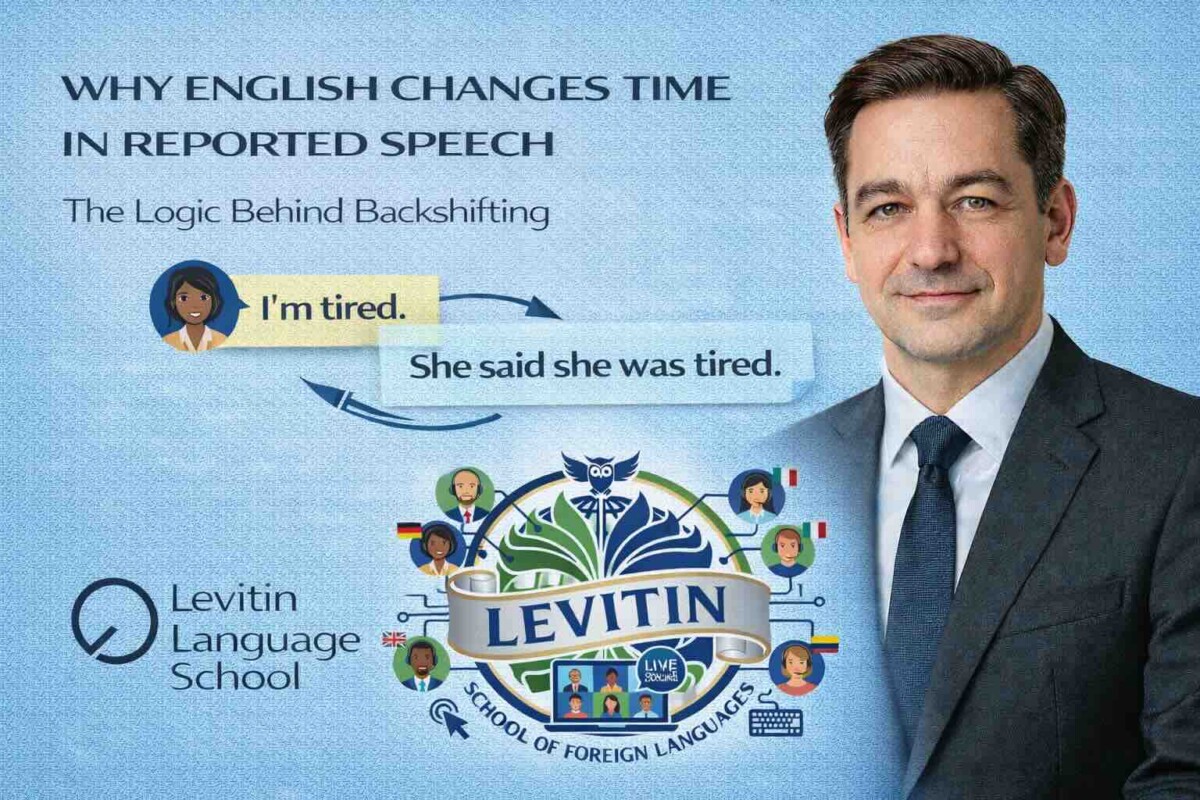
She says:
“I am tired.”
Reported speech:
She said she was tired.
To many learners this looks like an unnecessary transformation.
But in fact, the change of tense has a clear purpose.
English is not simply changing grammar.
It is changing the time perspective of the information.
Speech Always Has a Moment in Time
Every statement happens at a specific moment.
When someone says:
“I am tired.”
the sentence belongs to that exact moment of speaking.
But when we report the same words later, the situation changes.
Example:
She said she was tired.
Now the speaker is describing what was true at that past moment.
English grammar reflects this shift automatically.
Reported Speech Moves the Viewpoint
The real function of backshifting is not grammatical decoration.
It moves the viewpoint of the sentence.
Direct speech keeps the original perspective:
“I am tired.”
Reported speech moves the sentence into the narrator’s timeline.
She said she was tired.
The meaning becomes:
At the moment when she spoke, she was tired.
English grammar simply aligns the tense with the new narrative frame.
Why the Present Cannot Stay
Students often try to keep the present tense:
She said she is tired.
This is not always wrong, but it changes the meaning.
Now the sentence suggests:
She was tired then — and she is still tired now.
In other words, the tense communicates whether the situation continues or not.
This is why English sometimes keeps the present tense, as explained in the previous article.
But when the situation belongs only to the past, backshift appears naturally.
The Chain Reaction of Tenses
Once the reporting verb moves into the past, other tenses shift as well.
Examples:
Present → Past
“I live in Madrid.”
She said she lived in Madrid.
Present Perfect → Past Perfect
“I have finished the report.”
He said he had finished the report.
Future → Conditional
“I will call you.”
She said she would call me.
This is not random.
It is simply English aligning all events with the same past reference point.
English Is Protecting Meaning
Backshifting prevents confusion about time.
Without it, sentences could become ambiguous.
Example:
He said he is working on the project.
Does this mean:
- he was working then, or
- he is still working now?
The tense shift solves this problem:
He said he was working on the project.
Now the listener clearly understands that the situation belongs to the past moment of speaking.
Why Learners Often Overuse Backshift
Many learners apply the rule too aggressively.
They shift every tense automatically, even when the meaning should stay in the present.
For example:
The teacher said the Earth was round.
This sounds strange because the truth is still valid.
In real English, meaning always comes first.
Grammar follows logic.
The Real Rule Behind the Rule
Instead of memorizing transformations, it is easier to understand one principle.
Backshift appears when:
• the reporting verb is in the past
• the situation belongs only to that past moment
Backshift disappears when:
• the statement is still true
• the situation continues now
• the statement describes universal knowledge
English grammar is simply reflecting how speakers perceive time.
Grammar Is a Map of Thought
Many grammar rules seem mechanical until we look at their deeper logic.
Backshifting in English is not a random transformation.
It is a linguistic tool that helps speakers show:
- when information was true
- whether it is still true
- how the speaker relates to that moment in time
Once learners understand this idea, reported speech stops being a complicated grammar rule.
It becomes a clear and logical way to organize time inside language.
Author: Tymur Levitin
Founder & Director
Levitin Language School