

Many language learners notice something unusual in German conversations.
When someone expresses an opinion, it rarely appears alone.
Instead, the speaker often starts with the reasoning.
Only after that comes the conclusion.
For example, instead of saying:
I disagree.
A German speaker may say something closer to:
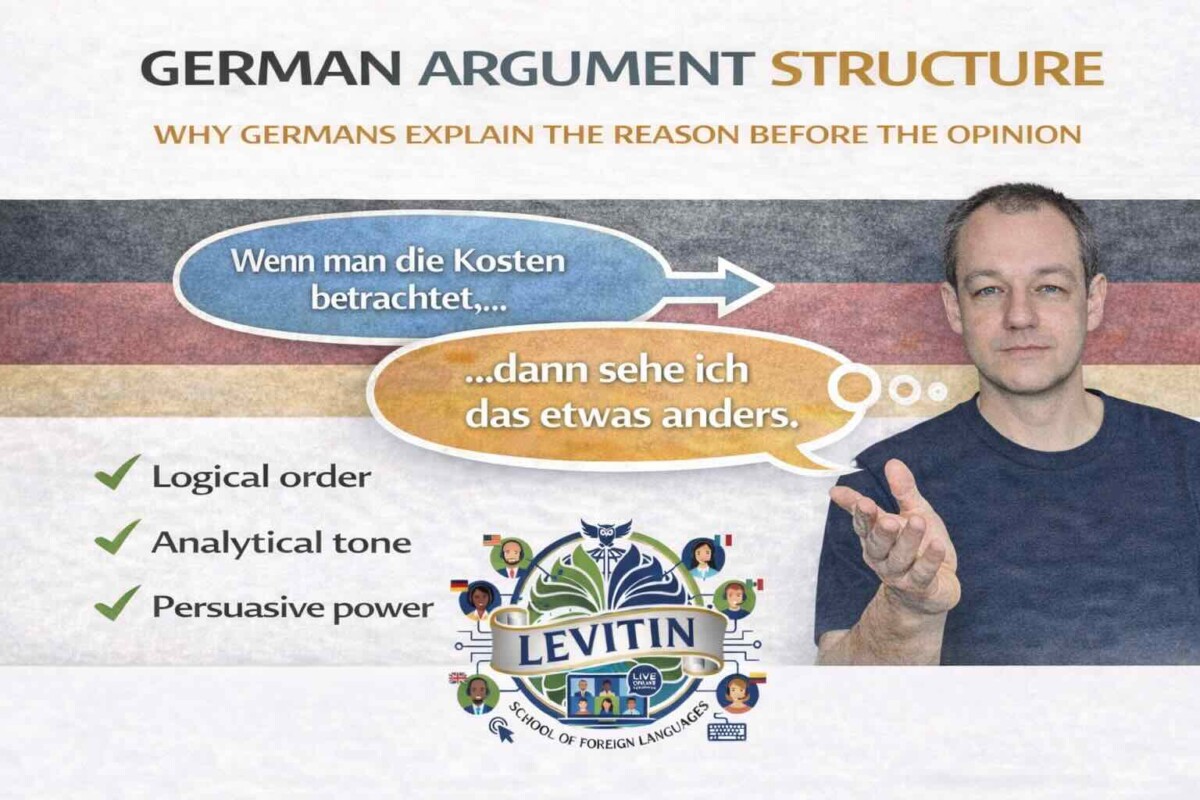
Wenn man die Kosten betrachtet, dann sehe ich das etwas anders.
The reasoning appears first.
The opinion follows.
This pattern reflects an important feature of German communication: structured argumentation.
The Logic Before the Position
In many languages, communication starts with the opinion.
Then the explanation follows.
Example:
“I think this is a bad idea because…”
In German discussions, the order often reverses.
First the analysis.
Then the position.
Example:
Wenn man die Risiken berücksichtigt, ist das vielleicht keine gute Idee.
The argument prepares the conclusion.
Why This Feels Different for Learners
For learners from more direct opinion-based cultures, this structure can feel unusual.
You may hear a long explanation and wonder:
“Do they agree or disagree?”
But in German discourse, the explanation is not secondary.
It is the foundation.
The opinion without reasoning can sound incomplete.
The Influence of Analytical Thinking
German academic and professional culture strongly values logical structure.
Arguments are expected to include:
- context
- reasoning
- conclusion
This pattern appears not only in writing but also in everyday speech.
The reasoning shows that the position is grounded.
Typical Linguistic Signals
German speakers often introduce reasoning with phrases such as:
- Wenn man bedenkt…
- Angesichts der Situation…
- Aus diesem Grund…
- Deshalb…
- Daher…
These signals prepare the listener for the final statement.
They build the argument step by step.
Opinion Without Reasoning Can Sound Abrupt
If someone simply says:
Das ist falsch.
It may sound overly blunt.
But if the statement is structured:
Wenn man die Zahlen betrachtet, ist das wahrscheinlich nicht korrekt.
The reasoning softens the conclusion.
The logic becomes visible.
Professional Communication
In German meetings and discussions, structured reasoning often increases credibility.
A statement like:
Ich denke, wir sollten das Projekt verschieben.
is stronger when structured as:
Wenn wir die aktuellen Ressourcen betrachten, wäre es sinnvoll, das Projekt zu verschieben.
The argument makes the conclusion more persuasive.
Learning to Structure Your Ideas
If you want to sound more natural in German discussions, it helps to adopt this structure.
Instead of presenting the opinion first, try building the reasoning.
Example:
Wenn man die Zeitplanung betrachtet, wäre es besser, nächste Woche zu starten.
The listener hears the logic before the decision.
The Rhythm of German Argumentation
A typical German argument often follows this sequence:
analysis → reasoning → conclusion
This structure reduces emotional tension and focuses attention on logic.
It transforms a personal opinion into a structured argument.
Final Thought
German argument structure is not about speaking longer.
It is about speaking more logically.
When reasoning appears before the opinion, the conclusion becomes easier to understand — and easier to accept.
Once you begin using this pattern, your German communication starts to sound more natural.
Not because your vocabulary changed.
But because your thinking structure did.
Author: Tymur Levitin
Founder & Director
Levitin Language School
© Tymur Levitin
Explore the German communication series:
https://levitintymur.com/languages/learning-german/
International language learning programs:
https://languagelearnings.com/