
You say something.
A German responds:
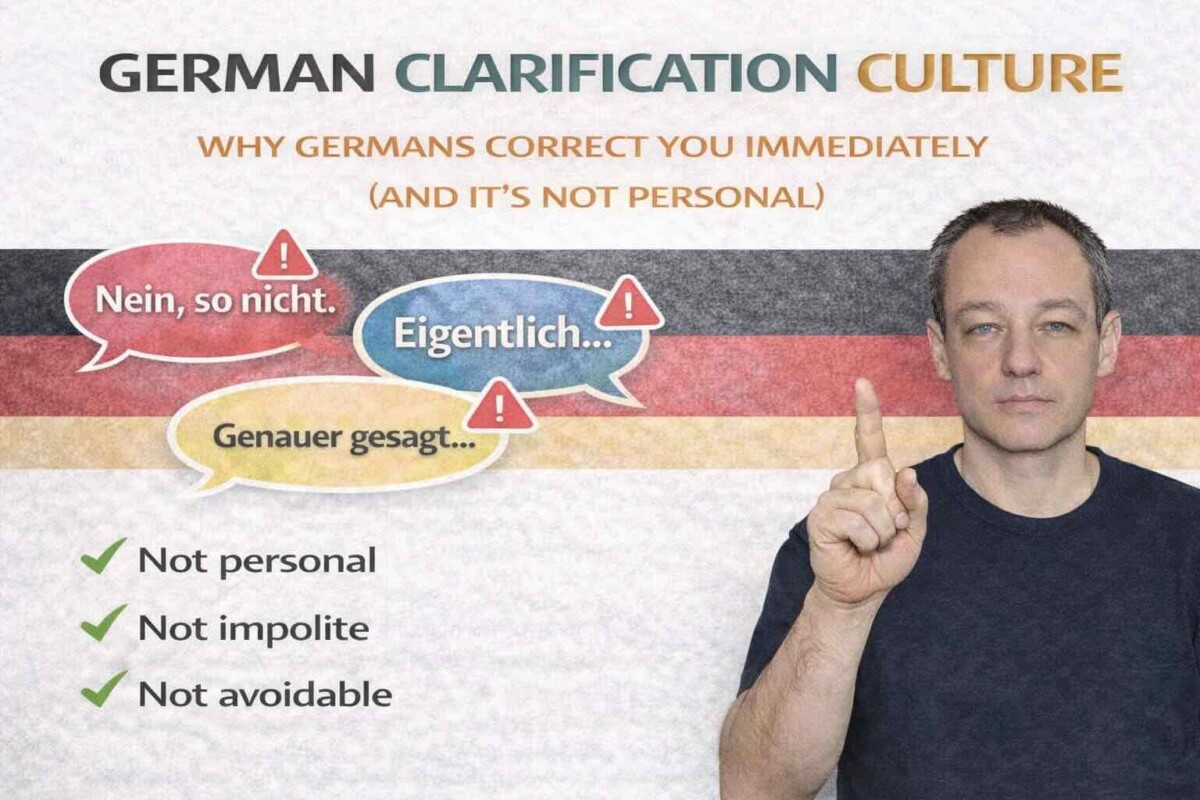
Nein, so nicht.
Das stimmt nicht ganz.
Eigentlich…
Genauer gesagt…
And suddenly, you feel corrected.
Embarrassed.
Interrupted.
Challenged.
But in many German interactions, correction is not confrontation.
It is calibration.
This article continues our German communication series and explores a phenomenon that many learners misunderstand: immediate clarification and correction culture.
The Speed of Correction
In some communication cultures, errors are ignored for harmony.
In German communication, inaccuracies are often addressed immediately.
Not later.
Not indirectly.
Not “for the sake of politeness.”
If something is slightly inaccurate, it is often adjusted in real time.
Why?
Because leaving inaccuracies uncorrected creates structural instability.
“Actually” Is Not Aggression
One of the most frequent correction signals in German is:
Eigentlich…
Literally: “actually.”
Functionally: “let’s refine this.”
Example:
Das Projekt startet im Sommer.
— Eigentlich im Juli.
This is not humiliation.
It is specification.
Precision Over Face-Saving
In some cultures, protecting the speaker’s emotional comfort takes priority.
In German interaction, protecting factual precision often comes first.
This can feel blunt.
But the hierarchy is different:
- Accuracy
- Clarity
- Efficiency
- Emotional cushioning
Not the other way around.
Why Learners Take It Personally
When someone says:
So ganz stimmt das nicht.
(That’s not entirely correct.)
Foreign learners may hear:
- “You are wrong.”
- “You are incompetent.”
- “You don’t understand.”
But often the meaning is narrower:
“There is a detail that needs adjustment.”
German correction is frequently about information, not identity.
The Linguistic Tools of Correction
German provides structured correction markers:
- Genauer gesagt…
- Streng genommen…
- Im Prinzip…
- Das heißt…
- Anders formuliert…
These are not insults.
They are refinement tools.
The language contains built-in mechanisms for recalibration.
Professional Context
In professional or academic settings, immediate correction signals:
- attentiveness
- responsibility
- engagement
- seriousness
If no one corrects inaccuracies, it may signal:
- lack of interest
- superficial listening
- avoidance
Correction can be a form of participation.
Why Germans Expect the Same from You
German communication is reciprocal.
If someone refines your statement, they often expect you to refine theirs as well.
Silence does not always equal agreement.
Precision dialogue means:
- mutual adjustment
- shared responsibility
- structural improvement
It is collaborative — even if it sounds firm.
The Emotional Adjustment Learners Must Make
To adapt to German correction culture, you must separate:
Correction ≠ rejection
Clarification ≠ criticism
Precision ≠ hostility
If you interpret every refinement emotionally, communication becomes exhausting.
If you interpret it structurally, communication becomes efficient.
What Fluency Really Means Here
Fluency is not only about speaking correctly.
It is about responding to correction calmly.
If someone says:
Das ist nicht ganz richtig.
A natural response is:
Stimmt, ich meine…
or
Danke für die Präzisierung.
That response signals maturity inside the system.
Final Thought
German correction culture is not about proving you wrong.
It is about making information stable.
Once you stop defending yourself emotionally and start refining structurally, conversations change.
You no longer feel attacked.
You feel aligned.
And that is when German stops sounding strict — and starts sounding precise.
Author: Tymur Levitin
Founder & Director
Levitin Language School
Global Learning. Personal Approach.
© Tymur Levitin
Learn German with analytical clarity:
https://levitintymur.com/languages/learning-german/
International programs and structured language training:
https://languagelearnings.com/
Explore the full German communication series on the blog.