
🔗 Choose your language: https://levitintymur.com/#languages
German plural forms often confuse beginners because there is no single plural ending. Instead, German uses several common patterns. The good news: once you know these patterns, plural forms become predictable and much easier to learn.
How Plurals Work in German
In German, plural nouns:
- do not use articles der/die/das
- usually take die in plural
- often change the noun ending
- sometimes add an umlaut (ä, ö, ü)
Example:
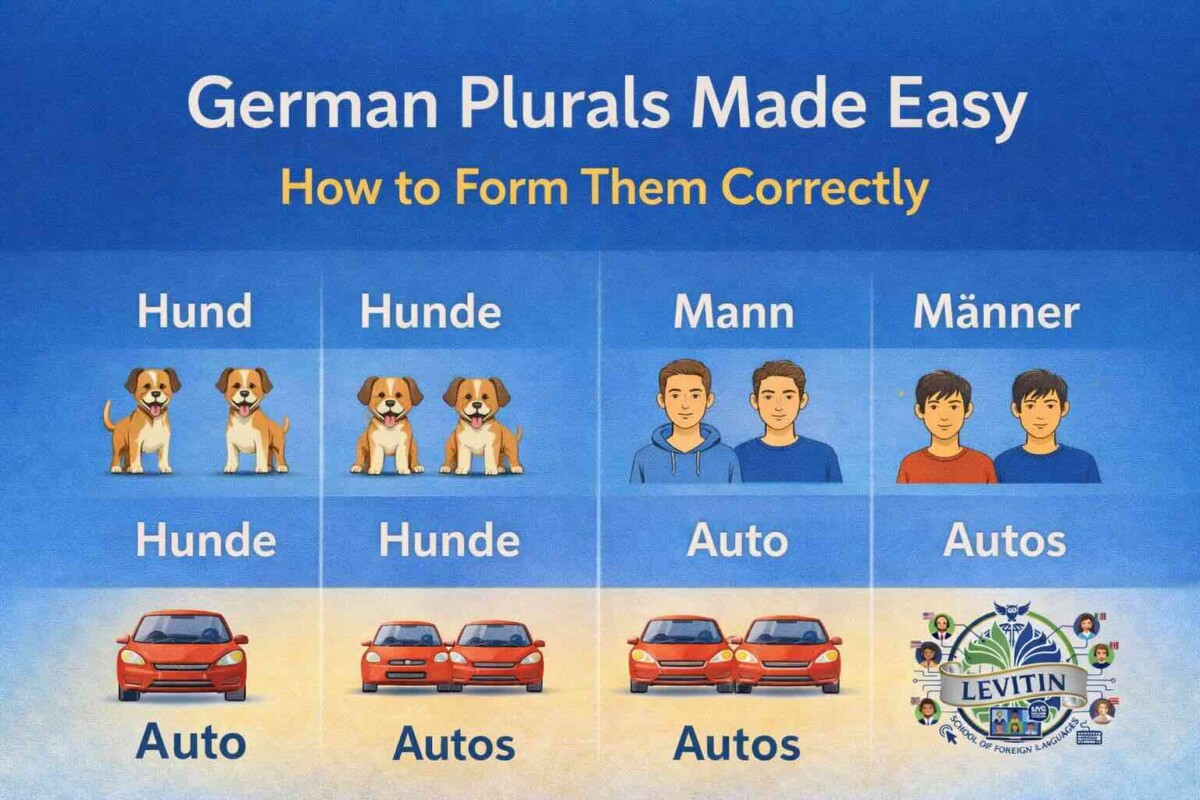
- der Mann → die Männer (the men)
The Most Common German Plural Forms
1. Plural with -e
Often used with masculine and neuter nouns.
Examples:
- der Hund → die Hunde (dogs)
- das Jahr → die Jahre (years)
2. Plural with -er (often with umlaut)
Common with neuter nouns.
Examples:
- das Kind → die Kinder (children)
- das Buch → die Bücher (books)
3. Plural with -n / -en
Very common with feminine nouns.
Examples:
- die Frau → die Frauen (women)
- die Blume → die Blumen (flowers)
4. Plural with -s
Often used for:
- foreign words
- abbreviations
Examples:
- das Auto → die Autos (cars)
- das Hotel → die Hotels (hotels)
5. No Ending (only umlaut or no change)
Some nouns change only with an umlaut or not at all.
Examples:
- der Vater → die Väter (fathers)
- der Lehrer → die Lehrer (teachers)
Plural Overview Table
| Singular | Plural | English |
|---|---|---|
| der Mann | die Männer | men |
| das Buch | die Bücher | books |
| die Frau | die Frauen | women |
| das Auto | die Autos | cars |
| der Lehrer | die Lehrer | teachers |
Common Mistakes — and How to Avoid Them
- ❌ die Manns
✔️ die Männer - ❌ die Bücher → article das
✔️ die Bücher (plural always uses die) - ❌ die Kind
✔️ die Kinder
Tips for Learning German Plurals
- Always learn nouns with article + plural form.
Example: der Hund — die Hunde - Watch for umlauts in plural forms.
- Group nouns by plural pattern when studying.
FAQ: German Plurals
Q: Is there one main rule for German plurals?
No. German uses several plural patterns.
Q: Which plural form is the most common?
-en and -e are very frequent.
Q: Do all plurals use “die”?
Yes — in nominative and accusative, plural always uses die.
Final Note
German plurals may seem irregular at first, but they follow clear patterns. With regular exposure and practice, they quickly become natural.
👉 For a deeper reflection on how form and meaning connect in German, see Tymur Levitin’s Author’s Column.
🔗 Related Articles (internal linking)
- https://levitintymur.com/german/how-to-use-articles-in-german-der-die-das-for-beginners/
- https://levitintymur.com/german/german-adjectives-for-beginners-rules-and-examples/
- https://levitintymur.com/german/german-cases-explained-nominative-accusative-dative-genitive/
Author: Tymur Levitin — Founder, Director, Senior Teacher
Levitin Language School | Start Language School by Tymur Levitin
👤 Teacher profile: https://levitintymur.com/teachers/tymur-levitin/
🌍 Learn German: https://levitinlanguageschool.com/learning-german/
Category: German Grammar for Beginners
© Tymur Levitin


