
Many language learners notice something interesting when talking with German speakers.
Conversations often sound more definite.
Statements appear clear.
Opinions sound structured.
Answers feel precise.
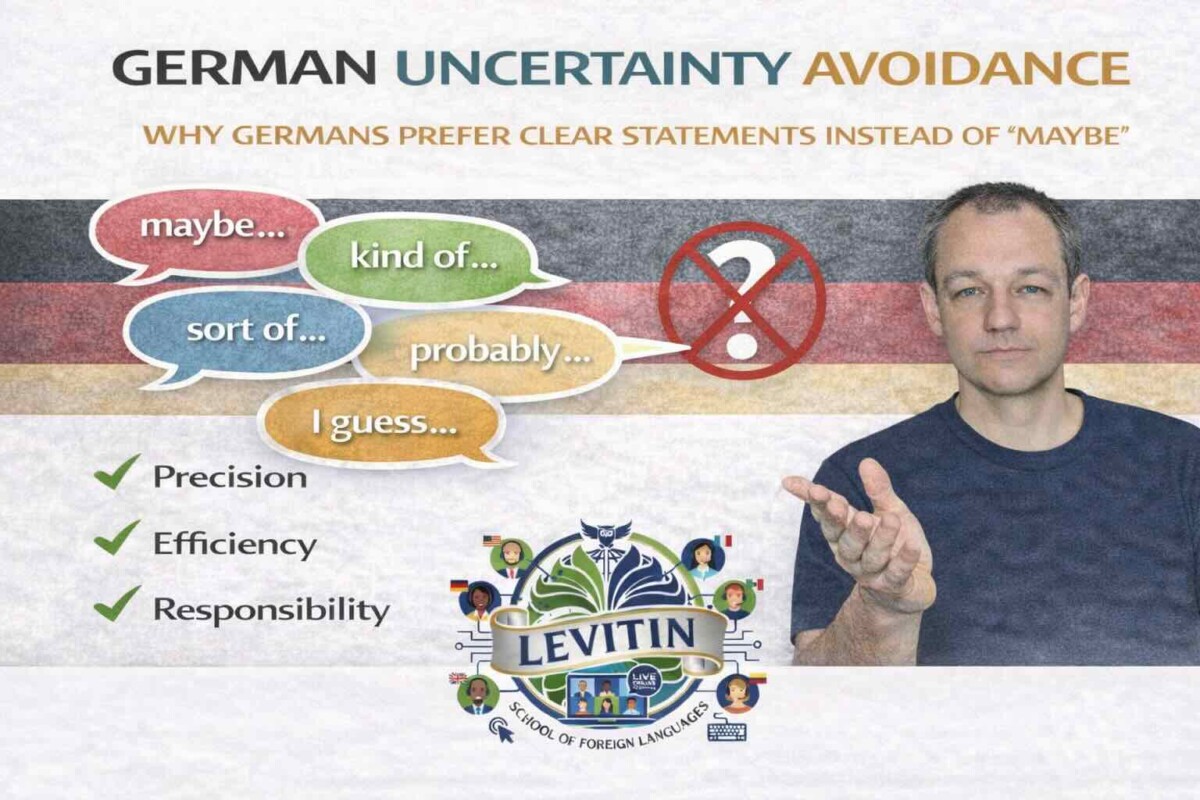
What is often missing are the soft expressions common in many languages:
maybe
kind of
sort of
probably
I guess
In German communication, excessive uncertainty can sound confusing.
This reflects an important cultural tendency: preference for clarity over ambiguity.
The Problem with “Maybe”
In many languages, uncertainty softens communication.
It can signal politeness.
Example:
“I guess we could start tomorrow.”
But in German communication, too many uncertainty markers may create the opposite effect.
They can make the statement unclear.
Instead of softening the message, they weaken it.
Clear Statements Are Often Preferred
A typical German response might sound like:
Wir beginnen morgen.
Instead of:
Vielleicht könnten wir morgen anfangen.
Both sentences are grammatically correct.
But the first one provides a clear decision.
The second leaves interpretation open.
Responsibility for the Statement
German communication often emphasizes responsibility for what is said.
A clear statement signals that the speaker:
- has considered the situation
- understands the implications
- stands behind the statement
Excessive uncertainty may sound like hesitation rather than politeness.
When Uncertainty Is Used
Of course, German speakers do express uncertainty.
But they tend to do it more precisely.
Instead of vague phrases, they may say:
- Ich bin mir nicht sicher.
- Das ist schwer zu sagen.
- Das hängt von mehreren Faktoren ab.
These expressions specify the reason for uncertainty.
The ambiguity becomes structured.
Professional Communication
In professional environments, clarity becomes even more important.
A statement like:
Vielleicht sollten wir das Projekt verschieben.
may sound indecisive.
A more typical formulation might be:
Angesichts der aktuellen Situation wäre es sinnvoll, das Projekt zu verschieben.
The reasoning replaces vague uncertainty.
Why This Feels Direct
For learners used to softer communication styles, this clarity can feel very direct.
But the intention is usually not confrontation.
It is efficiency.
Clear statements reduce misunderstandings.
Everyone knows where the speaker stands.
Learning to Sound More Natural
To adapt to German communication style, it helps to reduce unnecessary uncertainty markers.
Instead of:
Maybe we should discuss this later.
Try structuring the idea more clearly:
Wir sollten das später besprechen.
If uncertainty truly exists, explain it.
Precision is more important than softness.
The Balance Between Certainty and Flexibility
German communication does not eliminate uncertainty.
It organizes it.
A statement can still be flexible, but the logic remains clear.
The message becomes structured rather than vague.
Final Thought
German communication often values clarity over ambiguity.
Clear statements help conversations move forward.
They make decisions visible.
And once you start expressing ideas more directly, something interesting happens.
Your German begins to sound not only more confident —
but also more natural.
Author: Tymur Levitin
Founder & Director
Levitin Language School
© Tymur Levitin
Explore the German communication series:
https://levitintymur.com/languages/learning-german/
International language learning programs:
https://languagelearnings.com/