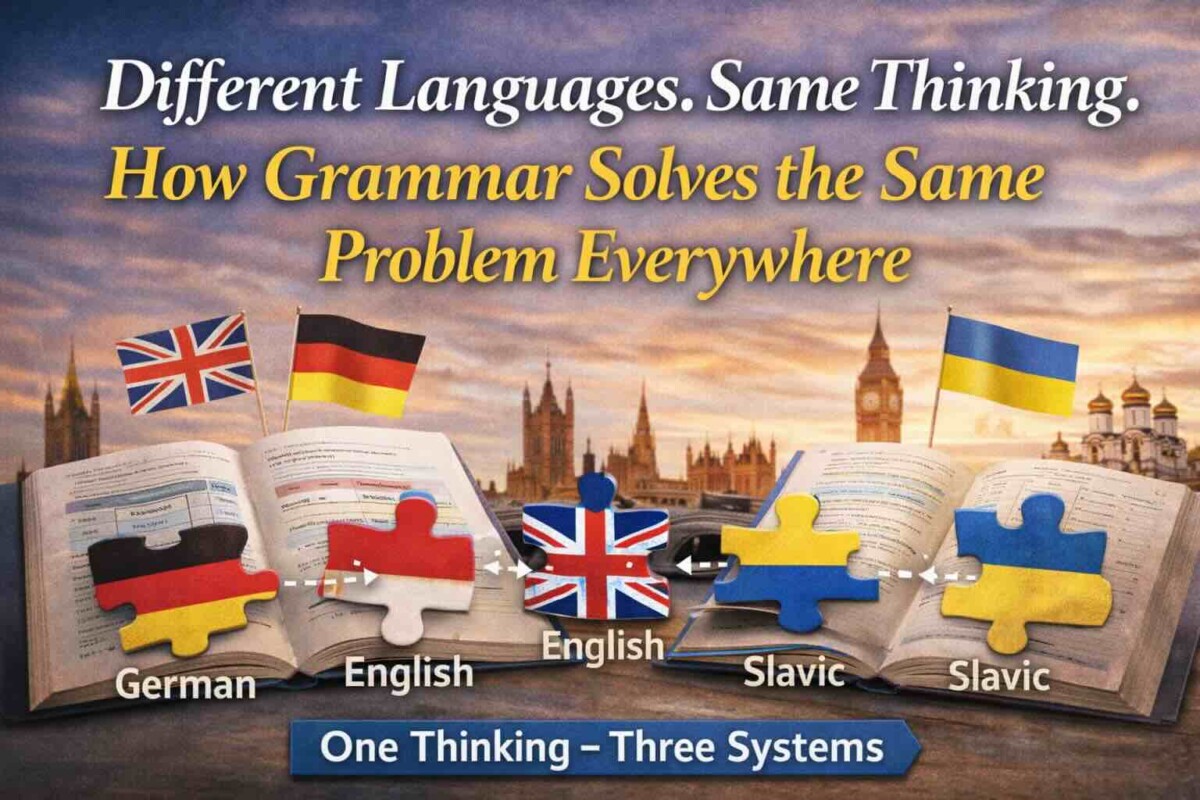

When people compare languages, they usually compare words.
They ask:
- Which language is harder?
- Which grammar is more complicated?
- Which system has more rules?
These questions miss the point.
Languages are not different because they think differently.
They are different because they encode the same thinking in different ways.
Every Language Solves the Same Task
Every human language must answer the same basic questions:
- Who is involved?
- Who affects whom?
- Does something move or stay?
- Where does it happen?
- Who receives what?
No language can avoid these problems.
What changes is not the logic —
only the tools.
Three Languages. One Structure.
Let us compare three systems.
German
German expresses meaning through:
- cases,
- articles,
- prepositions.
The function comes first.
The article reacts.
Movement, direction, and position are built into the form.
English
English removed case endings,
but it did not remove case logic.
It redistributed it into:
- word order,
- prepositions,
- fixed sentence roles.
The function still comes first.
The structure reacts.
Slavic Languages
Slavic languages keep the logic visible through:
- endings,
- flexible word order,
- question-based roles.
The form changes because the role changes.
The system is transparent — but unforgiving.
Why Learners Get Confused
Most learners are not confused by grammar.
They are confused because grammar is taught as:
- forms,
- tables,
- rules.
But grammar is actually:
a map of how meaning moves.
When learners stop asking:
“Which form is correct?”
and start asking:
“What role does this element play?”
everything becomes simpler.
Languages Do Not Compete. They Translate Each Other.
Once the underlying logic is understood,
languages stop being enemies.
German explains English.
Slavic languages explain German.
English explains structure.
Each system highlights what the others hide.
The Principle That Never Changes
You do not learn a language to memorize grammar.
You learn a language to understand how reality is organized inside a sentence.
Forms change.
Logic does not.
Author’s note
This article concludes the first part of an author’s column dedicated to revealing the shared logic behind different grammatical systems.
Future articles will explore this principle across additional languages and cultural contexts.
Author: Tymur Levitin
Founder, Director, Senior Teacher
Levitin Language School
Global Learning. Personal Approach.
© Tymur Levitin, 2026. All rights reserved.