

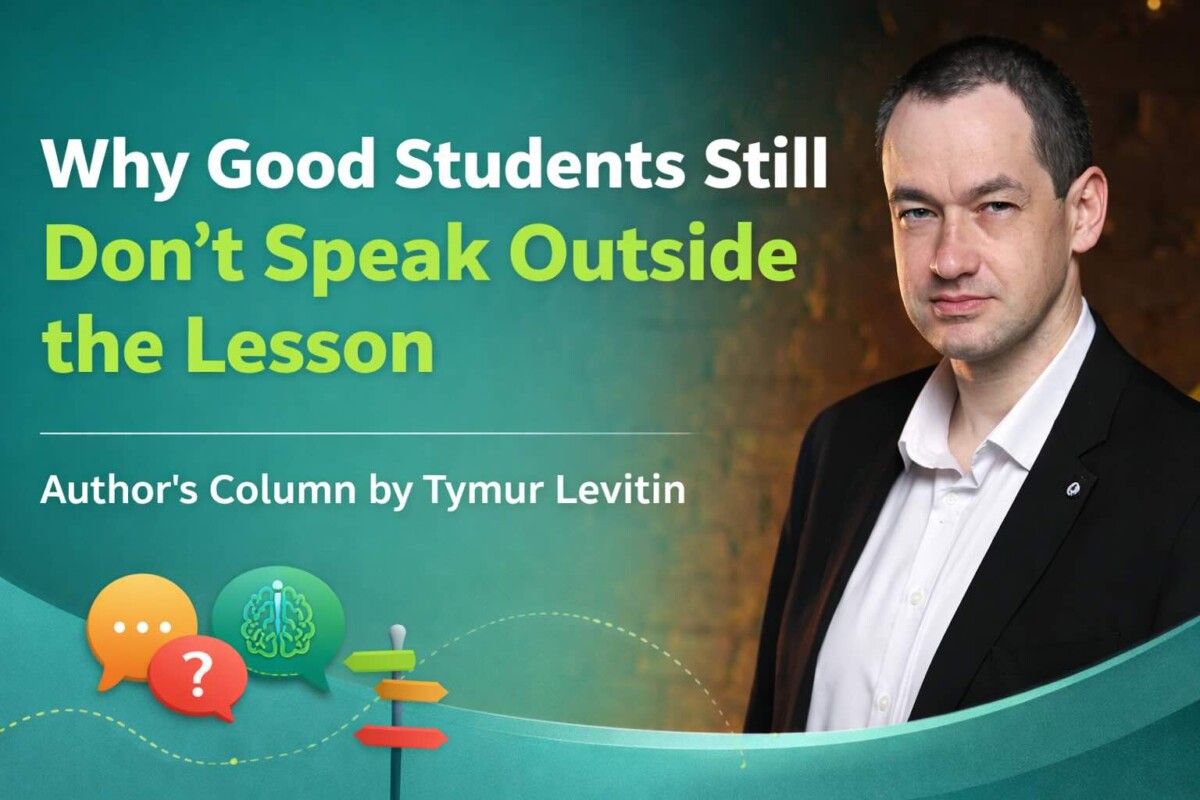
Author’s Column by Tymur Levitin
Language. Identity. Choice. Meaning.
© Tymur Levitin
A situation almost every learner recognizes
Many students share the same confusing experience.
During the lesson, everything works.
You understand the teacher.
You answer questions.
You even joke sometimes.
But then something happens.
Outside the lesson — in a real conversation — the language disappears.
The moment a real person asks:
“Can you tell me…?”
Your mind goes blank.
And the most frustrating part is this:
You know the material.
The mistake most learners make
Students usually explain this in one of three ways:
- “I need more vocabulary.”
- “I need more grammar.”
- “I need more confidence.”
But none of these is the real cause.
The real reason is much simpler — and less obvious:
You learned to perform a lesson, not to manage a conversation.
These are two completely different skills.
A lesson is a controlled environment
Inside a lesson, your brain feels safe.
Why?
Because the situation is predictable.
You know:
- the topic,
- the rhythm,
- the teacher’s reactions,
- the type of questions.
Even when it feels spontaneous, your brain recognizes the structure.
You are not just speaking a language — you are operating inside a familiar system.
Your brain works efficiently because it can anticipate what comes next.
Real conversation removes the structure
Now compare this with reality.
A real conversation includes:
interruptions,
unclear intentions,
unexpected questions,
jokes you didn’t prepare for,
accents, noise, emotions.
Your brain suddenly loses the framework.
And here something important happens:
It is not your vocabulary that collapses.
It is your orientation.
Language is not only knowledge — it is navigation
Speaking a language in real life is closer to driving than to passing a test.
A student who studies rules knows where the pedals are.
But a driver knows how to react when something unexpected happens.
Many learners never practice this second skill.
They learn:
how to answer,
but not how to manage.
They wait for clear questions.
Real conversations rarely give them.
Why the brain freezes
When your brain cannot predict the direction of a conversation, it switches into protective mode.
This produces familiar symptoms:
- you forget simple words,
- you answer too briefly,
- you avoid longer sentences,
- you switch to your native language,
- you say “yes” when you didn’t fully understand.
This is not a language problem.
This is a processing overload problem.
Your brain is trying to simultaneously:
understand,
plan,
translate,
evaluate risk,
and respond socially.
Inside a lesson, the teacher helps carry this load.
Outside the lesson, you carry it alone.
The hidden difference between learners and speakers
Here is the crucial distinction:
A learner tries to produce correct sentences.
A speaker tries to maintain interaction.
When you focus on correctness, you pause until everything is perfect.
But conversation does not wait.
Real speakers:
rephrase,
clarify,
ask back,
buy time,
negotiate meaning.
They do not search for the ideal sentence.
They keep the communication alive.
Why more grammar does not fix it
Students often respond to this problem by studying harder.
More exercises.
More rules.
More memorization.
But this targets the wrong skill.
Grammar improves sentence construction.
Conversation requires decision-making under uncertainty.
You must learn to:
ask for repetition,
redirect a topic,
admit partial understanding,
simplify an idea.
These are communication strategies — not grammar topics.
What actually helps
Progress begins when the goal changes.
Not:
“say it correctly”
but:
“keep the interaction moving.”
This means learning to say:
“Give me a second.”
“I’m not sure I understood.”
“Do you mean…?”
“Let me explain differently.”
These are not weak phrases.
They are the tools that transform a learner into a participant.
The role of teaching
At Levitin Language School, lessons are not designed only to produce sentences.
They are designed to teach students how to handle unpredictability.
Because real fluency is not the ability to answer prepared questions.
It is the ability to stay present when the conversation stops being comfortable.
Final thought
You do not lose your language outside the lesson.
You lose the structure that supported it.
Once you learn to manage communication — not just produce sentences —
the language stops disappearing.
Fluency is not what happens when everything is clear.
Fluency is what you do when nothing is.
—
Tymur Levitin
Founder & Director
Levitin Language School
© Tymur Levitin — All rights reserved.