
Before choosing a language to learn, explore all available options here:
https://levitintymur.com/#languages
Language often creates an illusion of universality. When we open a dictionary, it seems that every word has an equivalent somewhere else in the world. English has a translation for a German word, German has a translation for a Spanish word, and so on.
But the deeper we move into real speech, culture, and lived experience, the clearer it becomes: many words are not translations at all. They are worlds.
And some of these worlds exist only inside one language.
A Word That Carries a Culture
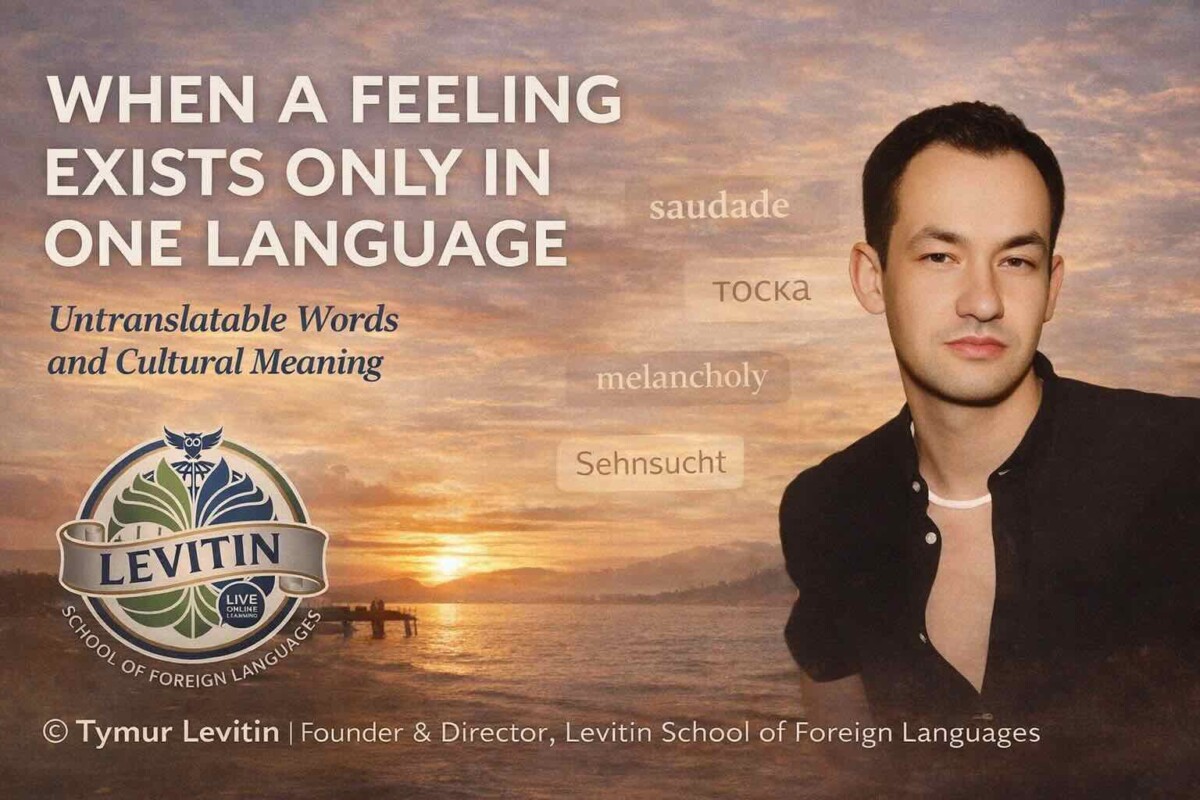
Consider the Portuguese word saudade.
It is often translated into English as longing, nostalgia, or melancholy. Yet none of these options truly captures what the word means to Portuguese speakers.
Saudade is not simply missing someone.
It is not only remembering the past.
It is a complex emotional space where memory, tenderness, absence, and quiet acceptance coexist. A person experiencing saudade is not necessarily trying to escape the feeling. In many cases, the emotion itself becomes something almost beautiful.
The English language can describe this state. But it cannot contain it in a single word.
That difference matters.
The German Language and the Architecture of Emotion
German offers another example: Sehnsucht.
This word is often translated as longing or yearning. But Sehnsucht is deeper and more philosophical. It refers to an inner desire directed toward something that may not even exist in reality.
It is the feeling of reaching for a distant possibility — a life, a place, or a future that one senses emotionally but cannot clearly define.
Romantic poets used this word to describe the human tendency to search for meaning beyond everyday life.
In translation, Sehnsucht becomes a description.
In German, it remains a living concept.
Russian and the Quiet Weight of “Тоска”
Russian offers one of the most famous examples discussed by translators: тоска.
At first glance, it may seem similar to sadness or melancholy. Yet native speakers know that these equivalents feel insufficient.
Тоска can include sadness, but it can also include emptiness, restlessness, longing, existential weight, or a quiet inner pressure that cannot easily be explained.
In certain contexts, the word can even refer to boredom. In others, it touches something close to spiritual suffering.
The Russian writer Vladimir Nabokov once wrote that no single English word fully captures the meaning of тоска. His observation remains one of the most cited examples of untranslatable language.
But perhaps the word is not truly untranslatable.
Perhaps it simply belongs to a cultural landscape that developed its own vocabulary for inner life.
When Translation Becomes Interpretation
At this point, translators face an unavoidable decision.
Should they reproduce the dictionary equivalent?
Or should they recreate the emotional atmosphere behind the word?
The second approach is more difficult, but also more honest.
A translator working with literature, music, or philosophy must often expand a single word into an entire sentence — sometimes even a paragraph — in order to preserve its meaning.
This is why translation is not a mechanical operation.
It is an act of interpretation.
Language as a Map of Human Experience
Languages do not divide the world in the same way.
Some cultures develop many words for emotional states. Others prefer broader categories. Some languages create precise philosophical vocabulary, while others rely on metaphor and context.
Each language therefore becomes a map of what its speakers have historically paid attention to.
When we encounter a word that cannot easily be translated, we are not facing a linguistic failure.
We are encountering a different way of seeing the world.
The Translator’s Responsibility
A good translator understands that words are never isolated units. They belong to entire systems of meaning: cultural history, literary tradition, social habits, and emotional expectations.
This is why translation cannot rely on vocabulary alone.
To translate honestly, one must understand the human experience behind the language.
Only then can a translator decide whether a word should be replaced, explained, expanded, or sometimes left untouched.
Because occasionally the most faithful translation is not a translation at all.
It is an invitation for the reader to enter another culture.
© Tymur Levitin
Founder and Director, Levitin Language School
Global Learning. Personal Approach.