

Sometimes translation fails not because a language lacks a word.
Sometimes the word exists.
But the meaning does not.
This is one of the most confusing experiences both for language learners and for translators. A dictionary may give you a direct equivalent. Grammatically everything seems correct. Yet when the word is used in real communication, something feels wrong.
The word exists.
But the meaning behind it lives in a different cultural system.
And language cannot simply transfer that system.
The Illusion of Dictionary Equivalence
Many language learners believe that translation is about replacing one word with another.
If English has a word, Russian must have one.
If German has a word, Spanish must also have it.
But languages are not symmetrical structures.
A dictionary may give you equivalents such as:
love — любовь — Liebe — amor
freedom — свобода — Freiheit — libertad
home — дом — Haus — casa
But behind each of these words stands a different emotional architecture.
The spelling changes.
The pronunciation changes.
And the cultural meaning changes even more.
Words That Look Identical but Feel Different
Even when languages share apparent equivalents, the emotional load of a word may be completely different.
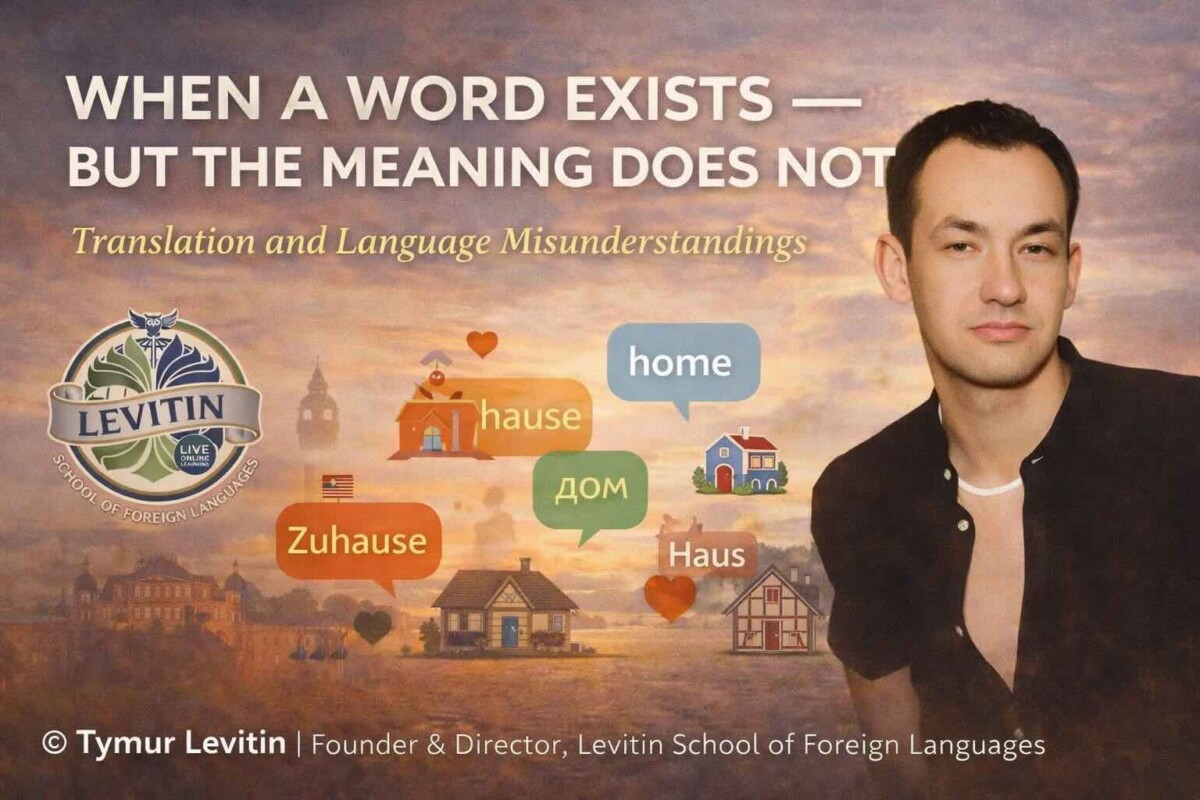
For example, the English word home often expresses emotional belonging.
But the German Haus is primarily a physical building.
If Germans want to express emotional belonging, they often use Zuhause instead.
Russian дом can mean both the building and the emotional concept — depending on context.
The word is the same.
The meaning shifts.
This is why translation is never mechanical.
When Culture Shapes Meaning
Some words carry cultural experiences that exist only inside a particular linguistic community.
German famously has words such as:
Fernweh – the longing to go somewhere far away
Schadenfreude – pleasure at another person’s misfortune
Gemütlichkeit – a sense of warmth, comfort, and belonging
English can explain these ideas.
But explanation is not the same as translation.
A translated phrase may describe the idea.
But it rarely carries the same emotional density.
The Translator’s Real Task
A translator does not move words between languages.
A translator moves meaning.
And meaning is built from several layers:
- linguistic structure
- historical usage
- emotional associations
- cultural context
Sometimes translators must replace a single word with a sentence.
Sometimes a metaphor must change completely.
Sometimes the most honest translation is to admit:
This concept does not exist in the same way in the other language.
Why This Matters for Language Learners
For students learning a new language, this realization is liberating.
If a phrase sounds strange even though the translation is “correct,” the problem may not be grammar.
The problem may be meaning.
Languages do not only describe reality.
They shape how speakers experience it.
When you learn a new language, you are not just memorizing vocabulary.
You are entering another way of interpreting the world.
Language Is Not a Code
One of the biggest myths about language learning is that languages are codes.
Replace one symbol with another.
And the message remains the same.
But languages are not codes.
They are cultural systems.
Words carry history, emotion, identity, and shared experience.
Translation therefore becomes an act of interpretation.
Not substitution.
The Moment When Translation Stops
There are moments when translation reaches its limits.
A word exists.
The grammar works.
The dictionary agrees.
But the feeling remains locked inside the original language.
And that is when we understand something important.
Language is not only about communication.
It is about how human experience becomes visible through words.
And sometimes, only one language has found the exact shape for a particular feeling.
© Tymur Levitin
Founder & Director
Levitin Language School
Global Learning. Personal Approach.