
Skip to content

language and culture

Not Just Words: What We Don’t See When We Translate Culture
Not Just Words: What We Don’t See When We Translate Culture | LEVITIN SCHOOL
Interesting information

Not Just Words: What We Don’t See When We Translate Culture

Language. Identity. Faith. Understanding. 🌍 Author’s Column by Tymur Levitin — Founder and Director of Levitin Language School / Language Learnings 🔗 Choose your language: https://levitintymur.com/#languages There’s a scene in a film:a man stands at sunset, whispering a prayer.To someone who doesn’t know his world, it may look like a farewell — a man walking […]

Tymur Levitin | LEVITIN SCHOOL Tymur Levitin
• 29.03.2026 • 2 min read
Read full article

language and culture

When “Cheap” Is Not Cheap: How Languages Judge Value Differently | LEVITIN SCHOOL
26.03.2026

When “Cheap” Is Not Cheap: How Languages Judge Value Differently

Author’s Column | Tymur Levitin on Language, Meaning and Respect

Before people argue about money, they argue about value. What one culture calls cheap, another calls affordable.What sounds like a bargain in one language can sound like an insult in another. This is not simply vocabulary.It is the linguistic expression of how societies evaluate effort, quality, and respect. Explore all language programs:https://levitintymur.com/#languages Author: Tymur LevitinLevitin […]

Tymur Levitin | LEVITIN SCHOOL Tymur Levitin
Read more →
When a Word Exists — But the Meaning Does Not | LEVITIN SCHOOL
26.03.2026

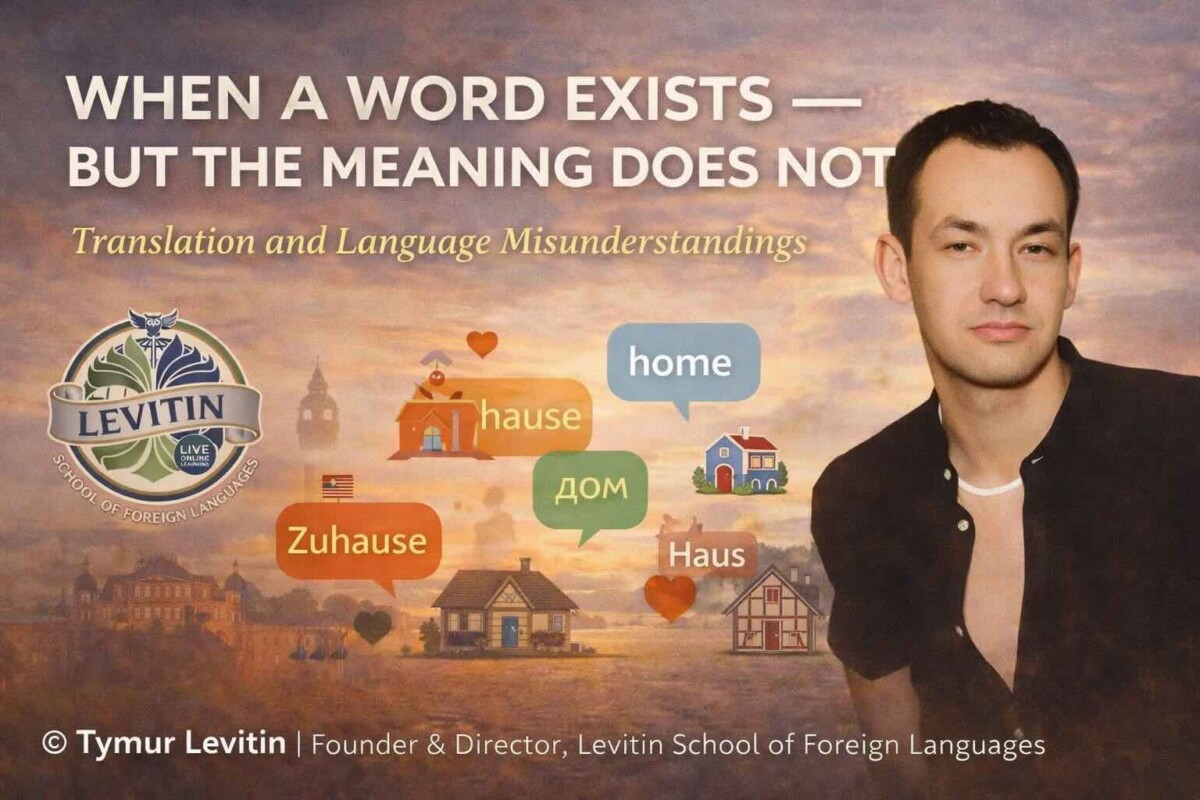
When a Word Exists — But the Meaning Does Not

Translation Theory and Cultural Meaning

Sometimes translation fails not because a language lacks a word. Sometimes the word exists. But the meaning does not. This is one of the most confusing experiences both for language learners and for translators. A dictionary may give you a direct equivalent. Grammatically everything seems correct. Yet when the word is used in real communication, […]

Tymur Levitin | LEVITIN SCHOOL Tymur Levitin
Read more →
Street Words That Do Not Translate: Fraer, Sucker and the Language of Outsiders
20.03.2026

Street Words That Do Not Translate: Fraer, Sucker and the Language of Outsiders

Language, Culture & Communication

Why Some Words Cannot Be Translated Directly Languages rarely translate perfectly.Some words carry meanings that exist only within a specific culture. When people try to translate them literally, the result often loses the real context behind the expression. Street language is one of the clearest examples of this phenomenon.Many expressions that appear simple on the […]

Tymur Levitin | LEVITIN SCHOOL Tymur Levitin
Read more →
When Words Become Codes: Music, Language, and the Masks We Wear | LEVITIN SCHOOL
20.03.2026

When Words Become Codes: Music, Language, and the Masks We Wear

Language, Culture & Communication

Why This Conversation Matters Language is never just a collection of words.In many cultures, words act as signals, roles, and sometimes even traps. A phrase that sounds harmless in one context can carry a completely different meaning in another. A joke, a lyric, or a casual expression may suddenly become a statement about identity, loyalty, […]

Tymur Levitin | LEVITIN SCHOOL Tymur Levitin
Read more →
When “Beautiful” Isn’t the Same Thing: Why Languages Don’t See Beauty the Same Way
19.03.2026

When “Beautiful” Isn’t the Same Thing: Why Languages Don’t See Beauty the Same Way

Language, Culture, and Meaning

Category: Language, Culture, and Meaning The Illusion of Universal Words Many learners believe that some words are universal.“Beautiful.”“Nice.”“Wonderful.” At first glance, they seem simple and transparent. A student opens a dictionary, finds a translation, and assumes the meaning travels intact from one language to another. But languages rarely work that way. What looks like a […]

Tymur Levitin | LEVITIN SCHOOL Tymur Levitin
Read more →
“Пройдоха” vs “Opportunist”: | LEVITIN SCHOOL
12.01.2026

“Пройдоха” vs “Opportunist”:

Author’s Column | Tymur Levitin on Language, Meaning and Respect

The Cultural Code Behind Charm, Cynicism, and Consent Choose your language → What It Really Means In Russian, the word пройдоха (proydókha) doesn’t simply mean “a trickster” or “an opportunist.” It’s much more layered — somewhere between admiration and suspicion, charm and irritation, action and manipulation. A пройдоха is someone who: It’s not a criminal.It’s […]

Tymur Levitin | LEVITIN SCHOOL Tymur Levitin
Read more →
“I Solve Problems”: When Translation Fails — and Silence Speaks | LEVITIN SCHOOL
12.01.2026

“I Solve Problems”: When Translation Fails — and Silence Speaks

Author’s Column | Tymur Levitin on Language, Meaning and Respect

Choose your language → What It Really Means In English, solving problems sounds perfectly normal — if you’re a technician, therapist, or maybe a diplomat. But when someone in Russian says: «Я решаю вопросы»(Ya reshayu voprosy) …it doesn’t mean they fix air conditioners.It doesn’t mean they’re a consultant or politician.And it certainly doesn’t mean they […]

Tymur Levitin | LEVITIN SCHOOL Tymur Levitin
Read more →
Latte in Germany: Why One Word Can Make You Blush | LEVITIN SCHOOL
12.01.2026

Latte in Germany: Why One Word Can Make You Blush

Author’s Column | Tymur Levitin on Language, Meaning and Respect

Author’s Column by Tymur Levitin – Levitin Language School / Start Language School by Tymur LevitinLanguage. Identity. Meaning. Survival. “Ich nehme eine Latte.”A simple sentence.Or is it? If you’re standing at a coffee shop counter in Germany, what you just said could either get you a hot drink… or a weird look. Or a smirk. […]

Tymur Levitin | LEVITIN SCHOOL Tymur Levitin
Read more →
Why Italians Don’t Call People “Rams” | LEVITIN SCHOOL
03.01.2026

Why Italians Don’t Call People “Rams”

Author’s Column | Tymur Levitin on Language, Meaning and Respect

What insults reveal about language, culture, and thinking In Russian and several other Slavic languages, calling someone a ram is a direct insult.It is sharp, personal, and degrading.It implies not only stubbornness, but intellectual blindness — a person who does not think, does not learn, and refuses to understand. In Italian, this logic simply does […]

Tymur Levitin | LEVITIN SCHOOL Tymur Levitin
Read more →