

Author’s Column by Tymur Levitin — Founder, Director, Senior Teacher of Levitin Language School / Start Language School by Tymur Levitin
Global Learning. Personal Approach. | Speak free!
Choose your language: https://levitintymur.com/#languages
Why this article exists
People often meet this topic not through ideology, but through language:
- in an exam text or listening task,
- in a university form,
- in HR paperwork,
- in news headlines,
- in everyday conversation with international colleagues.
The problem is simple: many terms look “translatable,” but they are not symmetric across languages.
“Gender” is not just “род.” “Sex” is not just “пол.”
And abbreviations like LGBTQ+ are not “a list of people,” but a linguistic shortcut for a complex semantic field.
This article is a practical linguistic guide: real meanings, typical contexts, common mistakes, and safe respectful wording.
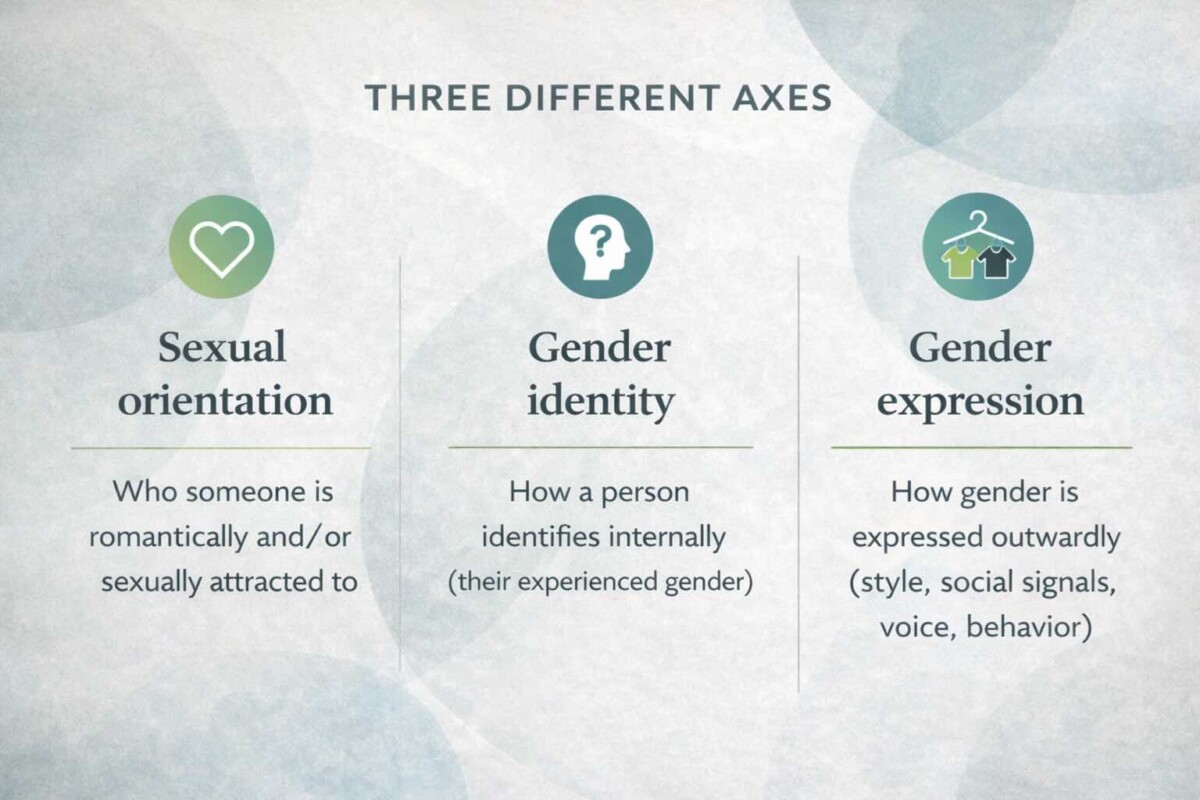
The first thing to understand: three different axes
Before any vocabulary, you need a map. Most confusion happens because people mix three different dimensions.
1) Sexual orientation
Who someone is romantically and/or sexually attracted to.
Core terms: heterosexual, gay, lesbian, bisexual, pansexual, asexual.
2) Gender identity
How a person identifies internally (their experienced gender).
Core terms: woman, man, nonbinary, transgender, cisgender.
3) Gender expression
How gender is expressed outwardly (style, social signals, voice, behavior).
Expression may align with identity or not, and culture strongly affects what is read as “masculine” or “feminine.”
If you keep these axes separate, the vocabulary becomes readable.
“Sex” vs “gender” in English: not synonyms, not a simple translation
Sex
In many contexts, sex refers to biological classification and related medical/legal categories.
Typical environments: medicine, legal documents, immigration papers, some official forms.
You may see:
- sex: male / female (sometimes expanded),
- sex assigned at birth,
- biological sex (in scientific/medical writing).
Gender
In modern everyday and institutional English, gender often relates to social/identity categories.
Typical environments: education, HR, surveys, social research, inclusive language guides.
You may see:
- gender: man / woman / nonbinary / prefer not to say,
- gender identity,
- gender expression.
Why learners get trapped
In Slavic and Germanic languages we already have grammatical gender (род / Genus).
That pushes learners into a wrong reflex:
“Gender = grammatical gender.”
But in most real texts, gender means identity/social category, not grammar.
So the practical rule is:
Translate meaning first, not the word.
Decide whether the text is about biology, identity, social categories, or grammar.
What LGBTQ+ is (linguistically)
LGBTQ+ is not a complete inventory.
It functions as an umbrella label — a compressed signal meaning:
“We are talking about sexual orientation and gender identity (and related topics).”
The “+” is a typographic way to avoid an endless list while leaving space for terms used by different communities and institutions.
In formal contexts you may also see broader frameworks like SOGIESC:
Sexual Orientation, Gender Identity, Gender Expression, and Sex Characteristics.
It is used because it is explicit and system-like.
A clear glossary: meanings and typical usage
Before the list, one important note: these words are labels, not diagnoses.
In formal English, neutral usage is usually descriptive, not defining a “type of person.”
Sexual orientation terms
Heterosexual (straight)
Attracted to the other sex/gender (in common usage). “Straight” is informal; “heterosexual” is neutral/formal.
Gay
Most commonly: a man attracted to men, but sometimes used broadly. Neutral in many contexts.
Lesbian
A woman attracted to women. Neutral.
Bisexual (bi)
Attracted to more than one gender. Neutral. “Bi” is informal.
Pansexual (pan)
Attracted to people regardless of gender, or across all genders (definitions vary by speaker). Often used as a self-identifier.
Asexual (ace)
Experiences little or no sexual attraction, or attraction under limited conditions (self-definitions vary). Often paired with “asexual spectrum.”
Aromantic (aro)
Experiences little or no romantic attraction (independent from sexual orientation).
Queer
An umbrella/self-identity term in many modern contexts.
Important: it can be sensitive depending on country, generation, and personal history. Best practice: use it when a person or the text uses it, not as your default label.
Gender identity terms
Cisgender (cis)
A person whose gender identity aligns with the sex assigned at birth. Neutral/technical.
Transgender (trans)
An umbrella term for people whose gender identity differs from the sex assigned at birth.
Best practice in English: treat it as an adjective:
- ✅ a transgender person / transgender people
- ❌ a transgender (as a noun)
- ❌ transgendered (often considered unnatural or outdated)
Nonbinary (NB)
A person who does not identify exclusively as a man or a woman. Neutral.
You may also see: gender non-conforming (context-dependent) and genderqueer (self-identifier).
Agender
A person who identifies as having no gender, or outside gender categories (self-definition varies).
Sex characteristics
Intersex
An umbrella term for natural variations in sex characteristics that do not fit typical definitions of male or female bodies.
This is not the same as gender identity or sexual orientation — it’s a different axis.
Pronouns and real communication: what matters in practice
In English, you may see:
- he / him
- she / her
- they / them (singular “they”)
- sometimes: ze / hir (rare, context-specific)
Singular “they”
This is practical to know for real-life texts and exams. It is commonly used when:
- the gender is unknown,
- the person prefers “they,”
- the speaker wants neutral wording.
Examples:
- Someone left their phone.
- Taylor said they will join later.
Safe etiquette lines (neutral and professional)
If you need to ask, keep it simple and private:
- How should I address you?
- What pronouns do you use?
If you don’t need to ask — don’t ask. In most everyday situations, using the person’s name is enough.
What you may see in forms, exams, and official texts
A short preface before the list: forms reflect a system, not a philosophy. Your task is to decode categories, not to “agree” with them.
Common fields:
- Sex (often legal/medical)
- Gender (often social/identity category)
- Sex assigned at birth
- Preferred name / Chosen name (name used in communication)
- Legal name
- Pronouns
- Prefer not to say
Abbreviations you may encounter:
- AFAB / AMAB — assigned female/male at birth (used in some contexts)
- LGBTQIA+ — expanded umbrella acronyms
Exam tip:
If a text uses academic vocabulary (gender identity, discrimination, inclusion, bias-free language), treat it as standard topic vocabulary. You don’t need activism to understand it; you need semantics.
Cross-cultural reality: the same word behaves differently across countries
A term can be:
- neutral in American professional English,
- formal or bureaucratic in one European context,
- sensitive or simply unfamiliar in another linguistic culture.
That is why the correct approach is not “learn one translation,” but:
- identify the register (academic, HR, casual, medical, legal);
- choose neutral phrasing;
- avoid slang when you don’t control the cultural weight.
Common learner mistakes (and how to avoid them)
Before the list: these errors happen even at C1 because they come from translation reflexes, not from grammar.
- Mixing sex and gender as synonyms.
- Translating gender as grammatical gender (род) in texts about identity.
- Using transgender as a noun (“a transgender”).
- Using queer as a default label without context.
- Over-asking personal questions in cultures where that is intrusive.
Minimal “safe language” rules (teacher version)
This is not ideology. It’s communication hygiene:
- Use a person’s name first — it’s universal.
- Use neutral professional vocabulary in public texts.
- If you must ask, ask briefly and privately.
- Don’t invent labels. Mirror what the person/text uses.
- In translation: prioritize meaning and context, not dictionary symmetry.
Conclusion: language is a navigation system
The world is multilingual and messy. Real texts are inconsistent. Forms are imperfect. People use words differently across countries and generations.
So the goal is not to “know the right opinion.”
The goal is to read correctly, translate correctly, and speak respectfully — with calm, precision, and linguistic awareness.
That is exactly what language education should give a learner: competence in real life.
Related resources (supporting elements)
- Blog hub: https://levitintymur.com/blog/
- Video Lessons hub: https://levitintymur.com/videos/
- Games (supporting element): https://levitintymur.com/games-to-learn-english/
- US blog hub: https://languagelearnings.com/blog/
Author’s development by Tymur Levitin — Founder, Director, Senior Teacher of Levitin Language School / Start Language School by Tymur Levitin.
© Tymur Levitin


