
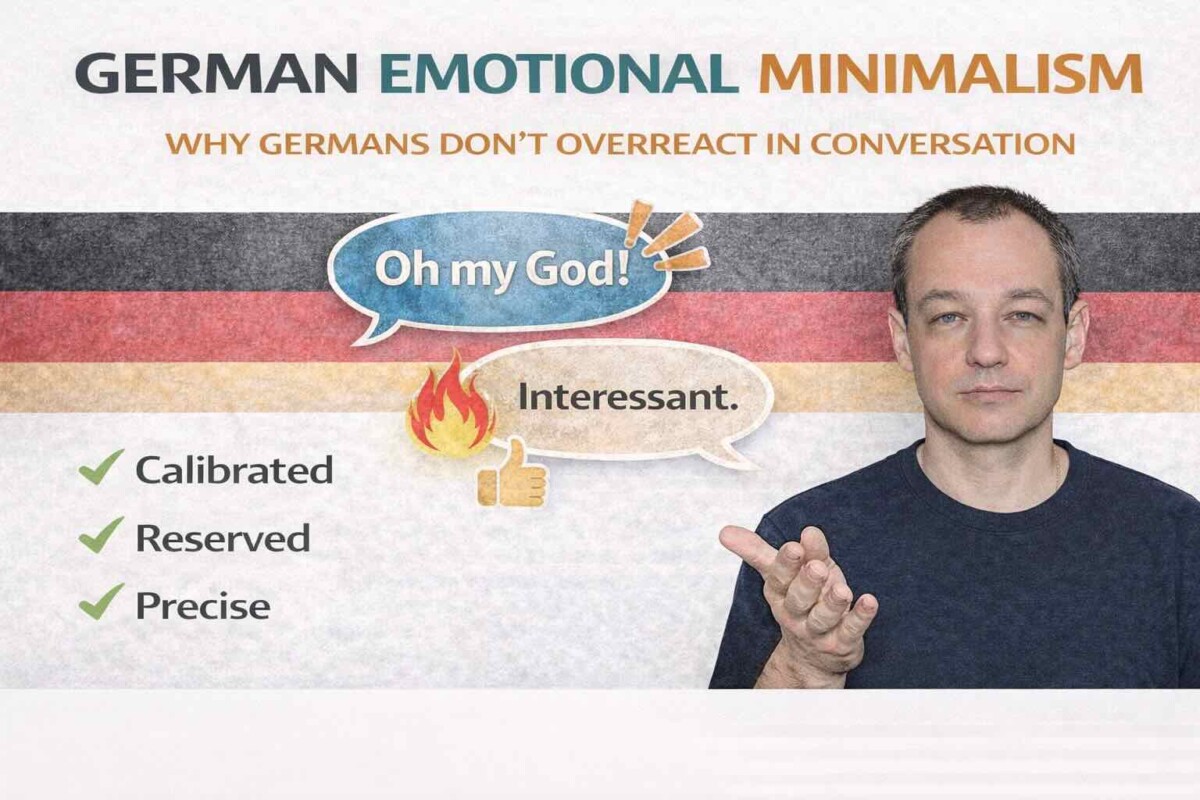
If you come from a language culture where enthusiasm is verbalized, emotions are amplified, and agreement is intensified, German can feel… restrained.
You say something exciting.
The response is:
Interessant.
Gut.
Ja.
And you think:
“Is that all?”
This article continues our German communication series and explores a subtle but powerful phenomenon: German emotional minimalism — the tendency to express reactions with controlled intensity, even when emotions are present.
The Illusion of Emotional Flatness
Many learners misinterpret German reactions as:
- indifferent
- cold
- unenthusiastic
- uninterested
But what they are hearing is not emotional absence.
It is emotional economy.
In German communication, intensity is often calibrated.
Exaggeration is reduced.
Signals are contained.
This does not mean feelings are weaker.
It means they are structured differently.
Example: Enthusiasm Across Languages
In some languages, you might hear:
- “Oh my God, that’s amazing!”
- “That’s incredible!”
- “I love it so much!”
- “Wow, that’s absolutely fantastic!”
In German, you may hear:
- Sehr gut.
- Nicht schlecht.
- Klingt gut.
- Ja, gefällt mir.
To a foreign ear, that sounds modest.
To a German ear, that can be genuine approval.
German praise often avoids emotional inflation.
Why Overreaction Sounds Unnatural in German
When learners translate enthusiasm literally, they often produce:
- Das ist unglaublich fantastisch!
- Ich liebe das absolut total!
- Das ist extrem mega super!
Grammatically correct.
Pragmatically exaggerated.
German tends to prefer:
- precision over amplification
- clarity over drama
- understatement over hyperbole
This is not universal. It is contextual.
But in professional and everyday environments, emotional control is valued.
The Role of Intonation
The key is not vocabulary alone.
German emotion often lives in:
- subtle intonation shifts
- slightly prolonged vowels
- micro-pauses
- facial expression
A simple Ja with the right tone can signal:
- agreement
- mild enthusiasm
- strong approval
- confirmation
Without raising the volume.
Emotional nuance is often melodic, not lexical.
The Professional Context
In professional environments, excessive enthusiasm can sound:
- immature
- theatrical
- unreliable
If someone says:
Das Projekt ist machbar.
That may already contain confidence.
It does not need:
- dramatic reinforcement
- emotional decoration
- rhetorical fireworks
German communication often separates emotional expression from factual evaluation.
Understatement as Strength
One of the most misunderstood features of German communication is understatement.
Example:
Nicht schlecht.
Literally: “Not bad.”
Functionally: sometimes strong praise.
Understatement creates stability.
It avoids emotional volatility.
It maintains credibility.
For learners, this feels counterintuitive.
But credibility in German often grows through restraint.
Why Foreigners Feel Uncertain
Learners from more emotionally expressive language cultures may think:
- “Do they actually like it?”
- “Are they just being polite?”
- “Is something wrong?”
But what they are experiencing is calibration.
German does not always mirror emotional intensity.
It evaluates first.
It reacts second.
It escalates rarely.
Emotional Precision vs Emotional Volume
This is the core distinction.
Some communication cultures increase volume to show sincerity.
German often increases precision instead.
Instead of:
“That’s absolutely amazing!”
You may hear:
Das ist überzeugend.
(That is convincing.)
Instead of:
“I’m extremely excited!”
You may hear:
Ich freue mich darauf.
(I’m looking forward to it.)
Emotion is present.
It is simply structured.
Why This Matters for Learners
If you over-amplify your reactions in German:
- you may sound exaggerated
- you may lose professional credibility
- you may appear less stable
If you under-react because you are unsure:
- you may seem disengaged
The goal is not emotional suppression.
The goal is emotional alignment.
Final Thought
German is not emotionally cold.
It is emotionally economical.
Once you understand that minimalism does not mean indifference, you stop misreading reactions.
And once you calibrate your own reactions accordingly, you stop sounding foreign — even when your grammar was already correct.
Author: Tymur Levitin
Founder & Director
Levitin Language School
Global Learning. Personal Approach.
© Tymur Levitin
Learn German analytically and pragmatically:
https://levitintymur.com/languages/learning-german/
International programs and language consulting:
https://languagelearnings.com/
Explore the full German communication series on the blog.