Before you start:
👉 Choose your language: https://levitintymur.com/#languages
Why Most Learners Forget Words — And Why It’s Not Their Fault
A typical student learns a word, repeats it, writes it down — and forgets it two days later.
This happens not because the student is weak, but because the word lives without context.
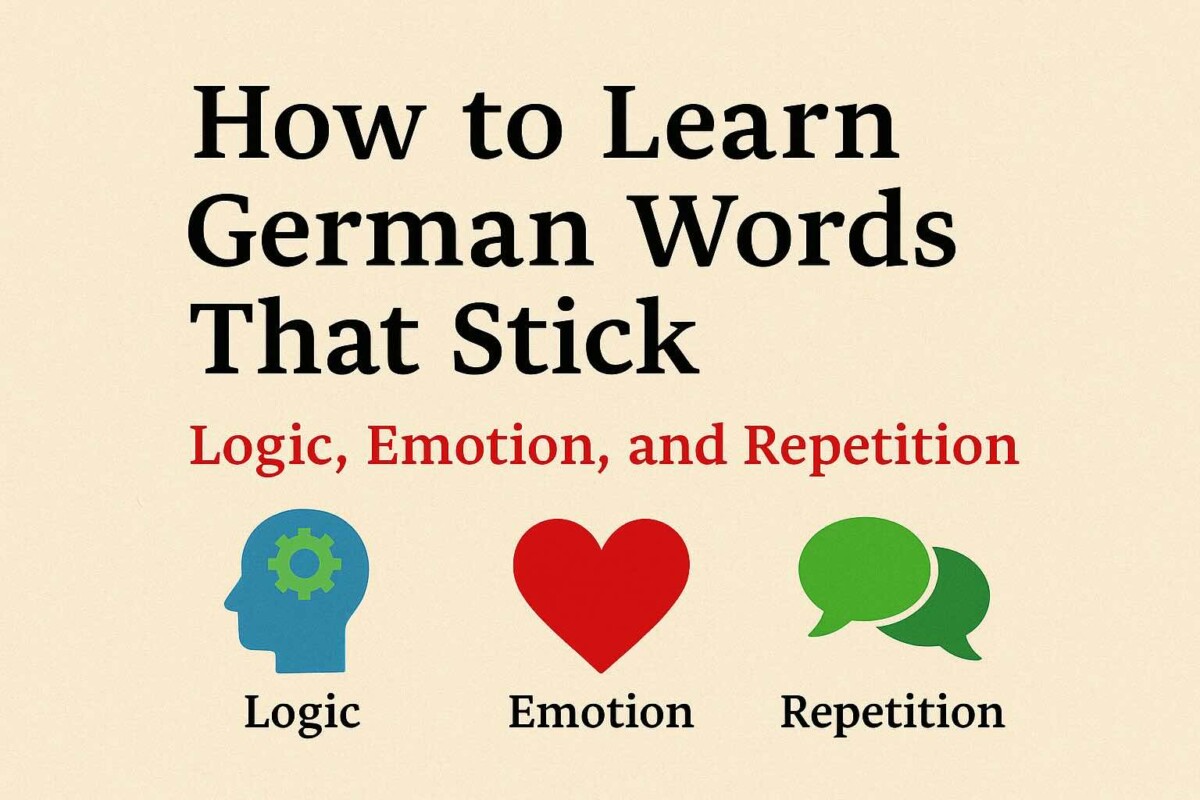
German words stick only when three systems work together:
- logic — the structure behind the word
- emotion — what the situation meant
- repetition — natural revisits in real communication
If even one element is missing, the word fades.
This article continues the series on natural vocabulary learning and builds on:
German Vocabulary in Context — Learn Words You’ll Actually Use
German Words in Real Conversations — Learn How People Actually Speak
The Logic Behind Words: Why German Is Not Random
German feels difficult only until you see the logic inside it.
Examples:
- verstehen → verstehen, Verständnis, verständlich
- fahren → Fahrer, Abfahrt, erfahren
- sehen → Aussicht, versehen, sehenswert
Every word family has an underlying concept.
When you learn this concept — you learn ten words at once.
German is not a vocabulary problem.
It is a system problem — and systems are learnable.
For more structural insights:
German Tenses Explained Simply — Learn to Use Time Naturally
Emotion: The Missing Ingredient in Your Memory
You remember what made you react — not what you saw on a list.
Words learned through:
- humor
- surprise
- real conversation
- emotional tone
- personal associations
last 7–10 times longer.
This is why real German speech (with doch, na ja, passt, halt, schon) sticks better than isolated dictionary forms.
To feel real speech:
German Words in Real Conversations — Learn How People Actually Speak
Repetition: Not Drills — Natural Return
Repetition works only when it feels natural.
Not:
- writing the word 20 times
- repeating it mechanically
- memorizing lists
But:
- seeing it again in a sentence
- hearing it in a conversation
- meeting it in context next week
- using it with a teacher
- reading it inside a story
This is why studying with a real person accelerates vocabulary: you meet the words again organically, not by force.
Start learning German with a teacher who builds vocabulary through context:
https://levitintymur.com/teachers/tymur-levitin/
Learn the language itself:
https://levitintymur.com/languages/learning-german/
Build German Vocabulary Through Patterns, Not Words
Patterns create memory anchors:
- es geht… → introduction to explanations
- ich hätte gern… → polite requests
- ich bin dabei… → ongoing actions
- mal kurz… → softeners that make speech natural
Every pattern boosts 10–20 new words automatically.
This is how you move from memorizing to speaking.
For conversational structure:
Learn German Through Conversation — The Natural Way to Fluency
The Secret: Combine Logic + Emotion + Repetition
This simple formula is what separates fluent speakers from “forever beginners.”
- Logic helps you understand why the word exists.
- Emotion attaches meaning to your memory.
- Repetition revisits it naturally.
Learn words the way Germans actually use them — not the way textbooks present them.
Want to Learn Words You’ll Actually Use?
Start with real communication, meaningful examples and living speech.
Learn German with a method that respects your logic and supports your confidence:
https://levitintymur.com/languages/learning-german/
Teacher profile:
https://levitintymur.com/teachers/tymur-levitin/
Explore more German articles:
- German Vocabulary in Context — Learn Words You’ll Actually Use
- German Words in Real Conversations — Learn How People Actually Speak
- German Tenses Explained Simply — Learn to Use Time Naturally
- German for Travel — Learn to Speak and Understand with Ease
- Business German Communication — Speak Professionally and Build Trust
Author’s Note
Author’s development by Tymur Levitin — founder, director and senior teacher of Levitin Language School / Start Language School by Tymur Levitin.
22+ years of teaching German, English, Ukrainian and Russian to students from more than 20 countries.
Global Learning. Personal Approach.
Official websites:
https://levitintymur.com
https://languagelearnings.com
© Tymur Levitin


