
Before you start moving words around in German, remember one simple idea:
German is not only about rules — it is about rhythm, emphasis, and intention.
You can keep all the words “correct” and still sound cold, rude, distant, overly formal, or simply confusing — just because you placed the wrong element in the wrong place.
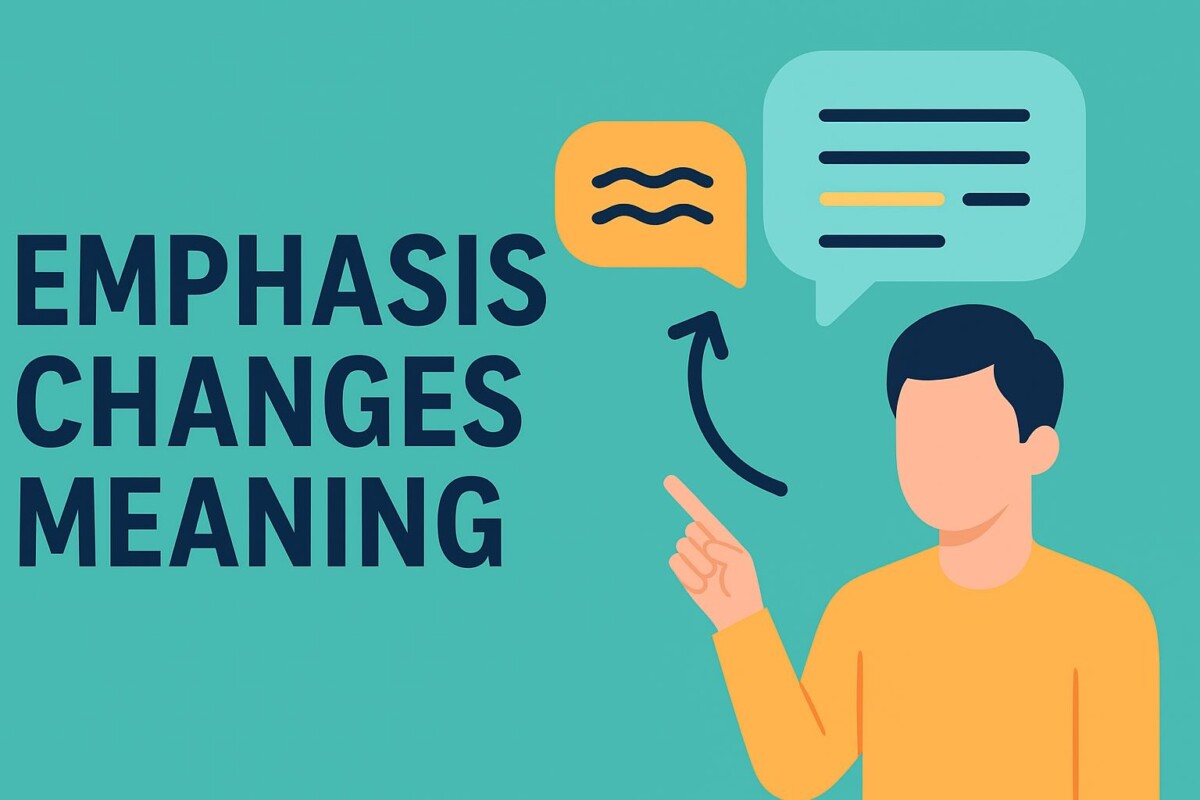
This article shows how emphasis changes meaning in German sentences — and how to use it consciously instead of guessing.
📌 Choose your language
English | DE | UA | RU
1. What Is Emphasis in German — Really?
When learners hear “emphasis”, they think of “speaking louder” or “stressing a word”.
In reality, German uses three layers to highlight meaning:
- Prosody – intonation, rhythm, voice.
- Word order – especially Position 1 before the verb.
- Context – what is already known and what is new.
In this article we focus on the second layer:
how moving elements in the sentence changes what the listener feels is important.
We are not rewriting grammar rules. We are teaching you how Germans actually think when they build a sentence.
2. The Sentence as a Stage: Position 1 as Spotlight
German main clauses are often described with a simple rule:
The finite verb is in Position 2.
Technically correct — and psychologically incomplete.
For a German listener, the critical question is not “Where is the verb?”
It is:
What stands in front of the verb?
Whatever enters Position 1 (Vorfeld) becomes:
- the entry point to your message
- the main actor on the stage
- the lens through which the sentence will be interpreted
Look at this simple example:
- Heute kaufe ich das Buch.
→ Today is the focus. When? Today. - Das Buch kaufe ich heute.
→ The book is the focus. Not the magazine, not the pen. - Ich kaufe das Buch heute.
→ More neutral narrative. The focus is softer, spread over the whole action.
Same words, same grammar, different intention.
You are not “breaking” the rules when you move elements.
You are controlling the spotlight.
3. One Sentence, Many Meanings: Practical Examples
Take this neutral sentence:
Ich habe das Auto gestern gesehen.
I saw the car yesterday.
Now shift the focus:
- Das Auto habe ich gestern gesehen.
→ The car, not something else. The object becomes emotionally marked. - Gestern habe ich das Auto gesehen.
→ Yesterday is important. Maybe today something changed. - Ich habe gestern das Auto gesehen.
→ Balanced, narrative — often used in storytelling. - Nur das Auto habe ich gestern gesehen.
→ Limiting focus: only the car, nothing more.
A German listener feels these nuances immediately — even if nobody ever explained the “rule”.
Your task as a learner is to build the same sensitivity consciously.
4. Emphasis vs. Satzklammer: Two Different Tools
At this point many students mix two separate ideas:
- Emphasis / focus – what we put in the spotlight.
- Satzklammer (sentence frame) – how German builds a structural frame around the information.
The Satzklammer is the combination of the finite verb and another verbal element:
- Ich möchte heute Abend einen Film sehen.
- Ich habe das Auto gestern gesehen.
It creates cognitive rails that keep the sentence stable.
What happens inside this frame can still move — and that is where emphasis lives.
So:
- Position 1 tells us what you highlight.
- The frame tells us how you anchor the action.
For a deeper, structural explanation of this frame, see our article:
→ What’s Outside the Frame: How German Word Order Reveals What You Really Mean
Here, we stay with emphasis as a speaking tool.
5. Verb First ≠ Always a Question or Command
The comment that often appears under videos and posts looks like this:
“If the verb is first, it must be a question or a command.”
Grammatically — no.
In real German, verb-first structures can be:
- questions
- commands
- emotional statements
- narrative highlights
- stylistic choices in written texts
Look at this sentence:
Aufwachen kann ich nicht von allein.
This is not a question and not an imperative.
It is a declarative sentence with emphasis on aufwachen — the action itself.
Compare:
- Aufwachen kann ich nicht von allein.
→ The act of waking up is the problem. - Ich kann nicht von allein aufwachen.
→ More neutral; the focus is on the whole situation. - Kann ich nicht von allein aufwachen?
→ Genuine question, depending on intonation. - Wach auf! / Wachen Sie auf!
→ Imperative: a direct command.
The words overlap, but the structure + intonation create different realities.
So when someone says “Don’t mislead people, this is not a question and not a command” —
they are right about that particular sentence, but wrong about the general rule.
The rule is simpler:
Verb-first is a powerful tool.
What it expresses depends on structure + context + intonation.
We cover these patterns in more detail in separate lessons and upcoming articles on inversion and information structure.
6. Emphasis, Politeness, and Emotion
Emphasis is not only grammar. It is social behavior.
A. Requests
- Ich brauche morgen deine Hilfe.
→ Neutral statement. - Morgen brauche ich deine Hilfe.
→ The time is important; often sounds more urgent. - Deine Hilfe brauche ich morgen.
→ Stronger emotional focus; in the wrong context can sound dramatic.
B. Apologies
- Es tut mir wirklich leid.
→ Standard apology. - Wirklich leid tut es mir.
→ Deep emotional emphasis; very personal. - Mir tut es wirklich leid.
→ Focus on my feelings and responsibility.
C. Conflict
- Ich verstehe dich nicht.
→ “I don’t understand you” — neutral. - Dich verstehe ich nicht.
→ “You I don’t understand” — marked, potentially confrontational.
Teaching only the “correct” word order without these nuances means teaching a language without people.
At Levitin Language School we teach how language behaves in real situations.
7. How Emphasis Interacts With Information Structure
Even in a short article about emphasis we cannot ignore one deeper layer:
information structure — what traditional linguistics calls Thema–Rhema or актуальное членование.
Very briefly:
- Theme (Thema) – what we are already talking about, the “starting point”.
- Rheme – what is new, the “message”.
In real speech:
- The theme often stands early in the sentence.
- The rheme carries the main stress and emotional weight.
German uses a combination of Position 1 + prosody to manage this.
Slavic languages rely more on flexible word order + intonation.
We will dedicate a separate, in-depth article to this topic.
Here you only need one idea:
Emphasis is not random.
It grows out of what is already known and what is new in the conversation.
When you feel this structure, you stop “choosing” word order blindly and start building logical sentences.
8. How to Practise Emphasis (Step by Step)
You can train emphasis without waiting for a native speaker.
- Take a simple sentence
– Ich will heute mit dir sprechen. - Move different elements to Position 1
- Heute will ich mit dir sprechen.
- Mit dir will ich heute sprechen.
- Ich will mit dir heute sprechen.
- Say each version out loud
– change intonation, feel which part becomes heavier. - Write short dialogues
Put the same sentence into:- a polite email
- an argument
- a romantic context
and adjust emphasis.
- Record yourself
Listen as if you were the other person:
What do you feel is important in each version?
This is not only pronunciation practice — it is training in emotional clarity.
9. How We Teach Emphasis at Levitin Language School
(Global Learning. Personal Approach.)
In our German lessons we do not ask students to “learn patterns by heart”.
Instead, we work through a simple but powerful sequence:
- Meaning first
- What exactly do you want to say?
- What should the other person feel or understand first?
- Focus choice
- Time? Place? Person? Object? Reason? Emotion?
- Position 1 decision
- We choose which element deserves the spotlight.
- Frame building
- We anchor the sentence with the correct verb form and structure.
- Voice and rhythm
- We practise saying the sentence the way real people say it.
This way students stop being afraid of “free word order” and start using it as a tool.
📌 10. Learn German With Meaning
If you want to go beyond rules and really feel how German sentences work, you can learn with us online — individually, from anywhere in the world.
🔗 Choose your language:
https://levitintymur.com/#languages
🔗 German course page:
https://levitintymur.com/languages/learning-german/
🔗 Teacher — Tymur Levitin:
https://levitintymur.com/teachers/tymur-levitin/
🔗 USA website:
https://languagelearnings.com
Related Reading
- What’s Outside the Frame: How German Word Order Reveals What You Really Mean
- German Words in Real Conversations: Learn How People Actually Speak
- The Power of Doubt in Language Learning
- The Language of Direction — Why Clarity Takes You Further Than Speed
- Why Is the Verb Always in the Second Position in German?
- Why German Word Order Isn’t Just About Rules
- Tense Shift #4: Why Are You Telling Me This?
- Topfen vs Quark
🌍 Read this article in other languages
• Deutsch


