Skip to content

German grammar explained

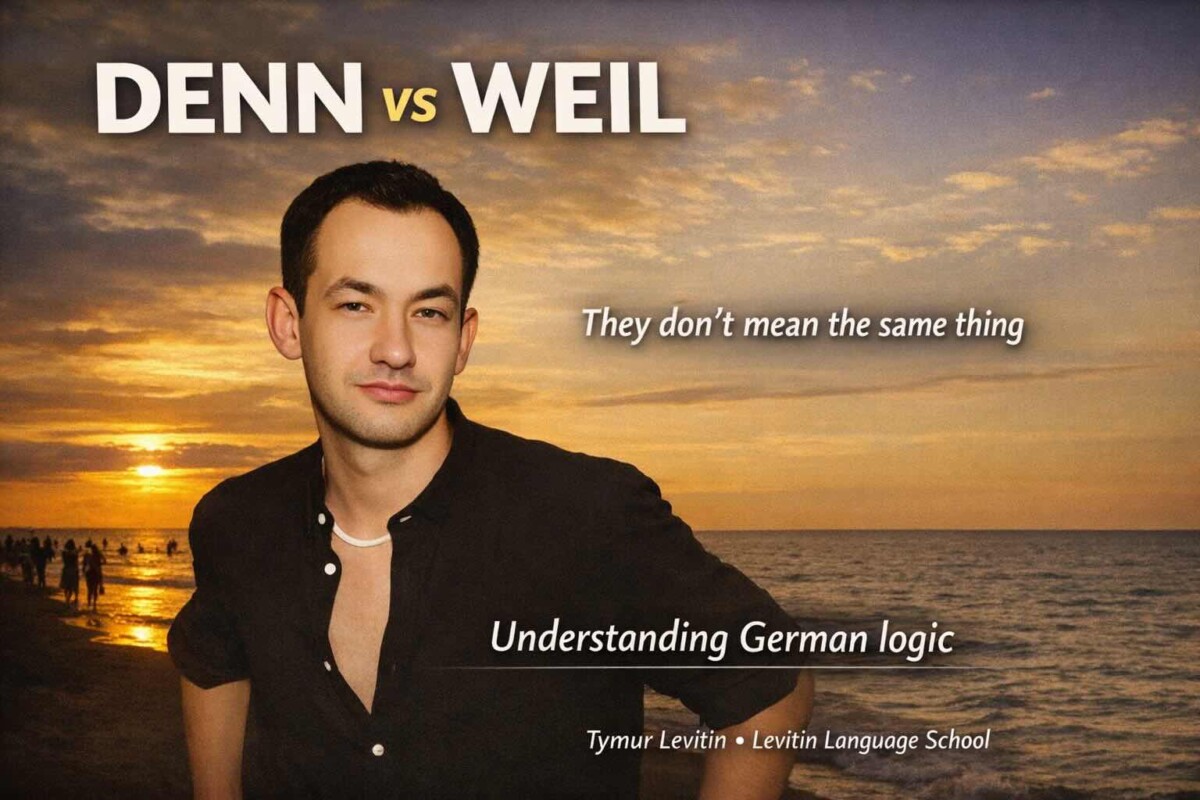
Why German “Because” Confuses Learners: Weil vs Denn Is Not Grammar
Why German “Because” Confuses Learners: Weil vs Denn Is Not Grammar | LEVITIN SCHOOL
German

Why German “Because” Confuses Learners: Weil vs Denn Is Not Grammar

Many students ask the same question: What is the real difference between weil and denn? Both mean “because”. Why does German need two words? They are usually given a simple rule: The student memorizes it.The student passes exercises.And then — in real conversation — the student hesitates every single time. Because the problem was never […]

Tymur Levitin | LEVITIN SCHOOL Tymur Levitin
• 22.02.2026 • 3 min read
Read full article

German grammar explained

Beyond Word Order: The Emotional Power of Emphasis in German | LEVITIN SCHOOL
21.08.2025

Beyond Word Order: The Emotional Power of Emphasis in German

Author’s Column | Tymur Levitin on Language, Meaning and Respect

When we talk about German grammar, most learners immediately think of rules: verb in the second position, subject–verb agreement, cases. But there’s something far more human, far more alive hidden in the structure of German: emphasis. And this is where grammar becomes psychology, and word order becomes emotion. Why Emphasis Is More Than Grammar German is […]

Tymur Levitin | LEVITIN SCHOOL Tymur Levitin
Read more →
German Ends with -ung, But What Does It Mean? | LEVITIN SCHOOL
04.08.2025

German Ends with -ung, But What Does It Mean?

Author’s Column | Tymur Levitin on Language, Meaning and Respect

🔗 Choose your language:Explore our German Teachers We see it everywhere in German. -ung. At the end of nouns like Rechnung, Bewegung, Übung, Entwicklung, Aussage, Erfahrung, Verbindung… and many more. But what exactly does -ung mean?And how does it compare to English? 🔸 -ung = a process, a result, or a concept In most cases, -ung nouns come from verbs.They express: In that way, they’re similar to English […]

Tymur Levitin | LEVITIN SCHOOL Tymur Levitin
Read more →
Why One Question Is Not Enough: The Two-Question Method That Makes German Grammar Click
28.07.2025

Why One Question Is Not Enough: The Two-Question Method That Makes German Grammar Click

Author’s Column | Tymur Levitin on Language, Meaning and Respect

Choose your language The Trap of “What?” — One Question Leads Nowhere You ask a student: “What’s the object in this sentence?” They hesitate.Because what? can mean many things in German: One question alone leaves you guessing.It doesn’t reveal how the sentence really works. Grammar Is Not About Forms — It’s About Relationships Words don’t stand alone.They […]

Tymur Levitin | LEVITIN SCHOOL Tymur Levitin
Read more →
How One German Sentence Can Mean Five Different Things — And Why That’s Not a Problem
20.07.2025

How One German Sentence Can Mean Five Different Things — And Why That’s Not a Problem

Author’s Column | Tymur Levitin on Language, Meaning and Respect

🧠 Choose your language: https://levitintymur.com/#languages It’s the Same Words — But Not the Same Message Ask any student of German: “Can one sentence mean five things?”The confident ones will say: “No, not really.”The honest ones will say: “I’m not sure.” The truth? One sentence can have many meanings.Not because the grammar changes.But because the intention, the focus, and the emphasis shift — […]

Tymur Levitin | LEVITIN SCHOOL Tymur Levitin
Read more →
What’s Outside the Frame? How German Word Order Reveals What You Really Mean | LEVITIN SCHOOL
17.07.2025

What’s Outside the Frame? How German Word Order Reveals What You Really Mean

Author’s Column | Tymur Levitin on Language, Meaning and Respect

📌 Choose your language English | DE | UA | RU {VIDEO_EN} | {VIDEO_DE} | {VIDEO_UA} | {VIDEO_RU} 1. German Word Order Isn’t Grammar — It’s a Map of Attention German word order is one of the most misunderstood topics among learners.Not because the rules are complicated — they’re not — but because the logic behind […]

Tymur Levitin | LEVITIN SCHOOL Tymur Levitin
Read more →
Why German Word Order Makes Sense — If You Look Closer | LEVITIN SCHOOL
14.07.2025

Why German Word Order Makes Sense — If You Look Closer

Author’s Column | Tymur Levitin on Language, Meaning and Respect

The Myth: German is Just Rigid Grammar Many language learners give up on German because they believe the word order is too strict, too mathematical, or simply unnatural. They memorize rules, charts, and verb positions, only to end up confused when those rules seem to fall apart in real conversations. But what if the problem […]

Tymur Levitin | LEVITIN SCHOOL Tymur Levitin
Read more →
How Emphasis Changes Meaning in German Sentences | LEVITIN SCHOOL
09.07.2025

How Emphasis Changes Meaning in German Sentences

Author’s Column | Tymur Levitin on Language, Meaning and Respect

Before you start moving words around in German, remember one simple idea:German is not only about rules — it is about rhythm, emphasis, and intention. You can keep all the words “correct” and still sound cold, rude, distant, overly formal, or simply confusing — just because you placed the wrong element in the wrong place. […]

Tymur Levitin | LEVITIN SCHOOL Tymur Levitin
Read more →
Why Is the Verb Always in the Second Position in German? | LEVITIN SCHOOL
07.07.2025

Why Is the Verb Always in the Second Position in German?

Author’s Column | Tymur Levitin on Language, Meaning and Respect

The Real Question Behind the Rule Many learners ask: “Why is the verb in the second position in German sentences?” It’s one of the most repeated rules in grammar books—but rarely explained clearly. In this article, I’ll give you not a list of rules, but a real explanation: one that shows how this structure reflects […]

Tymur Levitin | LEVITIN SCHOOL Tymur Levitin
Read more →