
{VIDEO_EN} |
{VIDEO_DE} |
{VIDEO_UA} |
{VIDEO_RU}
1. German Word Order Isn’t Grammar — It’s a Map of Attention
German word order is one of the most misunderstood topics among learners.
Not because the rules are complicated — they’re not — but because the logic behind them is cognitive, not mechanical.
Most explanations reduce the system to “Verb in Position 2” or “The Satzklammer holds the sentence together”.
All technically correct — and all insufficient.
The real story is deeper:
German uses word order to decide what matters.
English does this with voice and stress.
Ukrainian and Russian do this with intonation and context.
German does this with structure.
Word order is not decoration — it is the architecture of attention.
2. The Satzklammer: A Cognitive Frame, Not Just a Grammatical Structure
Let’s revisit a textbook example:
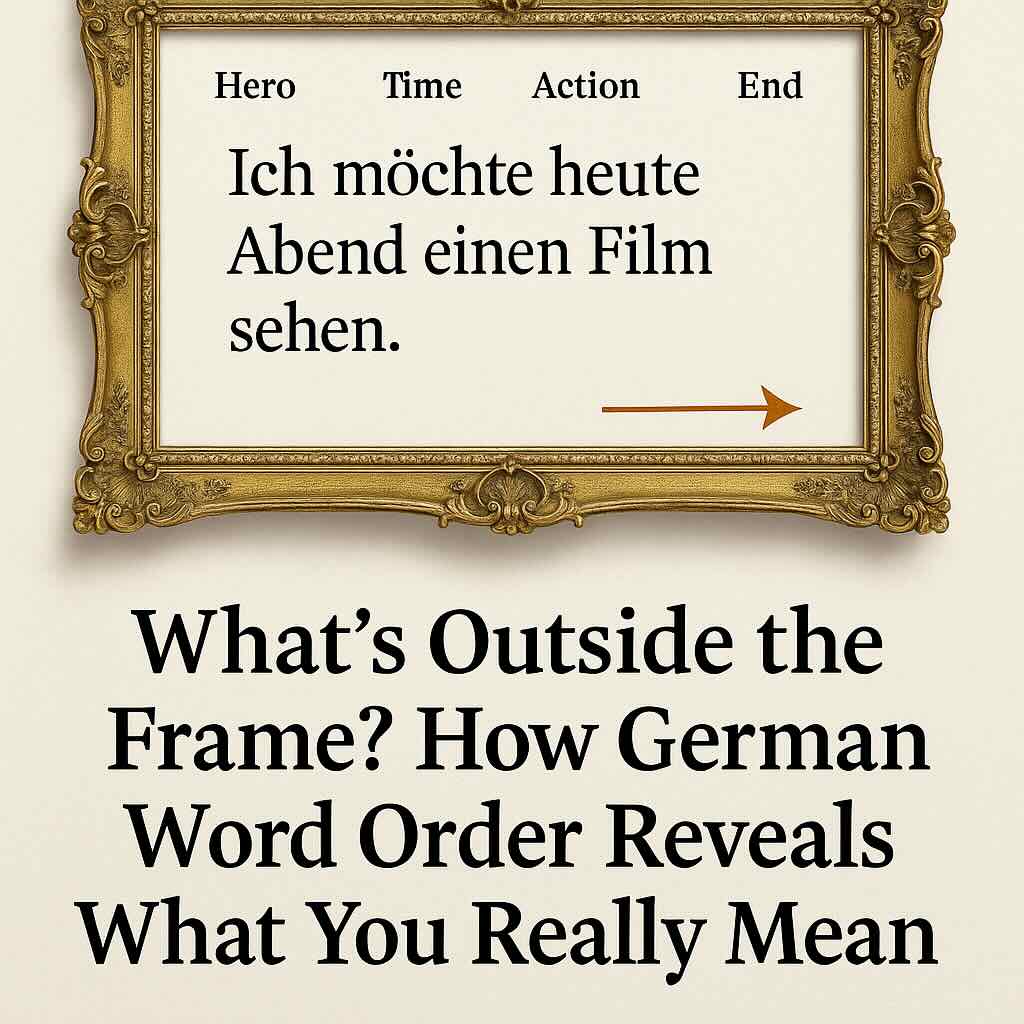
Ich möchte heute Abend einen Film sehen.
(I want to watch a movie tonight.)
The “frame” is:
👉 möchte … sehen
Students learn it mechanically.
Teachers present it as an abstract rule.
But structurally — and cognitively — it is something else.
Why split verbs at all?
Because German builds propositions in layers:
- Anchor the action (möchte … sehen)
- Fill the informational space inside
- Highlight meaning around the frame
This is the concept of cognitive anchoring:
- English uses rhythm and vocal stress for anchoring.
- Slavic languages use morphology (cases, prefixes).
- German uses syntactic rails — fixed boundaries that stabilize the listener’s expectations.
The Satzklammer is not rigidity — it’s support.
It allows German to carry more information without collapsing the sentence.
3. Position 1: The Spotlight That Changes Meaning Without Changing Words
Position 1 (Vorfeld) is the most powerful element of German syntax.
Not because it’s grammatically important —
but because it’s psychologically decisive.
Whatever enters Position 1 is interpreted as:
- the entry point to the speaker’s intention
- the mental lens through which the sentence should be understood
- the pragmatic focus of the message
Compare:
| Sentence | Meaning Shift |
|---|---|
| Ich möchte heute Abend einen Film sehen. | The person is central. |
| Heute Abend möchte ich einen Film sehen. | Time is central. |
| Einen Film möchte ich heute Abend sehen. | The object becomes emotionally marked. |
Three identical propositions.
Three different interpretations of intent.
This is why German word order is not “free”, but meaningfully flexible.
**4. English, Ukrainian, Russian vs German:
Four Logics Behind the Same Idea**
Most learners fail not because German is hard — but because they approach it with the wrong mental model.
English
Emphasis through melody:
“I WANT to watch a movie tonight.”
Ukrainian / Russian
Emphasis through shifting order + intonation:
Фільм я хочу подивитися ввечері.
Фильм я хочу посмотреть вечером.
German
Emphasis through Position 1 and the frame:
Einen Film möchte ich heute Abend sehen.
Each language has its own logic of expressing attention.
German’s logic is the most transparent — once you accept that structure = meaning.
5. Three Big Illusions About German Word Order
Illusion 1: “The verb must be in Position 2.”
False.
Position 2 is not a “slot for the verb”.
It’s the anchor of the sentence — the moment the listener understands the action frame.
Illusion 2: “German is strict.”
German is strict only where ambiguity would destroy clarity.
Elsewhere it’s one of the most nuanced languages on Earth.
Illusion 3: “German grammar is about correctness.”
It is actually about precision of meaning.
**6. Shift the Frame, Shift the Reality:
Micro-Scenarios From Real Life**
A. Making a request
- Ich brauche morgen deine Hilfe. → neutral
- Morgen brauche ich deine Hilfe. → urgency
- Deine Hilfe brauche ich morgen. → emotional emphasis
B. Apologizing
- Es tut mir wirklich leid. → standard
- Wirklich leid tut es mir. → deeper, more personal
- Mir tut es wirklich leid. → empathy-forward
C. Conflict
- Ich verstehe dich nicht. → neutral
- Dich verstehe ich nicht. → “I don’t understand you, specifically”
The frame becomes a tool of emotional transparency.
7. The German Sentence as a Stage (The Cinematic Model)
A German sentence functions like a film shot:
- Frame (Satzklammer) → camera boundaries
- Inside elements → actors
- Position 1 → spotlight
- End position → psychological echo
This cinematic metaphor explains why Germans perceive misplaced information as confusing — the lighting is wrong.
8. Why Learners Fail (And Why It’s Not Their Fault)
Because they were taught:
- rules, not logic
- positions, not meaning
- memorization, not intention
Once you shift to the cognitive model, German becomes intuitive.
9. The Method of Levitin Language School
(Global Learning. Personal Approach.)
Our approach:
Structure → Intention → Focus → Expression
We teach students to:
- see the frame
- decide on focus
- build meaning, not sentences
- control Position 1
- hear German as a system of attention, not rules
This is why our students grow quickly — German becomes a thinking tool.
10. The Final Model: Build Any Sentence With Meaning
- Anchor the frame.
- Identify the informational core.
- Choose the spotlight.
- Place the spotlight in Position 1.
- Let everything else fall logically inside the frame.
This shifts language learning from guessing to clarity.
Learn German With Meaning
🔗 German: https://levitintymur.com/languages/learning-german/
🔗 USA website: https://languagelearnings.com
🔗 Teacher profile: https://levitintymur.com/teachers/tymur-levitin/
🔗 Choose your language: https://levitintymur.com/#languages
Related Articles
- German Words in Real Conversations
- The Power of Doubt in Language Learning
- The Language of Direction
- Chemistry in English
Author
© Tymur Levitin — founder, director, lead instructor
Levitin Language School / Start Language School by Tymur Levitin


