Skip to content

German word order

German Word Order Is Not Crazy — It Just Follows Different Logic
German Word Order Is Not Crazy — It Just Follows Different Logic | LEVITIN SCHOOL
German

German Word Order Is Not Crazy — It Just Follows Different Logic

If there is one topic that makes German learners question their sanity, it is usually word order. A student learns: “Ich arbeite heute.” Everything seems fine. Then suddenly they encounter: “Heute arbeite ich.” Then: “Heute arbeite ich nicht.” Then: “Heute arbeite ich nicht im Büro.” Then: “Heute arbeite ich nicht im Büro, weil ich krank […]

Tymur Levitin | LEVITIN SCHOOL Tymur Levitin
• 24.05.2026 • 4 min read
Read full article

German word order

German Sentence Structure Explained: Where Does the Verb Go? | LEVITIN SCHOOL
13.04.2026

German Sentence Structure Explained: Where Does the Verb Go?

German

Category: German Grammar for Beginners One of the biggest differences between English and German is sentence structure. In English, the word order is usually simple: Subject + Verb + Object German often begins the same way, but the verb position can change. That is why many beginners understand individual German words but still feel confused […]

Tymur Levitin | LEVITIN SCHOOL Tymur Levitin

Read more →
German Logic Series — The Sentence Starts Before the First Word: How Germans Decide What Com...
22.02.2026

German Logic Series — The Sentence Starts Before the First Word: How Germans Decide What Comes First

German

(You can choose your language here: https://levitintymur.com/#languages) In the previous articles of this series, we discovered something uncomfortable for learners:native speakers do not follow rules while speaking.They make decisions. And this leads to a deeper question. If a German speaker does not “build” a sentence step by step…then when does the sentence actually begin? Surprisingly […]

Tymur Levitin | LEVITIN SCHOOL Tymur Levitin
Read more →
When Native Speakers “Break” Word Order — And Why It Still Sounds Right | LEVITIN SCHOOL
22.02.2026

When Native Speakers “Break” Word Order — And Why It Still Sounds Right

German

What German Teaches Us About Real Language Before you continue, you may want to read the previous articles in this series: • Why German “Because” Confuses Learners — weil vs denn is Not Grammarhttps://levitintymur.com/german/why-german-because-confuses-learners-weil-vs-denn-is-not-grammar/ • Before Grammar Comes Choice: Why Native Speakers Don’t Think in Ruleshttps://levitintymur.com/german/before-grammar-comes-choice-why-native-speakers-dont-think-in-rules/ • Native Speakers Don’t Build Sentences — They Aim […]

Tymur Levitin | LEVITIN SCHOOL Tymur Levitin
Read more →
Native Speakers Don’t Build Sentences — They Aim Them: How German Word Order Really Works
22.02.2026

Native Speakers Don’t Build Sentences — They Aim Them: How German Word Order Really Works

German

German learners often feel something strange. They know the rules.They know the tables.They know where the verb “should” go. And yet, when Germans speak — it doesn’t sound like rules. It sounds… intentional. Not correct.Not incorrect.Intentional. And this is exactly where most courses fail. They teach you how to construct a sentence. But a native […]

Tymur Levitin | LEVITIN SCHOOL Tymur Levitin
Read more →
Before Grammar Comes Choice: Why Native Speakers Don’t Think in Rules | LEVITIN SCHOOL
22.02.2026

Before Grammar Comes Choice: Why Native Speakers Don’t Think in Rules

German

When people start learning German, they are usually given a simple survival tool:a table. After weil — verb at the end.After denn — normal word order.After dass — verb at the end.After und — nothing changes. Students memorize it.They pass tests.They even reach B2 or C1. And then something strange happens. They understand grammar — […]

Tymur Levitin | LEVITIN SCHOOL Tymur Levitin
Read more →
Why German “Because” Confuses Learners: Weil vs Denn Is Not Grammar | LEVITIN SCHOOL
22.02.2026

Why German “Because” Confuses Learners: Weil vs Denn Is Not Grammar

German

Many students ask the same question: What is the real difference between weil and denn? Both mean “because”. Why does German need two words? They are usually given a simple rule: The student memorizes it.The student passes exercises.And then — in real conversation — the student hesitates every single time. Because the problem was never […]

Tymur Levitin | LEVITIN SCHOOL Tymur Levitin
Read more →
German Word Order in Real Life — Why Correct Sentences Still Sound Wrong | LEVITIN SCHOOL
04.01.2026

German Word Order in Real Life — Why Correct Sentences Still Sound Wrong

German

Before you start:👉 Choose your language: https://levitintymur.com/#languages When Grammar Is Right but Something Feels Off Many learners reach a frustrating stage in German: And still, native speakers react differently than expected. They understand you — but they don’t hear you as natural. This article explains why correct German can still sound wrong — and how […]

Tymur Levitin | LEVITIN SCHOOL Tymur Levitin
Read more →
German Inversion: When Word Order Becomes Meaning | LEVITIN SCHOOL
20.11.2025

German Inversion: When Word Order Becomes Meaning

Author’s Column | Tymur Levitin on Language, Meaning and Respect

Author’s Column — Tymur LevitinLevitin Language School / Start Language School by Tymur Levitin Choose Your Language English | Deutsch | Українською | По-русски https://levitintymur.com/#languages German Inversion: A Complete, Meaning-Based Guide Most explanations of German word order stop at a surface rule:“Move something to the beginning → verb stays in Position 2.”Useful, yes — but […]

Tymur Levitin | LEVITIN SCHOOL Tymur Levitin
Read more →
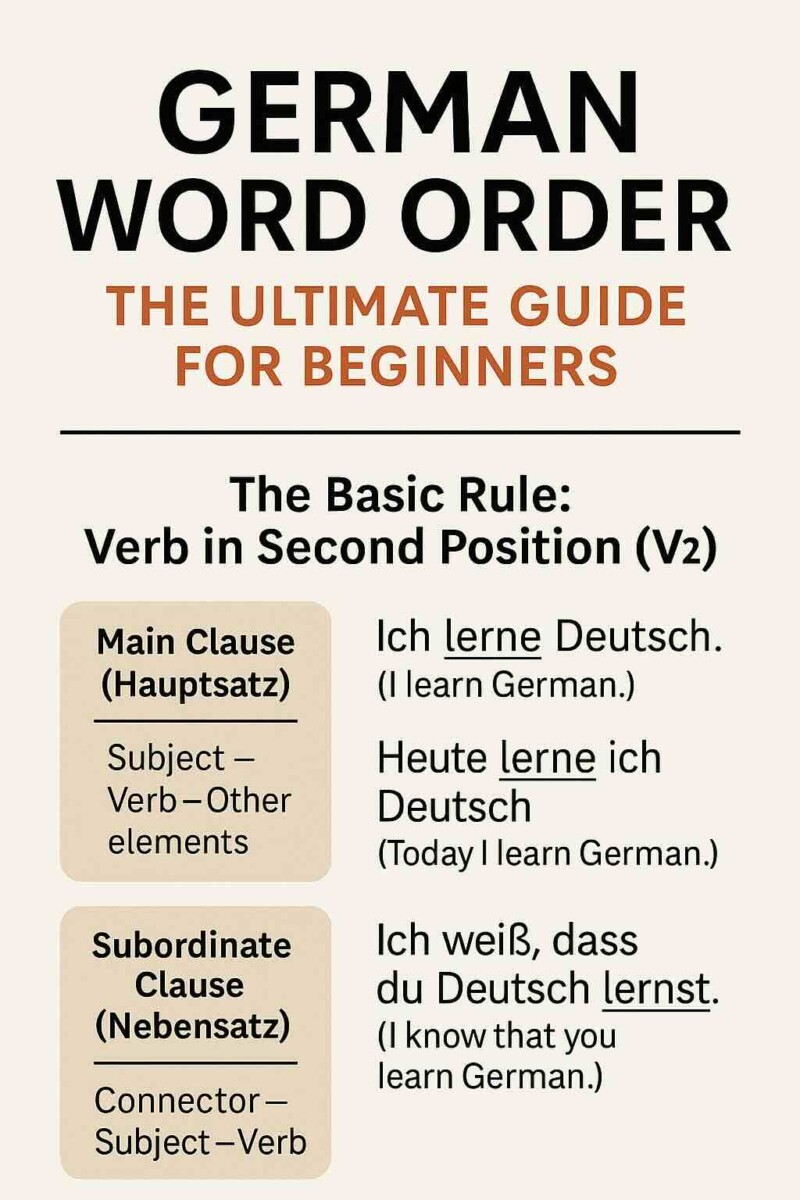
German Word Order: The Ultimate Guide for Beginners | LEVITIN SCHOOL
11.09.2025

German Word Order: The Ultimate Guide for Beginners

German

🔗 Choose your language One of the first challenges for German learners is word order. At first, it seems complicated — but German word order follows clear rules. Once you understand the patterns, you can build correct sentences with confidence. The Basic Rule: Verb in Second Position (V2) In a main clause (Hauptsatz), the conjugated […]

Tymur Levitin | LEVITIN SCHOOL Tymur Levitin
Read more →