
Levitin Language School | Career and Language Skills
🔗 Choose your language
“You never get a second chance to make a first impression.”
— Will Rogers
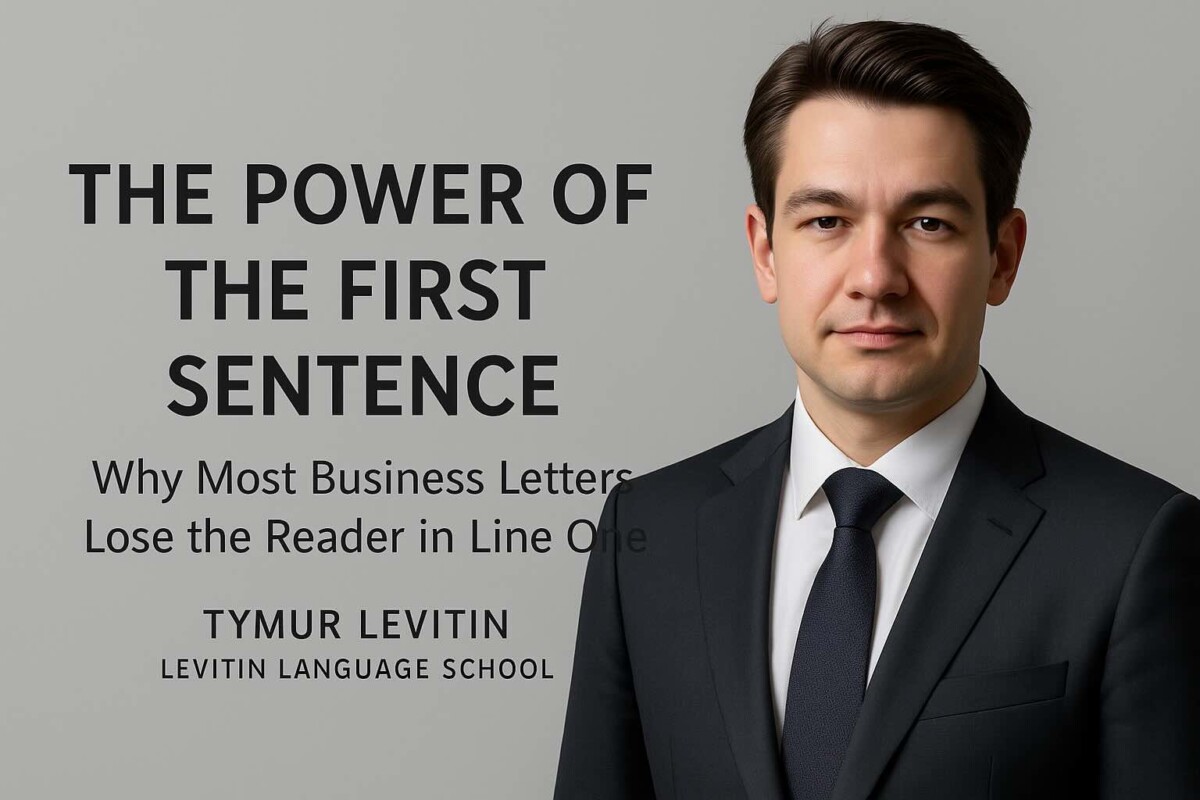
Why the First Sentence Matters More Than You Think
In business communication, most people worry about the closing line — how to sound polite, how to sign off correctly.
But the truth is simple: if your first sentence doesn’t work, nobody will care about the rest.
Whether it’s an email, a proposal, or a LinkedIn message, your opening line decides everything:
read or delete, reply or ignore.
The first sentence is your professional handshake in writing. It either builds connection — or builds distance.
The Psychology of the First Sentence
In the first three seconds, your reader’s brain makes two decisions:
- Is this relevant to me?
- Is this easy to read?
If the answer to either is “no,” you’ve already lost them.
Your reader’s mind scans the opening line for clarity, tone, and energy — not for grammar.
That’s why “I hope this email finds you well” fails: it’s polite but empty.
The brain labels it as background noise and moves on.
Cold Openers and Empty Phrases
Let’s face it — most business emails start exactly the same way:
| ❌ Weak Openers | Why They Fail |
|---|---|
| “I hope this email finds you well.” | Overused and meaningless. |
| “With reference to our previous correspondence…” | Bureaucratic and cold. |
| “We would like to inform you that…” | Formal but lifeless. |
None of these tell the reader why you’re writing or why they should care.
Better Alternatives That Create Connection
| ✅ Strong Openers | Why They Work |
|---|---|
| “Thank you for your quick reply — your note clarified an important point.” | Starts with appreciation and relevance. |
| “Following up on our meeting yesterday — here’s a short summary of next steps.” | Clear, concise, and action-oriented. |
| “I really appreciated your comment about efficiency — it inspired one idea I’d like to share.” | Personal, specific, and authentic. |
A strong opener is not just a greeting.
It’s the bridge between courtesy and purpose.
Cultural Variations: One Sentence, Five Styles
🇬🇧 British “Soft Start”
- “I hope everything is well on your side.”
➝ Meaning: polite formality.
The British style avoids directness — but can feel distant to American or German partners.
🇺🇸 American “Friendly Opener”
- “Great talking to you yesterday — thanks for your insight!”
➝ Meaning: quick connection.
Friendly tone, short context, immediate purpose.
🇩🇪 German “Cut to the Point”
- “Bezugnehmend auf Ihr Schreiben vom 10. Oktober …”
➝ Translation: “With reference to your letter of October 10…”
✅ Efficient and precise, but sounds cold in English.
Better English version: “Following your letter on October 10, here are the updated details.”
🇺🇦 Ukrainian Formality
- “Шановні колеги, дякуємо за лист. Ми уважно ознайомилися з вашими пропозиціями та хочемо висловити кілька зауважень.”
➝ Translation: “Dear colleagues, thank you for your letter. We have carefully reviewed your proposals and would like to share several remarks.”
✅ Polite and clear, but in English this can be too heavy — better to shorten to:
“Thank you for your letter. Here are our comments on your proposal.”
🇷🇺 Russian Formality
- “Уважаемые партнёры, благодарим за предоставленную информацию и выражаем признательность за сотрудничество.”
➝ Translation: “Dear partners, thank you for the information and for your cooperation.”
✅ Respectful, but formulaic. In English, a simpler and more natural version would be:
“Thank you for the update — it’s great to stay connected on this.”
How to Build the Perfect First Line
Here’s a simple three-part formula that never fails:
- Context — Show what you’re referring to. “Following your presentation on Monday…”
- Acknowledgment — Show awareness and respect. “…we really appreciated the clarity of your analysis.”
- Direction — Show where the message is going. “We’d like to suggest one practical change.”
Together, they create clarity, professionalism, and a natural flow — all within one sentence.
Why Most People Fail at It
Because they:
- copy corporate clichés,
- fear sounding “too simple,”
- forget to sound human.
But simplicity is what executives actually respect.
No one ever said: “That email was too clear — I didn’t like it.”
Final Words
In business, every message competes for attention.
And attention starts with the first sentence.
You don’t need to impress — you need to connect.
Say something that matters, and the reader will keep reading.
✍️ Author: Tymur Levitin
Founder, director, and senior teacher at Levitin Language School
Start Language School by Tymur Levitin
© Tymur Levitin. All rights reserved.
Author’s development by Tymur Levitin — founder, director, and senior teacher of Levitin Language School.
🔗 Recommended Articles
- We Regret to Inform You: Saying No in Business English Without Burning Bridges
- The Tone Problem: How International Business Goes Wrong Over One Sentence
- Formal, Polite, Useless: Why Business Emails Fail — and How to Write Them Right
- Business English That Actually Works: Speak Your Mind. Formally.
🔗 Choose Your Language
Looking to improve your skills in a specific language? Explore our dedicated pages:


