
Author: Tymur Levitin — Founder and Director of Levitin Language School / Start Language School by Tymur Levitin
📝 “Words matter. But meaning matters more.”
Choose your language
➡️ https://levitintymur.com/#languages
Why This Matters
Students often confuse key English expressions when describing relationships. In many languages, one verb can mean to kiss, to love, to live with someone, or to sleep together. But in English, these nuances are clearly separated. Misusing them can cause misunderstandings — or even embarrassment.
This article explains the real meaning of “make out” and contrasts it with similar expressions like “hook up,” “date,” and “live together.” The goal is to help learners use each expression precisely, with confidence and cultural awareness.
Let’s Start with “Make Out”
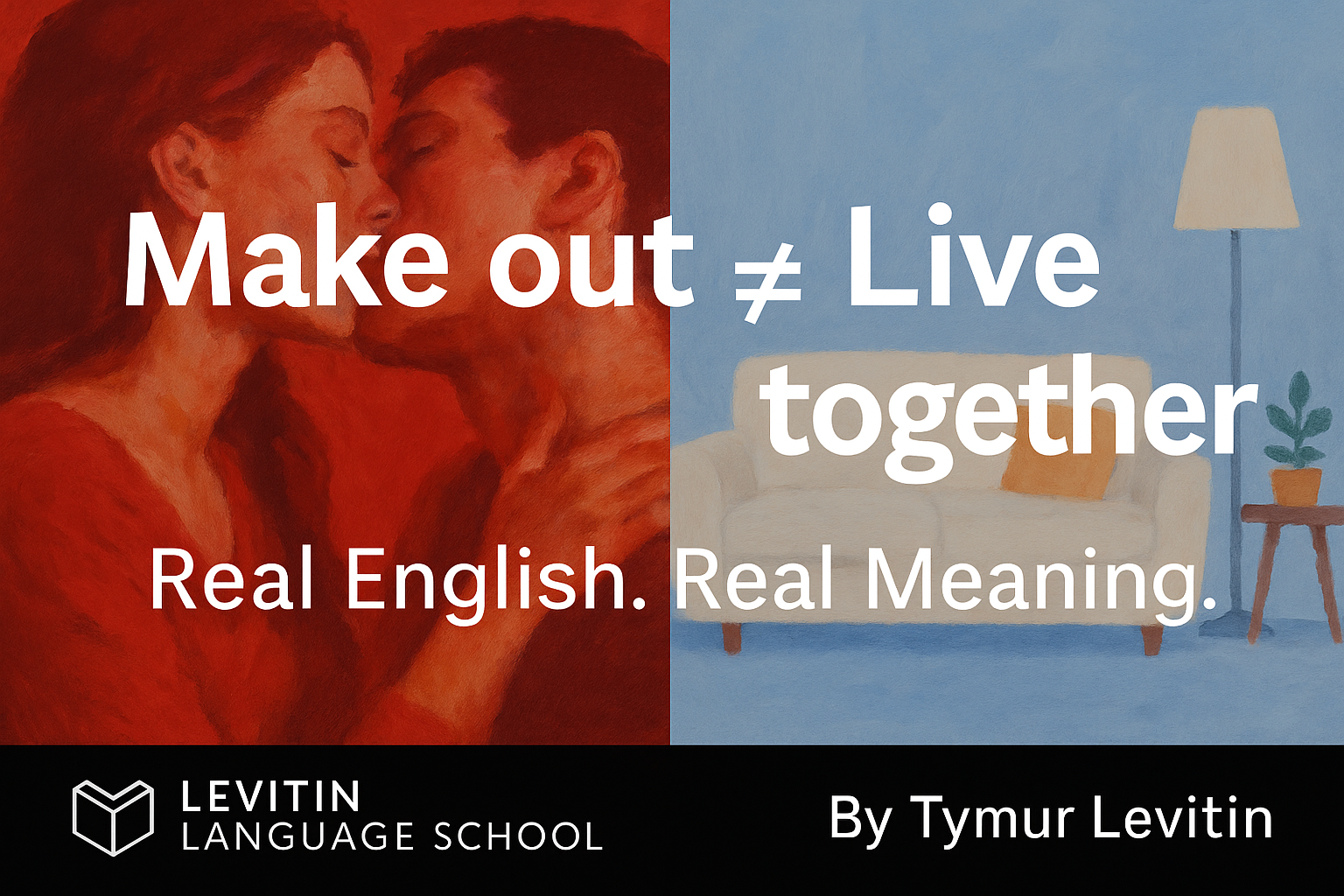
“Make out” means to kiss passionately, to engage in romantic or physical affection.
It does not mean to live together or be in a relationship.
Examples:
- They were making out in the car.
- Teenagers often make out at parties.
Register: Informal
Caution: This is about physical affection — not dating or cohabiting.
Expression Breakdown: Meanings, Style, and Use
1. Make out
Meaning: to kiss passionately / physically engage with someone
Register: Informal
Romantic Relationship? Not necessarily
Living Together? No
2. Hook up
Meaning: to have sex (often casual, uncommitted)
Register: Informal
Romantic Relationship? Usually not
Living Together? No
3. Date / Go out
Meaning: to see someone romantically, go on dates
Register: Neutral
Romantic Relationship? Yes
Living Together? Not necessarily
4. Be in a relationship
Meaning: to be in an ongoing, committed romantic relationship
Register: Neutral
Romantic Relationship? Yes
Living Together? Possibly
5. Live together
Meaning: to share a home, with or without being married
Register: Neutral
Romantic Relationship? Often yes
Living Together? Yes
6. Shack up
Meaning: to live together outside of marriage (informal)
Register: Informal, sometimes disapproving
Romantic Relationship? Yes
Living Together? Yes
7. Sleep with someone
Meaning: to have sex with someone
Register: Neutral
Romantic Relationship? Not necessarily
Living Together? No
8. Have an affair
Meaning: to cheat on a partner (a secret sexual/romantic relationship)
Register: Formal
Romantic Relationship? Yes, but secret
Living Together? No
Translation & Comparison Table
| English | Russian | Ukrainian | German | Spanish |
|---|---|---|---|---|
| make out | страстно целоваться | пристрасно цілуватися | knutschen / rummachen | besarse apasionadamente |
| hook up | переспать (разг.) | переспати (розм.) | abschleppen / Sex haben | acostarse / liarse (coloquial) |
| date / go out | встречаться, ходить на свидания | зустрічатися, ходити на побачення | sich treffen / daten | salir con alguien |
| be in a relationship | быть в отношениях | бути у стосунках | in einer Beziehung sein | estar en una relación |
| live together | жить вместе | жити разом | zusammenleben | vivir juntos |
| shack up | сожительствовать (разг.) | жити в гріху (розм.) | zusammenziehen (umgang.) | irse a vivir juntos (informal) |
| sleep with someone | переспать с кем-то | переспати з кимось | mit jemandem schlafen | acostarse con alguien |
| have an affair | иметь роман / интрижку | мати інтрижку | eine Affäre haben | tener una aventura |
Real English, Real Context
Let’s look at authentic examples from modern media:
- TV show: “Did you hear? She hooked up with her ex last night.”
(This means they had sex — not that they’re dating again.) - Novel: “They’d been making out behind the bleachers before anyone noticed.”
(Just kissing, not necessarily in a relationship.) - Podcast: “We’ve been living together for a year, but we’re not married.”
These real-life uses show the clear separation of physical intimacy, romantic commitment, and cohabitation in English.
Cultural Awareness: Don’t Assume One Word Fits All
In Russian, you might hear:
- “Они вместе” — which could mean living together, dating, or even being married.
- “Живут вместе” — which may not sound intimate without further context.
In Ukrainian, phrases like:
- “Вони разом” — may simply mean being a couple or being seen together.
- “Живуть разом” — usually implies cohabitation but not necessarily romance.
In English, precision matters. Words are not interchangeable. That’s why we teach not just vocabulary — but meaning in context.
Final Thoughts from Tymur Levitin
When students confuse “make out” with “live together,” it’s not just a vocabulary issue. It’s about understanding how English encodes relationships through language.
As teachers, we help our students not only speak — but speak clearly, respectfully, and meaningfully.
At Levitin Language School, we focus on real-life usage, nuance, and cultural sensitivity. Because language isn’t just words — it’s how we connect.
Read more about the author: https://levitintymur.com/teachers/tymur-levitin/
Read more articles in our Author’s Column:
https://levitintymur.com/blog/
Choose your language:
https://levitintymur.com/#languages
Visit our US website:
https://languagelearnings.com
© Tymur Levitin — Founder, Director, Senior Teacher and Translator
Levitin Language School / Start Language School by Tymur Levitin
🗂️ Author’s Column — Real English, Real Meaning


