
Before we begin, feel free to choose the language you’re currently learning:
👉 Choose your language
One Word, Multiple Realities
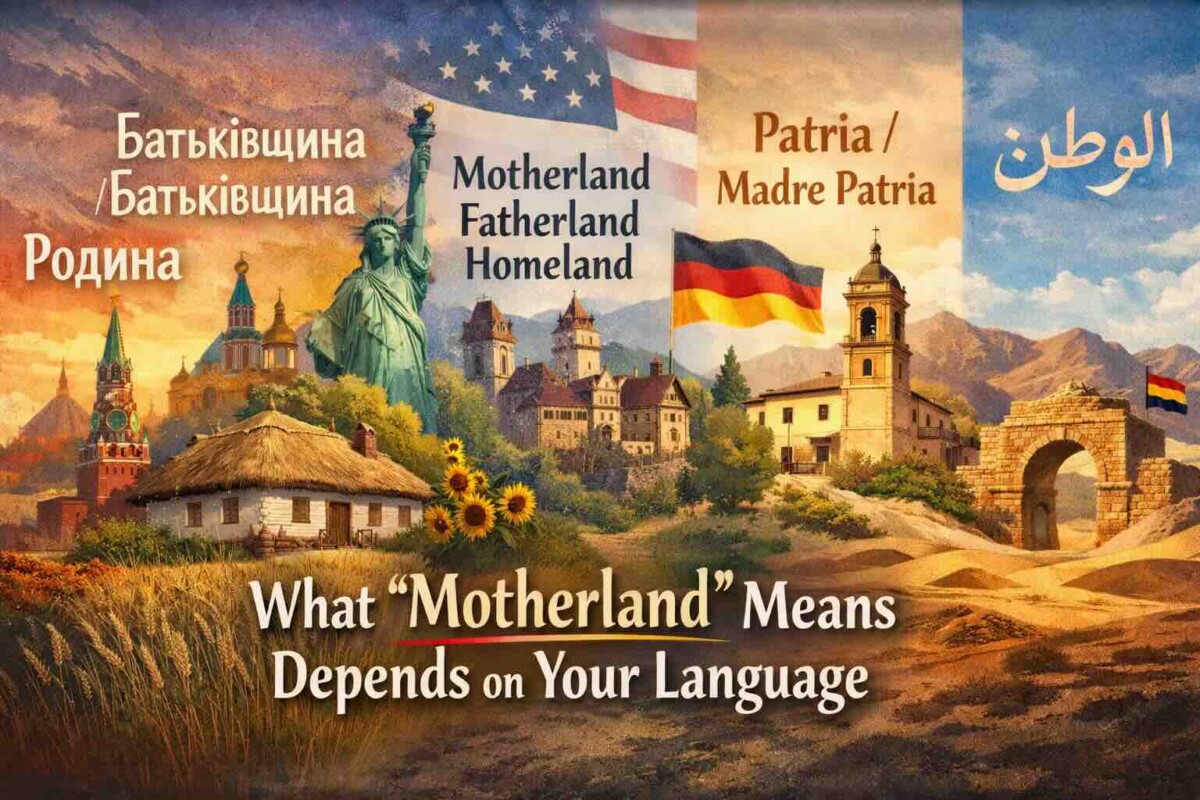
In Russian, the word Родина means more than just the place of birth — it’s the land, the people, the soil, the bloodline. It’s where you come from, even if you no longer live there.
In Ukrainian, we encounter an important nuance. The same spelling — батьківщина — splits into two different meanings, depending on the speaker and the context:
- БатьківщИна — homeland, country of origin.
- БАтьківщина — the legacy or inheritance from your parents; your family land, what was passed down.
This duality is not always codified in dictionaries, but it’s alive in speech — especially in villages, among older generations, or in deeply rooted families. People say:
“Це моя батьківщина — тут хата батькова, земля діда.”
Meaning not “my country,” but “this is my father’s house and land — it is mine through memory.”
Russian: Родина and Отчизна
In Russian, Родина is the most common word for homeland. But there’s also Отчизна — a loftier, more poetic word. Literally, it connects to “отец” (father), just as Батьківщина comes from “батьки” in Ukrainian.
While Родина is used in daily life, Отчизна often appears in literature, songs, and patriotic speech. The emotional weight is different — Отчизна evokes sacrifice, duty, lineage.
English: Homeland, Motherland, Fatherland
English offers several terms:
- Homeland — the most neutral and common. It’s what’s used on passports and in legal terms (homeland security).
- Motherland — more poetic, nostalgic. Less common in everyday speech.
- Fatherland — rare, often historical or ironic. Sometimes associated with German usage.
Each word paints a different picture. You wouldn’t say “I long for my homeland” and “I long for my motherland” in the same emotional register.
German: Vaterland and Heimat
In German, Vaterland is the direct equivalent of “fatherland.” It carries historical weight and patriotic overtones. But there’s another word — Heimat — which can’t truly be translated.
Heimat is not just a place. It’s where you belong. It can be a country, a village, a feeling. It’s the smell of baking bread, the sound of a dialect, the rhythm of familiar streets. Heimat deserves its own article — and it will have one.
Spanish and Arabic: Patria, Madre Patria, الوطن
Spanish speakers use patria, from pater — Latin for father. But in many Latin American countries, Spain is often referred to as la madre patria — the mother country. This duality reflects colonial history and postcolonial identity.
Arabic has الوطن (al-watan), a powerful word meaning homeland — often used with deep emotion, especially in regions marked by exile, migration, or political struggle.
Why This Matters in Language Learning
When teaching languages, we often focus on vocabulary. But words like motherland can’t be “translated” — only understood.
At Levitin Language School, we help students grasp the emotional, cultural, and historical weight of words. Not just what they mean in the dictionary — but what they mean to real people.
When someone says “I miss my homeland”, they don’t mean a dot on the map.
They mean a childhood tree. A familiar voice. A buried root.
✍️ Author: Tymur Levitin
Founder, Director and Head Teacher at Start Language School by Tymur Levitin (Levitin Language School)
© Tymur Levitin