
Levitin Language School | Career and Language Skills
🔗 Choose your language
“Silence is one of the great arts of conversation.”
— Marcus Tullius Cicero
The Unspoken Language of Leadership
In business communication, we often talk about what to say — words, grammar, tone, structure.
But few people think about what not to say.
Silence, when used intentionally, is not absence. It is presence — a sign of confidence, control, and awareness.
In the wrong hands, it can feel cold or dismissive.
But in the hands of a skilled communicator, silence becomes a language of its own.
The Meaning of Silence in Communication
Silence can mean many things — agreement, hesitation, respect, reflection, or even power.
In leadership, it often replaces what words cannot express.
- In negotiations — silence forces the other side to fill the gap.
- In conflict — silence can de-escalate tension.
- In teaching or mentoring — silence gives space for thought.
The key is not to fear silence, but to own it.
It’s the pause that makes your message land.
Cultural Differences in Silence
🇬🇧 British Restraint
Silence in British business culture is polite space — a sign of respect and reflection.
But too long a pause may feel uncomfortable.
The trick is balance: say less, but mean more.
🇺🇸 American Directness
In the U.S., silence is often seen as awkward.
It can imply disagreement or disinterest.
American professionals tend to fill silence quickly — often with reassurance or small talk.
In cross-cultural meetings, this creates tension:
a European partner waits thoughtfully, while an American jumps to fill the gap.
🇩🇪 German Precision
In Germany, silence is analytical.
A pause means: I am thinking carefully about what you said.
It signals seriousness and professionalism — not distance.
A German manager’s short silence after a proposal often means deep consideration, not rejection.
🇺🇦 Ukrainian Communication
In Ukrainian professional culture, silence can express humility or respect.
Sometimes it’s used to avoid confrontation or to give weight to one’s words.
However, in international settings, this pause can be misread as hesitation.
Example:
- Silence after “We’ll think about your offer” in Ukrainian context = genuine reflection.
- In English context = uncertainty or lack of decision.
🇷🇺 Russian Communication
Silence in Russian-speaking business environments often signals emotional weight — not avoidance.
It can mean agreement, tension, or a moment of thought.
The silence itself becomes part of the negotiation, adding gravity to the situation.
In English, this direct emotional pause can feel too heavy or dramatic, but in Russian culture it’s often seen as honest and real.
Professional Silence vs. Avoidance
Silence has power — but it must be conscious.
If you go silent because you’re avoiding conflict or responsibility, it turns into weakness.
If you pause to listen, to think, to respect — it becomes strength.
The difference lies in intention.
Practical Situations Where Silence Works
- Negotiations
- Say your offer — then stop talking.
Let the silence do the work.
- Say your offer — then stop talking.
- Feedback Conversations
- After you ask a question — pause.
The real answer comes after the first silence.
- After you ask a question — pause.
- Conflict Resolution
- When emotions rise, silence restores balance.
You control the temperature by not reacting.
- When emotions rise, silence restores balance.
- Teaching, Coaching, Leading
- Silence gives your team or student time to think — and to take ownership of their ideas.
Final Words: Listen to the Pause
Language is not only what you say.
It’s also the space you create for others to think, respond, or breathe.
In business — and in life — silence is not emptiness.
It’s the quiet confidence of those who don’t need to fill every moment with noise.
Learn to listen to the pause.
That’s where understanding begins.
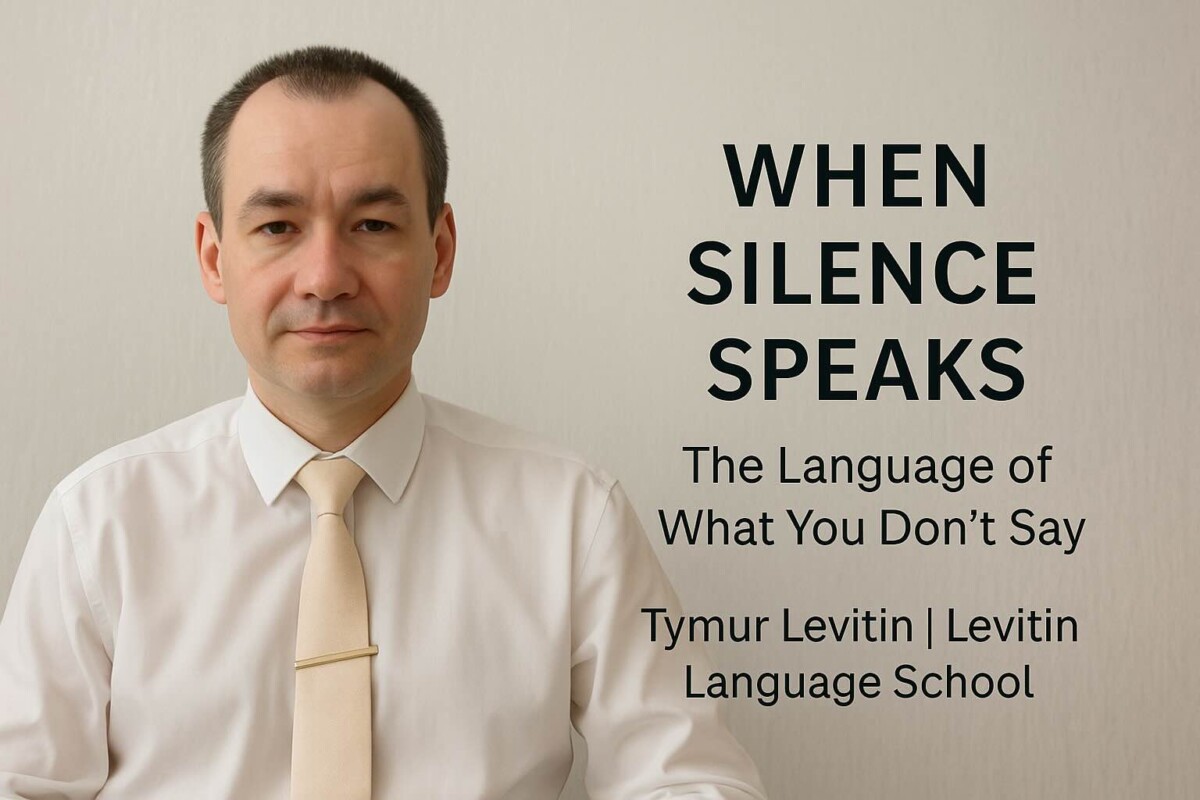
✍️ Author: Tymur Levitin
Founder, director, and senior teacher at Levitin Language School
Start Language School by Tymur Levitin
© Tymur Levitin. All rights reserved.
Author’s development by Tymur Levitin — founder, director, and senior teacher of Levitin Language School.

🔗 Recommended Articles
- The Power of the First Sentence: Why Most Business Letters Lose the Reader in Line One
- We Regret to Inform You: Saying No in Business English Without Burning Bridges
- The Tone Problem: How International Business Goes Wrong Over One Sentence
- Formal, Polite, Useless: Why Business Emails Fail — and How to Write Them Right
🔗 Choose Your Language
Looking to improve your skills in a specific language? Explore our dedicated pages:


