
🗂️ Category: Online Language Learning
🗣️ Introduction
Textbooks give you “proper English.” But in the real world you meet two living languages: American English and British English.
In the US, you’ll hear gonna, wanna, lemme. In the UK, it’s innit, wotcha, gissa.
If you want to understand movies, music, and everyday people, you need both.
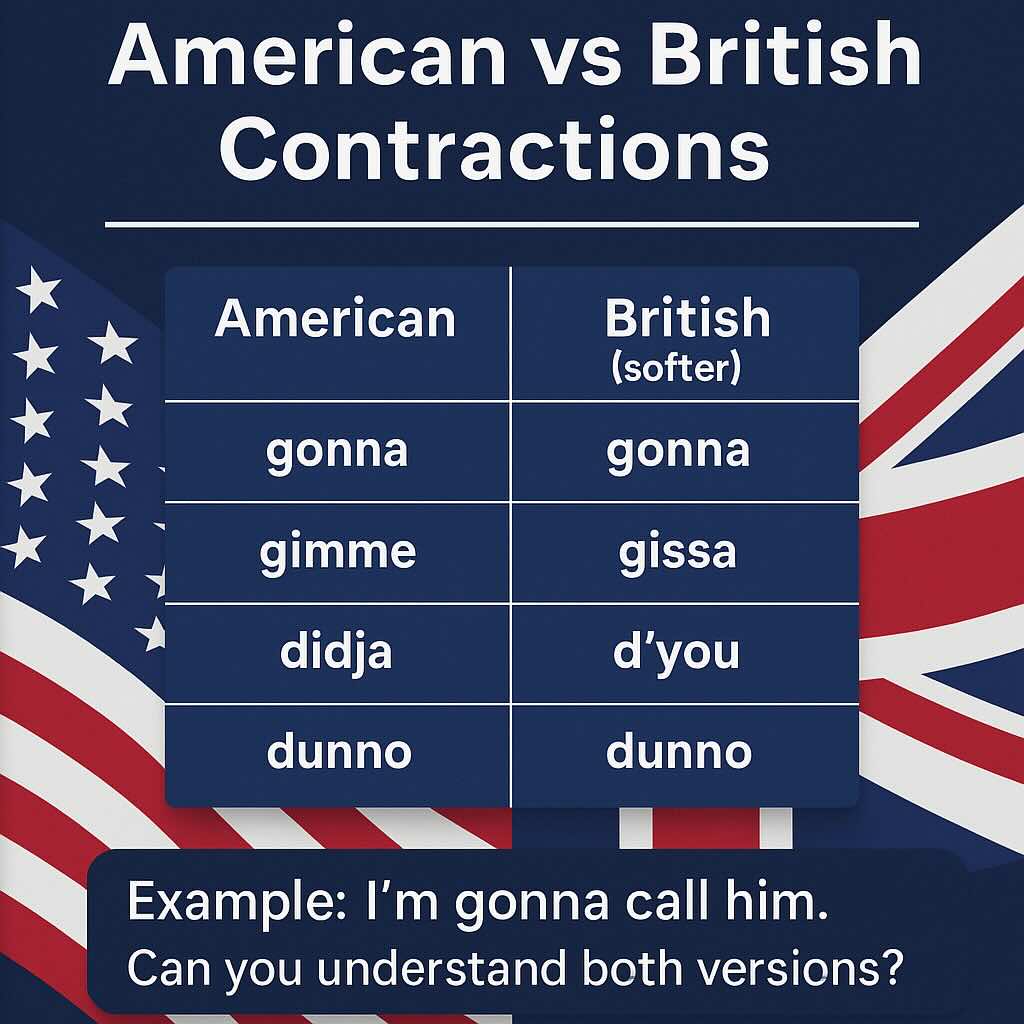
🔑 Comparison Table: US vs UK
| Meaning | American form | British form | Example |
|---|---|---|---|
| going to | gonna | gonna (softer) | US: I’m gonna call him. / UK: I’m gonna ring him. |
| want to | wanna | wanna (softer) | Do you wanna eat? (both) |
| let me | lemme | lemme | Lemme check. (both) |
| give me / give us | gimme | gissa (= give me) | US: Gimme a break. / UK: Gissa job. |
| did you / do you | didja | d’you / didja | US: Didja see it? / UK: D’you like it? |
| isn’t it | — | innit | UK only: Nice day, innit? |
| I don’t know | dunno | dunno | US: I dunno. / UK: Dunno, mate. |
| have to | hafta | hafta (less common) | US: I hafta leave. / UK: I hafta go. |
| supposed to | sposta | sposta (less common) | You’re sposta be here. (both) |
| aren’t you | — | ain’tcha | UK: You’re coming, ain’tcha? |
🟢 Gonna
- US: strong, universal in spoken English.
- UK: exists, but often softer [gənə].
- Trap: learners think it’s “American only.”
- What to do: recognize it everywhere, but avoid in formal writing.
🟢 Gimme vs Gissa
- US: Gimme a break! = Give me a break.
- UK: Gissa job! = Give me a job.
- Important: in Cockney, us = me, not “us.”
- Trap: students translate “give us” as plural. Wrong.
- What to do: know the cultural difference. Use gimme, recognize gissa.
🟢 Didja vs D’you
- US: Didja call her?
- UK: D’you like it?
- Trap: Do ya ≠ d’you. Wrong blending.
- What to do: listen carefully: [dɪdʒə] in US, [dʒə] in UK.
🟢 Innit (UK only)
- US: no equivalent.
- UK: universal tag: isn’t it.
- Trap: Brits use it in all tenses (He’s smart, innit?).
- What to do: don’t copy in exams, but learn to recognize it instantly.
🟢 Dunno
- US: I dunno.
- UK: Dunno, mate.
- Trap: tone differs — US more neutral, UK more colloquial.
- What to do: safe in casual talk, avoid in writing.
🟢 Hafta / Sposta
- US: common in speech.
- UK: appear, but less frequent.
- Trap: learners may think they don’t exist in the UK. They do, just softer.
- What to do: expect them in both accents.
🧬 X-ray of a Phrase
Do you want to go?
➡️ US: Do you wanna go? → Wanna go?
➡️ UK: D’you wanna go? → Wanna go?
Isn’t it nice?
➡️ US: Isn’t it nice? (rarely shortened).
➡️ UK: Innit nice? → Nice, innit?
📺 US vs UK in Pop Culture
- US examples:
- Friends — “I’m gonna tell you something.”
- How I Met Your Mother — “Didja call her?”
- UK examples:
- Sherlock — “D’you think so?”
- EastEnders — “Nice, innit?”
- Boys from the Blackstuff — “Gissa job!”
👔 Street vs Exam: Two Dress Codes
- US street speech: gonna, wanna, lemme
- UK street speech: innit, wotcha, gissa
- Exams/business: always use full forms — going to, want to, isn’t it, give me
🎭 Classroom Story
A student once asked:
“Teacher, I heard ‘gissa job’ in a British movie. Why ‘us’?”
Answer:
“In Cockney, us = me. Don’t translate literally. Just hear it as give me.”
Lesson: culture changes language — and you need both codes.
📝 Conclusion
US and UK contractions are not “wrong.” They are shortcuts of real speech.
- Learn them to survive in movies, songs, and daily talk.
- Use them casually with friends.
- Switch to full forms in exams, business, and writing.
📌 At Levitin Language School / Start Language School by Tymur Levitin, we prepare you for English as it’s really spoken — in New York and in London.
🔗 Related materials
- Why Americans Say “Gonna” Instead of “Going to”
- Why the British Say “Innit” and “Wotcha”
- Tymur Levitin — Teacher & Founder
✍️ Author’s Column
Author’s work by Tymur Levitin — founder, director, and head teacher of Levitin Language School.
© Tymur Levitin


