

🗂️ Category: Online Language Learning
🗣️ Introduction
You studied isn’t it, but suddenly you hear innit. You expect what are you doing?, but someone says wotcha doing?.
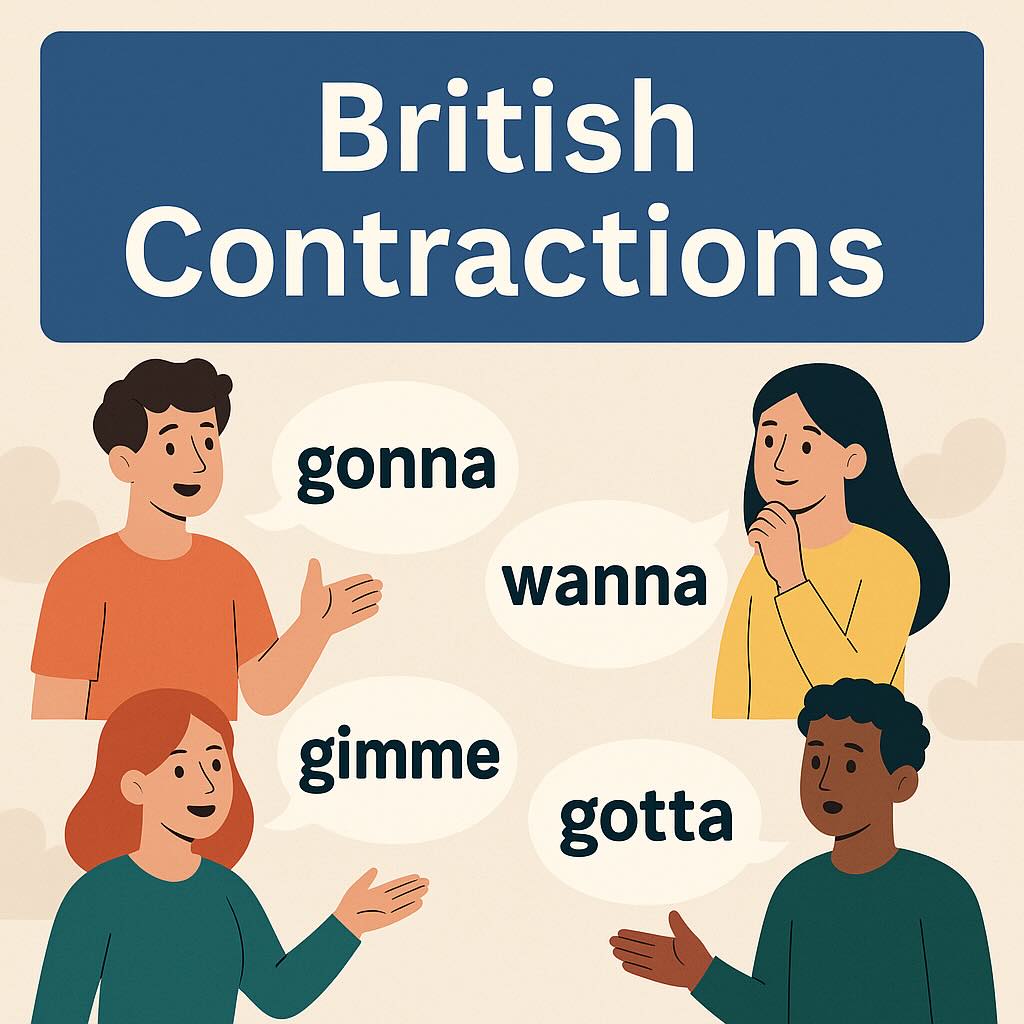
British English is full of contractions and reductions that surprise learners just as much as the American gonna and wanna. But they are different, with their own culture, sound, and rhythm.
Let’s explore the most common British contractions — and when you can (and cannot) use them.
🔑 Common Contractions in British English
| Standard form | Spoken form | Pronunciation | Example |
|---|---|---|---|
| isn’t it | innit | [ˈɪnɪt] | Nice day, innit? |
| what are you | wotcha | [ˈwɒtʃə] | Wotcha doing? |
| do you / did you | d’you / didja | [dʒə], [dɪdʒə] | D’you like it? / Didja see him? |
| aren’t you | ain’tcha | [ˈeɪntʃə] | You’re coming, ain’tcha? |
| let me | lemme | [ˈlɛmi] | Lemme check. |
| give us (me) | gissa | [ˈɡɪsə] | Gissa job. |
| I don’t know | dunno | [dəˈnəʊ] | Dunno, mate. |
| isn’t he | inn’ee | [ˈɪn.i] | Funny bloke, inn’ee? |
🟢 Innit
- Correct: It’s nice, isn’t it?
- Real speech: Nice, innit?
- Student mistake: thinking innit is always correct grammar. ❌ (Brits use innit as a universal tag question, even if it’s “wrong”).
- Trap: He’s smart, innit? → technically wrong, but natural in speech.
- What to do: recognize it as a conversational marker, don’t use it in formal writing.
🟢 Wotcha
- Correct: What are you doing?
- Real speech: Wotcha doin’?
- Student mistake: thinking it’s a completely new word. ❌
- Trap: Wotcha is also used as a greeting: “Wotcha!” = “Hi!”
- What to do: understand both meanings. Use “what are you” in exams.
🟢 D’you / Didja
- Correct: Do you like it?
- Real speech: D’you like it?
- Student mistake: Do ya like it? (wrong blend).
- Trap: Didja sounds similar to American, but usually softer in UK English.
- What to do: listen and recognize, keep “do you” in writing.
🟢 Ain’tcha
- Correct: Aren’t you coming?
- Real speech: You’re coming, ain’tcha?
- Student mistake: thinking ain’t = “bad grammar.” ❌
- Trap: ain’t is old but still alive in everyday UK speech.
- What to do: know it, don’t use it in exams.
🟢 Lemme
- Correct: Let me check.
- Real speech: Lemme check.
- Trap: same as American English — only informal.
- What to do: safe for casual chats, not for formal contexts.
🟢 Gissa
- Correct: Give me a job.
- Real speech: Gissa job.
- Important: here us = “me”, not “us”!
👉 This is not rhyming slang.
Cockney has two traditions:
- Rhyming slang (stairs → apples and pears).
- Contractions (give us a → gissa).
Gissa belongs to the second group. No rhyme — just lazy reduction.
- Student mistake: translating literally as “give us (plural).”
- What to do: always understand it as give me, but don’t use it in exams or business.
🟢 Dunno
- Correct: I don’t know.
- Real speech: Dunno, mate.
- Trap: very British when paired with mate.
- What to do: fine in casual talk, avoid in formal speech.
🟢 Inn’ee
- Correct: He’s funny, isn’t he?
- Real speech: Funny bloke, inn’ee?
- Trap: squeezed together into one sound [ˈɪn.i].
- What to do: recognize it, but keep “isn’t he” in writing.
🧬 X-ray of a Phrase
Isn’t it a bit late?
➡️ Isn’t it a bit late? (textbook)
➡️ Isn’t it late? (natural)
➡️ Innit late? (spoken)
➡️ Late, innit? (real street speech)
🌍 Cross-Language Parallels
- Russian: разве не так → не так?
- Ukrainian: чи не так → не так?
- German: nicht wahr → nich wahr?
💡 All languages reduce agreement markers.
👔 Street vs Exam: Dress Code
- Street: innit, wotcha, gissa
- Exam/Business: isn’t it, what are you, give me
🎭 Classroom Story
One student heard in London:
“Gissa pint, mate!”
He thought it meant “give us (plural).”
In fact, it simply meant: “Give me a pint.”
Lesson: in Cockney, “us” = “me.”
📺 Real-Life Speech
👂 Innit? everywhere — teenagers, taxi drivers, TV.
👂 Wotcha! as a greeting — in old British sitcoms.
👂 Gissa — working-class slang, Liverpool, London.
📝 Conclusion
British contractions are not mistakes, but cultural shortcuts.
- Learn to understand them.
- Use them only in casual speech.
- Switch to full forms in exams, business, or writing.
📌 At Levitin Language School / Start Language School by Tymur Levitin, we teach you not just words, but the real voices of the UK — so you can understand London, Liverpool, or Manchester with confidence.
🔗 Related materials
- Why Americans Say “Gonna” Instead of “Going to”
- Why Students Fail in Listening: It’s Not What You Think
- Tymur Levitin — Teacher & Founder
✍️ Author’s Column
Author’s work by Tymur Levitin — founder, director, and head teacher of Levitin Language School.
© Tymur Levitin


