
(The Tymur Levitin Method in Action, Part 6)
🌍 Choose your language
https://levitintymur.com/#languages
Introduction
One of the most dangerous illusions in language learning is the belief that communication is about translating words.
Students try to:
- translate sentence by sentence,
- search for “the correct equivalent”,
- reproduce phrases exactly as they learned them.
And then they freeze.
Because real communication does not work that way.
People do not exchange words.
They exchange meaning.
The Tymur Levitin Method focuses on this difference — early, clearly, and without compromise.
❌ Why Literal Translation Breaks Communication
Literal translation feels safe.
It creates the illusion of control.
But language is not mathematics.
The same idea:
- is expressed differently across languages,
- uses different structures,
- carries different emotional weight,
- and often cannot be translated word by word at all.
When students rely on literal translation, they:
- lose speed,
- lose confidence,
- lose naturalness,
- and often lose the message itself.
The problem is not the lack of vocabulary.
The problem is the wrong unit of thinking.
🧠 How Native Speakers Actually Speak
Native speakers do not ask themselves:
“Is this sentence correct?”
They ask:
“Did you get what I mean?”
They adjust:
- wording,
- intonation,
- structure,
- even grammar —
until the meaning lands.
They build speech around intention, not rules.
That is why communication works even when the language is imperfect.
🧱 The Tymur Levitin Method — From Words to Meaning
In this method, students are trained to shift focus:
from
❌ “How do I translate this?”
to
✅ “What do I want to say?”
Instead of forcing exact equivalents, students learn to:
- describe,
- simplify,
- restructure,
- and adapt in real time.
This creates flexibility — the core of fluency.
Language stops being a cage and becomes a tool.
🔄 Why Similar Languages Are an Advantage, Not a Problem
Many learners are taught to “separate” languages strictly.
In reality, languages constantly interact in the brain.
Similar structures, shared logic, and overlapping concepts:
- accelerate understanding,
- support improvisation,
- and help in stressful situations.
The Tymur Levitin Method does not fight this process.
It uses it consciously.
If one word is missing — another structure appears.
If one form is forgotten — meaning still survives.
That is real language competence.
🚶 From Correctness to Effectiveness
At first, students want to speak correctly.
Later, they want to be understood.
True progress happens when:
- correctness stops blocking speech,
- meaning takes priority,
- and confidence replaces fear.
Effectiveness always comes before perfection.
And perfection, if it comes, comes later.
🌿 Conclusion — Language Lives in Meaning
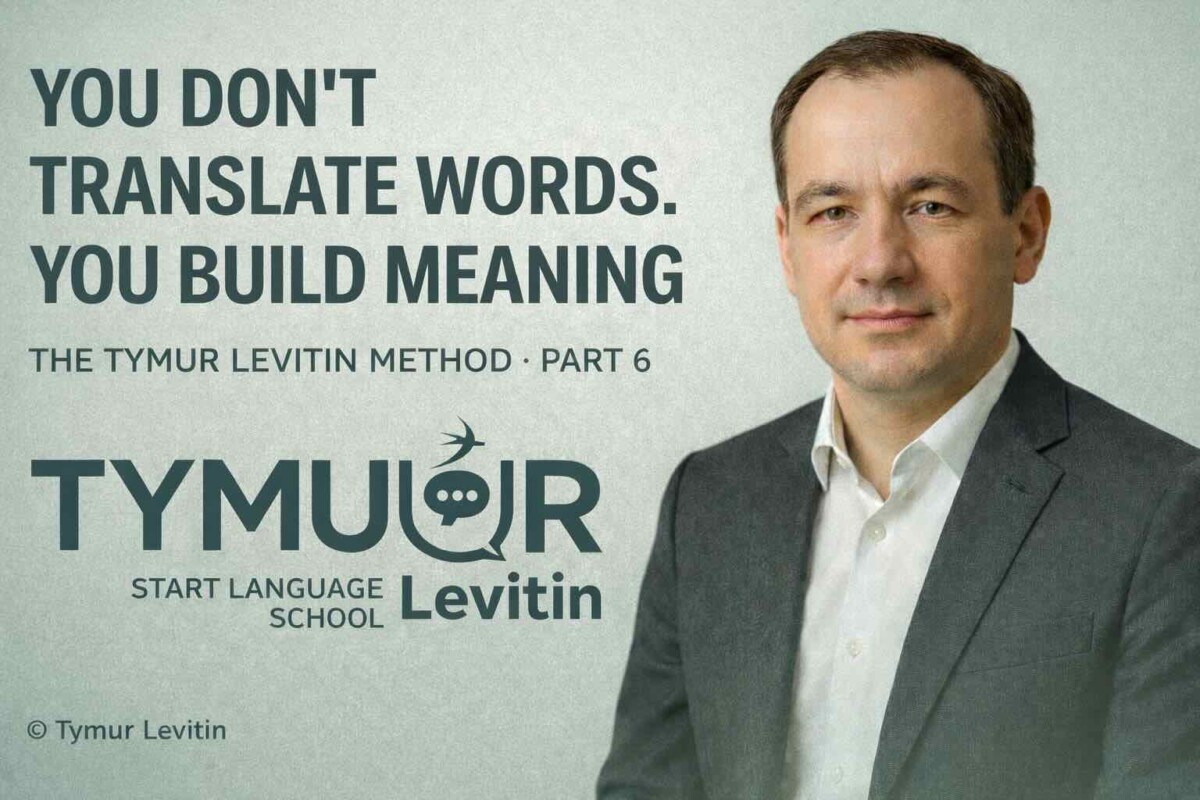
You don’t translate words.
You build meaning.
When learners understand this, language stops being fragile.
They stop breaking every time a word is missing.
They speak.
They adjust.
They communicate.
“Fluency is not knowing the right words.
It is knowing how to get your meaning across.”
— Tymur Levitin
🔗 Read also
- Understanding Before Speaking — The First Step in the Tymur Levitin Method
https://levitintymur.com/authors-column-tymur-levitin-on-language-meaning-and-respect/understanding-before-speaking-the-first-step-in-the-tymur-levitin-method/ - Grammar Is Logic, Not Rules — Thinking Through Structure
https://levitintymur.com/authors-column-tymur-levitin-on-language-meaning-and-respect/grammar-is-logic-not-rules-thinking-through-structure/ - Improvisation Is Freedom — Speaking Without Fear
https://levitintymur.com/online-language-learning/improvisation-is-freedom-speaking-without-fear/ - Mistakes Don’t Block Speech — Fear Does
https://levitintymur.com/online-language-learning/mistakes-dont-block-speech-fear-does/ - Thinking in Another Language Is a Skill — Not a Gift
https://levitintymur.com/online-language-learning/thinking-in-another-language-is-a-skill-not-a-gift/
🪶 Author
© Tymur Levitin — Founder, Director, and Head Teacher
Levitin Language School | Start Language School by Tymur Levitin


