
Before you start:
👉 Choose your language: https://levitintymur.com/#languages
Why Synonyms Are Never Really the Same
Most learners believe that synonyms are interchangeable.
In German, this is one of the biggest traps.
Words may share a dictionary meaning — but they never share:
- emotional weight
- level of formality
- cultural context
- speaker intention
That is why Germans instantly sound natural — and learners often don’t.
This article continues the series on real German usage and meaning:
German Vocabulary in Context — Learn Words You’ll Actually Use
German Words in Real Conversations — Learn How People Actually Speak
German Collocations You Need to Sound Natural
Thinking in German — Stop Translating and Start Speaking Naturally
Meaning vs Feeling: The Core Difference
German is extremely precise when it comes to how something feels, not just what it means.
Compare:
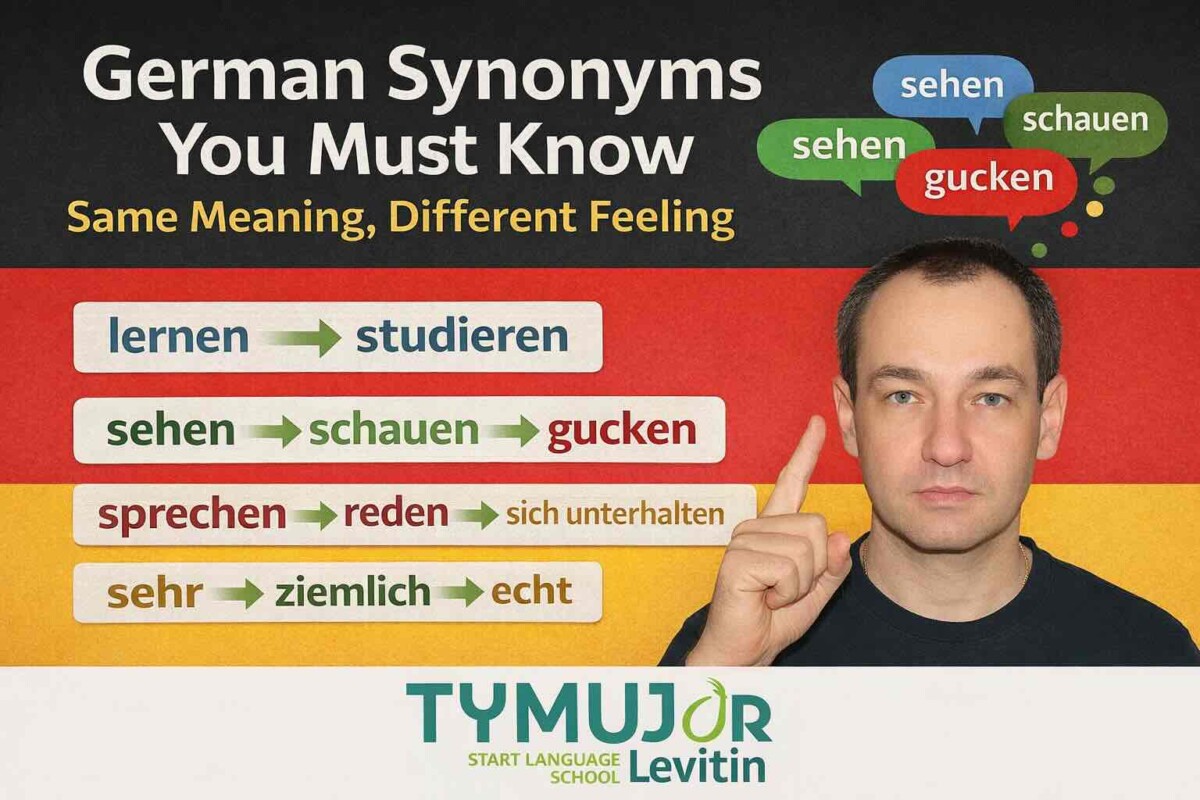
sehen / schauen / gucken
- sehen — neutral, factual perception
- schauen — intentional looking, attention
- gucken — informal, casual, spoken
✔ Ich sehe das.
✔ Schau mal!
✔ Wir gucken später.
Same “meaning”. Completely different tone.
sprechen / reden / sich unterhalten
- sprechen — formal, neutral, controlled
- reden — informal, emotional, spontaneous
- sich unterhalten — balanced, social, friendly
✔ Wir sprechen über das Problem.
✔ Lass uns darüber reden.
✔ Wir haben uns lange unterhalten.
Choosing the wrong one changes how you sound — not grammatically, but socially.
machen / tun
English learners struggle here.
- machen — general creation or action
- tun — abstract, moral, emotional action
✔ Was machst du?
✔ Das tut mir leid.
✔ Tu mir einen Gefallen.
You do a favor — but you make an action.
This is not logic — this is language culture.
sehr / total / ziemlich / echt
All mean “very” — but:
- sehr — neutral, formal
- total — emotional, spoken
- ziemlich — restrained, careful
- echt — expressive, subjective
✔ Das ist sehr wichtig.
✔ Das ist total verrückt.
✔ Das ist ziemlich kompliziert.
✔ Das ist echt gut.
Synonyms show personality.
Why Germans Hear What Learners Don’t
Native speakers instantly feel:
- if you sound distant or warm
- formal or relaxed
- confident or insecure
- natural or translated
That feeling comes from word choice, not grammar.
This is why thinking in German matters more than knowing German.
To develop this sensitivity in practice:
https://levitintymur.com/teachers/tymur-levitin/
How to Learn Synonyms the Right Way
Forget lists.
Instead:
- Learn synonyms in contrast, not isolation.
- Attach each word to a situation, not a translation.
- Notice who would say it — and when.
- Revisit the word in real conversation.
This is how meaning turns into intuition.
To build this skill systematically:
https://levitintymur.com/languages/learning-german/
German Is a Language of Choice
Fluency is not about knowing words.
It is about choosing the right word.
That choice is what makes speech sound:
- natural
- confident
- adult
- human

Explore More German Learning Articles
German Vocabulary in Context — Learn Words You’ll Actually Use
German Words in Real Conversations — Learn How People Actually Speak
How to Learn German Words That Stick — Logic, Emotion, and Repetition
German Collocations You Need to Sound Natural
Thinking in German — Stop Translating and Start Speaking Naturally
Author’s Note
Author’s development by Tymur Levitin — founder, director and senior teacher of Levitin Language School / Start Language School by Tymur Levitin.
22+ years of teaching German, English and Ukrainian to students from more than 20 countries.
Global Learning. Personal Approach.
Official websites:
https://levitintymur.com
https://languagelearnings.com
© Tymur Levitin


