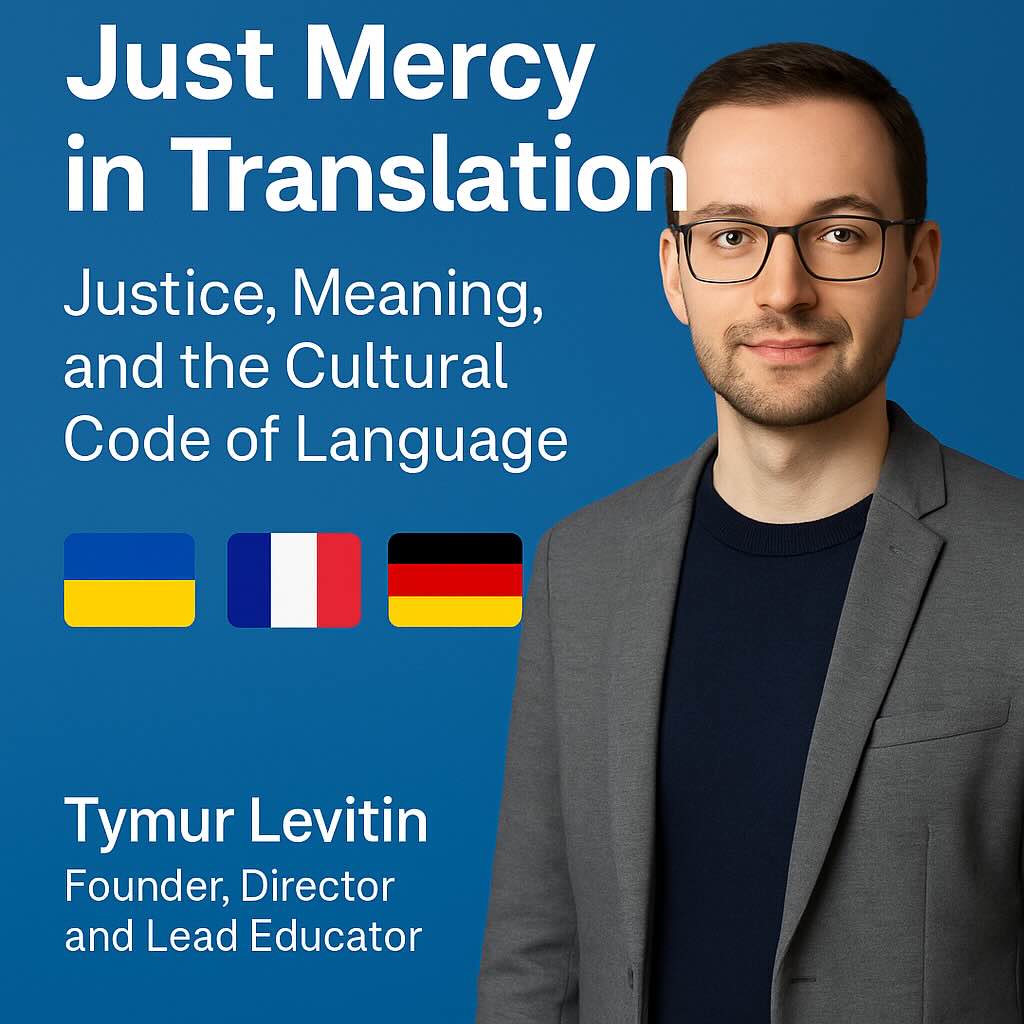

By Tymur Levitin — founder, director, and lead educator at Levitin Language School
🔗 Choose your language
👤 Teacher Profile – Tymur Levitin
He was sentenced to die for a crime he didn’t commit. The courtroom was silent. A young lawyer stood beside him, fighting not just for one man’s life — but for the meaning of justice itself.
The title of the film? Just Mercy.
But what does that phrase even mean? And why does it sound so different in every language it was translated into?
What Does “Just Mercy” Actually Mean?
The title is deceptively simple. In English, “just” means both:
- Only (“just this thing”), and
- Fair (“a just decision”).
So the phrase “Just Mercy” may mean:
- Only mercy
- Fair mercy
- Justice through mercy
- A plea: “Please, just give mercy”
This ambiguity is not accidental. It reflects the central conflict of the film: a man wrongly sentenced to death, and a lawyer confronting an unjust legal system. The title carries a full ethical weight in just two words.
But how do you carry that weight across languages — and across cultures?
How the Title Was Translated Around the World
| Language | Title | Justice Element | Mercy Element | Strategy |
|---|---|---|---|---|
| Ukrainian | Судити по совісті | ✅ Yes | ✅ Yes | Meaning-based |
| Russian | Просто помиловать | ❌ No | ✅ Yes | Emotional/literal |
| French | La Voie de la justice | ✅ Yes | ❌ No | Justice-focused |
| German | Just Mercy | ✅ Implicit | ✅ Implicit | Title retained |
| Italian | Just Mercy | ✅ Implicit | ✅ Implicit | Title retained |
| Polish | Just Mercy | ✅ Implicit | ✅ Implicit | Title retained |
Every Translation Is a Decision
Translating Just Mercy isn’t about replacing words. It’s about choosing what matters more in the culture you’re translating for.
- The Ukrainian version, Судити по совісті (“To judge by conscience”), highlights moral and ethical justice. It doesn’t mention mercy explicitly — but it is mercy. The kind that comes from human dignity.
- The Russian version, Просто помиловать (“Just forgive”), focuses on the emotional act of clemency. There’s no justice in the title. Just the hope for reprieve.
- The French version, La Voie de la justice (“The path of justice”), omits mercy completely. It leads with law, not forgiveness.
- Some countries — Germany, Italy, Poland — simply kept the English Just Mercy. Perhaps out of respect for the ambiguity. Or perhaps because no local words could hold both meanings at once.
As a translator and language teacher, I’ve learned this: a good translation tells the truth. A great one tells two truths at once.
Language Reflects Culture
This case shows how language is not just vocabulary. It’s values.
- In some languages, justice is legalistic. In others — moral or spiritual.
- Mercy may sound noble. Or weak. Or religious. Or rare.
Translation always reveals what a culture prioritizes — and what it hides.
If your language doesn’t have a word for something… do your people still feel it? Or do they just stop talking about it?
A Thought Experiment for Learners
If you had to translate “Just Mercy” into your own language, what would you write?
Would you focus on justice? On mercy? On conscience? Would you try to keep both? Would you give up and leave it in English?
This is not just about film titles. It’s about how we think in language, and how we teach others to do the same.
Classroom activity suggestion:
Ask your students to translate “Just Mercy” into their native language — and justify their choice. Then compare it to the official title in their country. What changed? What stayed?
Why “Судити по совісті” May Be the Best Translation
Of all the translations, the Ukrainian title might be the most faithful to the spirit of the film.
- It balances justice and mercy without naming either directly.
- It sounds natural and culturally rooted.
- It resonates with the film’s central ethical question: not whether a man committed a crime, but whether a system can afford to ignore its own conscience.
It doesn’t translate the words. It translates the meaning.
Final Thoughts
Translating Just Mercy is not about accuracy. It’s about focus. Every version is a mirror — not of the film, but of the society watching it.
So the next time you watch a movie, pause at the title.
Ask yourself: Is that what the story is really called?
And then ask: What would I have named it — in my own language?
Because that’s where real language learning begins.

Related reading:
- Understanding Realia in Translation: Cultural Nuances Across Languages
- Translating Literary Identity: A Cross-Language Study of Salinger and Remarque
- Real Language Is Never Literal
© Tymur Levitin
Levitin Language School / Start Language School by Tymur Levitin
Global Learning. Personal Approach.


