
🗂️ Category: Online Language Learning
🗣️ Introduction
You studied going to, but suddenly you hear gonna. You know the word, but in real speech it transforms into something completely different.
This is normal: in spoken American English, words are reduced (or “swallowed”) because language follows muscle movement and ease of pronunciation, not textbook spelling.
Let’s explore the most common American contractions — and when you can (and cannot) use them.
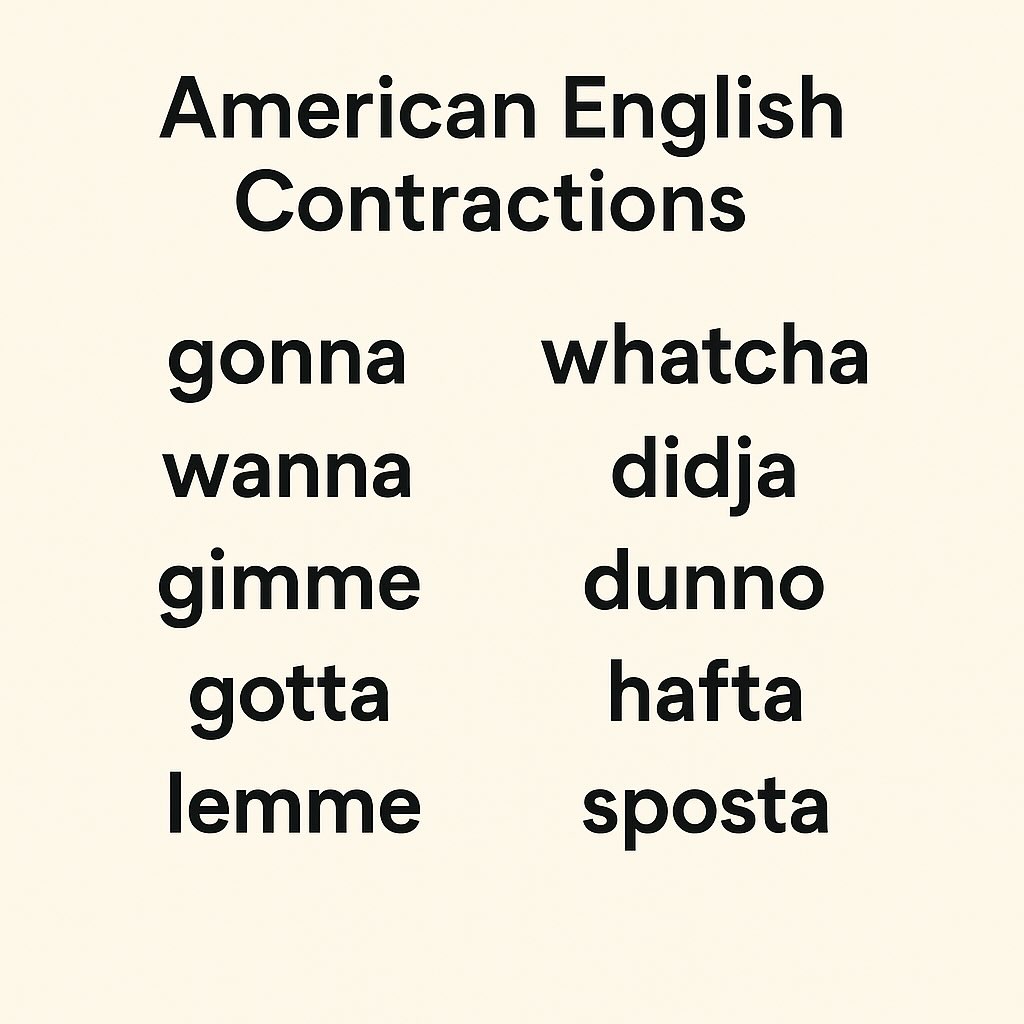
🔑 Common Contractions in American English
| Standard form | Spoken form | Pronunciation | Example |
|---|---|---|---|
| going to | gonna | [ˈgənə] | I’m gonna call her. |
| want to | wanna | [ˈwɑːnə] | Do you wanna eat? |
| give me | gimme | [ˈɡɪmi] | Gimme a second. |
| got to | gotta | [ˈɡɑːɾə] | I gotta go now. |
| let me | lemme | [ˈlɛmi] | Lemme see that. |
| what do you | whatcha | [ˈwɒʧə] | Whatcha doing? |
| did you | didja | [ˈdɪdʒə] | Didja see it? |
| don’t know | dunno | [dəˈnoʊ] | I dunno what to say. |
| have to | hafta | [ˈhæftə] | I hafta leave. |
| supposed to | sposta | [ˈspoʊstə] | You’re sposta be here. |
🟢 Gonna
- Correct: I’m gonna call her.
- Real speech: Gonna call her (without I’m).
- Student mistake: I gonna call her. ❌
- Trap: dropping am/is/are.
- What to do: Always keep I’m / he’s / we’re when speaking. Recognize the “bare” gonna but don’t copy it on exams.
🟢 Wanna
- Correct: Do you wanna eat?
- Real speech: Wanna eat? (no Do you).
- Student mistake: I wanna to go. ❌
- Trap: adding an extra to.
- What to do: Use wanna + verb. Remember: never “wanna to.”
🟢 Gimme
- Correct: Gimme a second.
- Real speech: ’Emme a sec (extra swallowed).
- Student mistake: Give me please a second. ❌ (wrong word order).
- Trap: thinking gimme = rude. It’s casual, not impolite (tone matters).
- What to do: Use gimme only with friends; in formal settings, say Could you give me….
🟢 Gotta
- Correct: I gotta go.
- Alternative: I’ve gotta go. (closer to grammar).
- Real speech: Gotta go! (without I).
- Student mistakes:
- I’gotta go ❌ (apostrophe never used here).
- I gotta to go ❌ (double to).
- Trap: confusing gotta with got a.
- What to do: For exams — I have to go. For casual talk — I gotta go.
🟢 Lemme
- Correct: Lemme see that.
- Real speech: ’Emme see (slurred).
- Student mistake: Let me to see it. ❌
- Trap: lemme doesn’t mean “let me allow” — only “let me do something.”
- What to do: Recognize both forms, but write let me in essays.
🟢 Whatcha
- Correct: Whatcha doing? = What are you doing?
- Real speech: Whatcha gonna do? (double reduction).
- Student mistake: thinking whatcha = new word.
- Trap: to be is still there, just hidden: what are you → whatcha.
- What to do: Train your ear to catch it; don’t write it.
🟢 Didja
- Correct: Didja see it? = Did you see it?
- Real speech: D’ja see it?
- Student mistake: Did you saw it? ❌
- Trap: did always takes the infinitive (see, not saw).
- What to do: Listen for -ja, but speak/write did you.
🟢 Dunno
- Correct: I dunno what to say.
- Real speech: Dunno (alone, without I).
- Student mistake: I no know. ❌
- Trap: Sounds childish if overused in serious talk.
- What to do: Use I don’t know in formal situations, dunno with friends.
🟢 Hafta
- Correct: I hafta leave. = I have to leave.
- Real speech: Hafta go.
- Student mistake: I have leave. ❌
- Trap: mixing have to with have got to.
- What to do: In writing — have to. In speech — hafta is natural.
🟢 Sposta
- Correct: You’re sposta be here. = You are supposed to be here.
- Real speech: Sposta be here.
- Student mistake: Suppose to (without d). ❌
- Trap: learners often forget the -d.
- What to do: Understand sposta = supposed to. In writing — always include the d.
🧬 X-ray of a Phrase
What are you going to do tomorrow?
➡️ What are you going to do tomorrow? (textbook)
➡️ What’re you going to do tomorrow? (natural)
➡️ What are you gonna do tomorrow? (first reduction)
➡️ Whatcha gonna do tomorrow? (real speech)
💡 This shows both the grammar skeleton and the phonetic muscles.
🌍 Cross-Language Parallels
- Russian: сейчас → щас, что ты → чё ты
- Ukrainian: зараз → зась, будеш → будеш’
- German: haben wir → hamma, ich habe es → ich hab’s
💡 All languages reduce in real speech. English isn’t unique!
👔 Street vs Exam: Language Dress Code
- Street: jeans & T-shirt → gonna, wanna, lemme
- Exam/Business: suit & tie → going to, want to, let me
💡 Both are correct. The key is knowing where to wear them.
🎭 Classroom Story
A student once said:
❌ I gonna call her.
I answered:
✅ I’m gonna call her.
👉 The issue wasn’t gonna — it was forgetting am.
Lesson learned: slang doesn’t cancel grammar.
📺 Real-Life Speech
👂 What you may hear:
- I’ve gotta go. → [aiv ɡɒɾə goʊ]
- I gotta go. → [a ɡɒɾə goʊ]
- Gotta go! → [ɡɒɾə goʊ] (no subject)
💡 Films, songs, daily life: all three are normal.
📝 Conclusion
Contractions like gonna or wanna are not mistakes. They are natural shortcuts of real speech.
- Train your ear to catch them.
- Use them casually with friends.
- Switch to full forms in exams, business, or academic writing.
📌 At Levitin Language School / Start Language School by Tymur Levitin, we don’t just give you vocabulary — we show you the X-ray of language, so you can hear, feel, and use English like natives do.
🔗 Related materials
- Why Students Fail in Listening: It’s Not What You Think
- Myth: The More You Memorize, the Better You Get
- Tymur Levitin — Teacher & Founder
✍️ Author’s Column
Author’s work by Tymur Levitin — founder, director, and head teacher of Levitin Language School.
© Tymur Levitin


