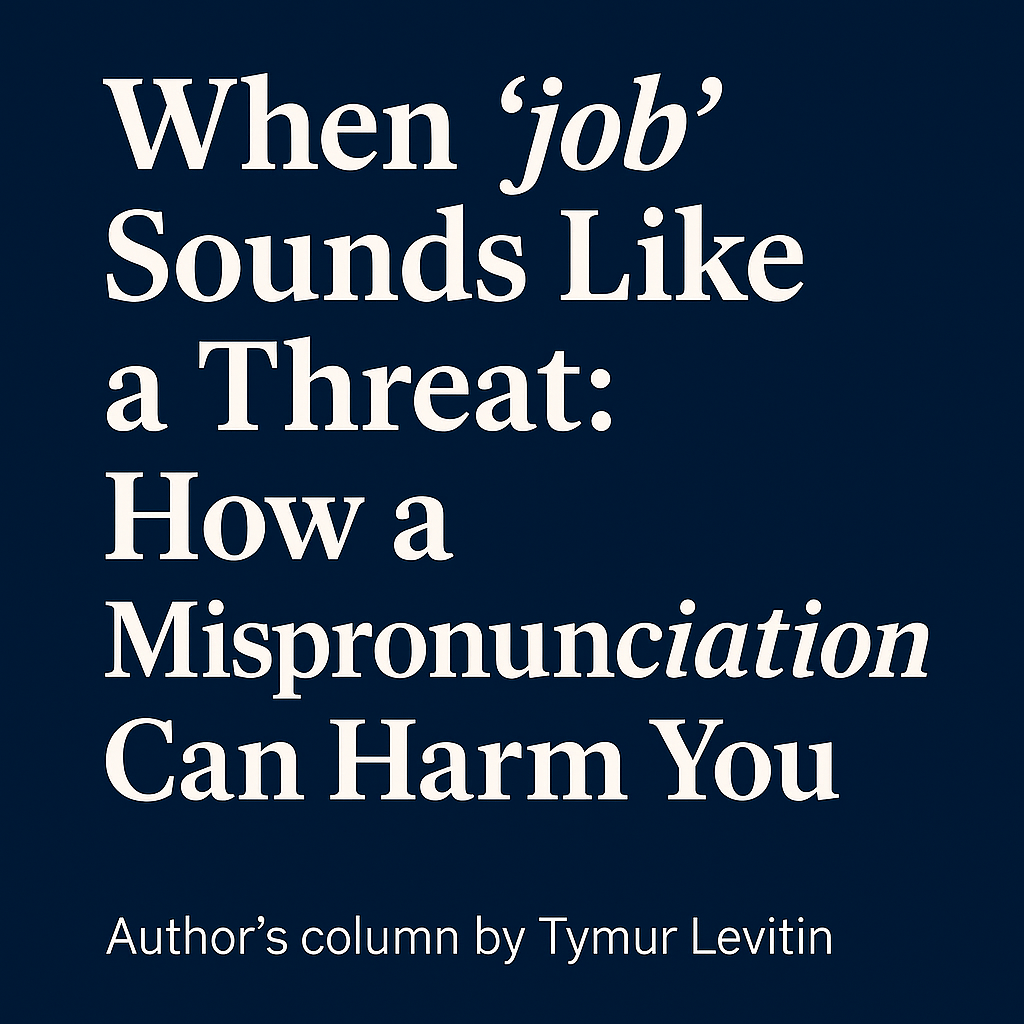
🔞 For adult readers only
This article is intended for students, teachers, and parents aged 18 and over. It addresses real cross-cultural risks related to pronunciation errors, without using obscene language.
Its purpose is purely educational and preventive.
🎯 Pronunciation Isn’t Just a Sound
When learning a language, we often focus on grammar, vocabulary, or stylistics. But pronunciation is more than just technique. Sometimes, one mispronounced word can change the entire meaning — or even trigger serious misunderstanding, conflict, or danger.
⚠️ A Real Case from My Teaching Practice
In my work with international students, I’ve encountered the same situation more than once: someone pronounces the word job in a way that sounds like yob, believing it’s acceptable or even correct.
Usually, students have heard it somewhere and just repeat it — unaware that in several Slavic languages, this pronunciation closely resembles an extremely vulgar and aggressive word referring to sexual violence.
That’s why I believe it’s essential to warn students clearly. A pronunciation mistake like this can lead to much more than embarrassment — it can put someone at risk.
🗣️ [dʒɔb] ≠ [yob]
In German, the word “Job” (borrowed from English) is pronounced [dʒɔp].
But when mispronounced as [yob], [ʝop], or [йоб], it may be misinterpreted in Slavic countries as an obscene and aggressive sexual term.
This is especially risky for:
- female learners repeating what they hear without knowing the context;
- students living or working in Slavic-speaking environments;
- anyone unaware of the cross-linguistic implications of such phonetic overlaps.
🧭 The Ethics of Teaching: Stay Silent or Speak Up?
Every teacher faces a choice:
- Smooth it over,
- Say nothing,
- Or take responsibility and speak clearly.
I choose the latter. Because:
- No one else will say it;
- The consequences can be serious;
- And sometimes, one honest sentence is all it takes to protect someone.
👦 What About Children?
If the student is underage, the explanation must be softer — but still effective. For example:
“If you pronounce this word incorrectly, it can sound like something bad or inappropriate in other countries. That’s why we say it the right way — to sound respectful and be understood clearly.”
The goal is to protect, not to scare.
🧱 Bottom Line
- A pronunciation mistake isn’t always harmless.
- In some cases, it can lead to misunderstandings, disrespect — or worse.
- And if we, as educators, know the risks, then we must say so.
At our school, we don’t believe in silence when real-life safety is at stake.

📎 Related reading from our blog
→ Why We Don’t Promise You’ll Speak in 30 Days
→ The Language Barrier Is Not About Language
→ Land vs Staat — why one “country” isn’t always the same
Choose your language
English version |
Русская версия |
Українська версія |
Deutsche Version
🟦 Author’s Column
Tymur Levitin on Language, Meaning and Respect
📍 Founder, teacher, and translator at Levitin Language School — Start Language School by Tymur Levitin
© Tymur Levitin
🔗 Choose your language


