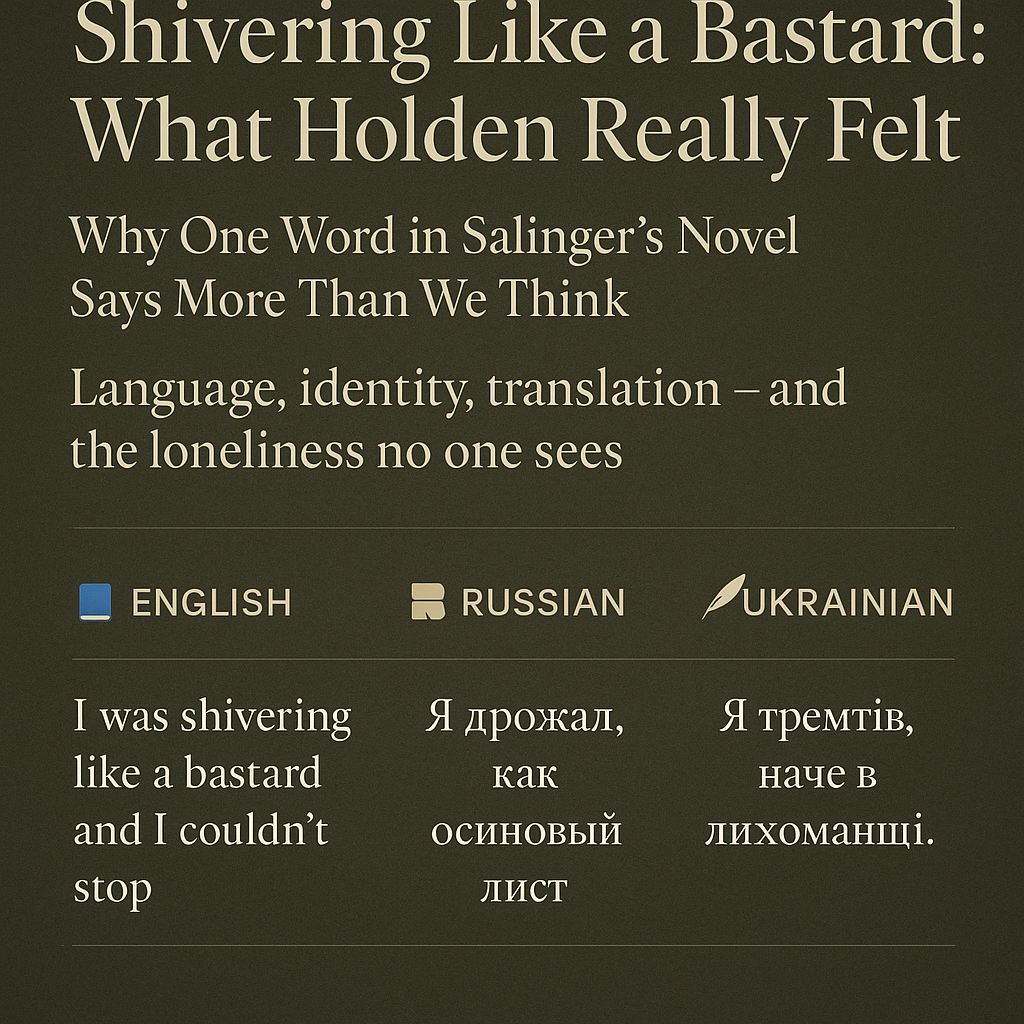

Why One Word in Salinger’s Novel Says More Than We Think
Language, identity, translation – and the loneliness no one sees
🔗 Choose your language: https://levitintymur.com/#languages
❝ Sometimes, a word we almost miss reveals everything. ❞
There’s a scene in The Catcher in the Rye that barely takes up a paragraph.
Holden is sitting alone in a hotel room. He hasn’t slept. He just told a prostitute that he doesn’t want to do anything. She leaves. He turns off the light. And then:
“I was shivering like a bastard and I couldn’t stop.”
That’s it. No dramatic explosion. No threat. No tears.
But it’s one of the most emotionally naked lines in the entire novel — and perhaps one of the most quietly mistranslated.
🌫️ A Seventeen-Year-Old in a Cold Room
And no one is coming to pick him up
Holden is 16. Expelled from school. Hiding from his parents.
He’s wandered into a big city with no real plan and no one to turn to.
This isn’t a war scene. No gun to his head. No trauma in the usual sense.
Just emptiness, shame, and a deep feeling that he doesn’t belong anywhere.
And so he shivers. Not from fear. Not from cold. From something deeper:
the inner chill of someone no longer sure they matter to anyone.
📖 The Translations: What Changed in Each Language?
Let’s look at how the line “I was shivering like a bastard and I couldn’t stop.”
was translated into Russian and Ukrainian — and what each version keeps or loses.
📘 Original (English):
I was shivering like a bastard and I couldn’t stop. You couldn’t have stopped shivering the way I was shivering if you’d been in a refrigerator.
This line carries physical tension, but also social abandonment and emotional collapse.
“Bastard” here is not just a word — it’s Holden’s entire identity in that moment.
🧩 Russian translation (Rita Rait-Kovaleva):
Я дрожал, как осиновый лист. Никак не мог остановиться. Так дрожать, пожалуй, и в холодильнике не замёрзнешь.
✔ Rhythm preserved
✔ Leaf = trembling image
✖ “Bastard” = erased
✖ Emotional identity = lost
This version chooses a safe metaphor, removing the harshness and shame embedded in the original.
The phrase becomes neutral, almost poetic — but loses the raw loneliness Holden feels.
🪶 Ukrainian translation (Oleksa Logvynenko):
Я тремтів, наче в лихоманці, й ніяк не міг угамуватися. Так тремтіти, як я тоді, годі було б навіть у холодильнику.
✔ Natural Ukrainian phrasing
✔ Body imagery (“fever”) preserved
✖ No trace of “bastard” or identity pain
This version suggests physical weakness — a feverish shaking — but avoids any social or psychological reference.
Holden sounds sick, not abandoned.
🧬 Bastard ≠ Bad Guy
It means alone. Left out. Unclaimed.
The word bastard comes from Old French bâtard, literally meaning a child born out of wedlock, often without rights, without recognition.
In medieval times, a bastard wasn’t just someone born outside marriage —
he was excluded from inheritance, from the family, from the system.
Holden’s use of the word doesn’t mean “I was a jerk.”
It means: “I was shaking like someone who has no one.”
That’s the kind of trembling that can’t be cured with a blanket.
🧠 What the Translations Missed — and Why It Matters
Yes, “bastard” is a strong word. Maybe even uncomfortable.
But when translators replaced it with “aspen leaf” or “fever”,
they removed the social pain, the identity wound, the self-loathing.
It’s no longer about a boy who feels abandoned by the world —
it’s just about a boy who’s cold.
And that’s the difference between reporting emotions and translating them.
💬 So What Should the Translation Be?
If we were to translate the spirit of the line, not just the grammar,
a more honest version might be:
Я тремтів, як той, кого ніколи ніхто не чекає.
(I was shivering like someone no one ever waits for.)
Or:
Я тремтів, мов сирота в чужому місті.
(I was shivering like an orphan in a strange city.)
Because that’s what Holden is in that moment —
not afraid, but fundamentally alone.
🧩 The Bigger Picture: Translation as Choice
Every translation is a choice.
Between clarity and poetry. Between literal and emotional.
Between what is said — and what is really meant.
Salinger’s line is short, but it says everything:
The way a teenage boy, pretending to be grown up,
starts shivering like someone the world has forgotten.
That’s not a line you fix.
That’s a line you honor.
🔗 Related reading:
- Understanding Realia in Translation: Cultural Nuances Across Languages
- What a Dictionary Won’t Tell You — and Why Intuition Might
🗂️ Rubric: Author’s Column — Tymur Levitin on Language, Emotion, and Translation
📄 Profile of the author
📘 Main Blog Page
© Tymur Levitin, author, translator, educator
Founder of Levitin Language School & Start Language School by Tymur Levitin
All rights reserved.


