Skip to content

false friends

Pacan vs Pacan
Pacan vs Pacan | LEVITIN SCHOOL
Polish

Pacan vs Pacan

When One Word Means Two Completely Different People Author’s column by Tymur LevitinFounder & Director — Levitin Language School / Start Language School by Tymur LevitinGlobal Learning. Personal Approach. Introduction: When Words Look the Same but Are Not Some of the most dangerous words in any language are not the ones you don’t know —but […]

Tymur Levitin | LEVITIN SCHOOL Tymur Levitin
• 06.02.2026 • 4 min read
Read full article

false friends

Latte in Germany: Why One Word Can Make You Blush | LEVITIN SCHOOL
12.01.2026

Latte in Germany: Why One Word Can Make You Blush

Author’s Column | Tymur Levitin on Language, Meaning and Respect

Author’s Column by Tymur Levitin – Levitin Language School / Start Language School by Tymur LevitinLanguage. Identity. Meaning. Survival. “Ich nehme eine Latte.”A simple sentence.Or is it? If you’re standing at a coffee shop counter in Germany, what you just said could either get you a hot drink… or a weird look. Or a smirk. […]

Tymur Levitin | LEVITIN SCHOOL Tymur Levitin

Read more →
False Friends in English: The Words That Betray You | LEVITIN SCHOOL
19.08.2025

False Friends in English: The Words That Betray You

Author’s Column | Tymur Levitin on Language, Meaning and Respect

Author’s Column | Tymur Levitin on Language, Meaning and Respect © Tymur Levitin — Founder, Director and Lead Educator of Levitin Language School & Start Language School by Tymur Levitin “A word is not the thing. And that’s where all the trouble starts.” What Are False Friends? In translation, not every word that looks familiar is your […]

Tymur Levitin | LEVITIN SCHOOL Tymur Levitin
Read more →
Comparative Lexicology: Understanding Language Through Words and Context | LEVITIN SCHOOL
12.08.2025

Comparative Lexicology: Understanding Language Through Words and Context

Author’s Column | Tymur Levitin on Language, Meaning and Respect

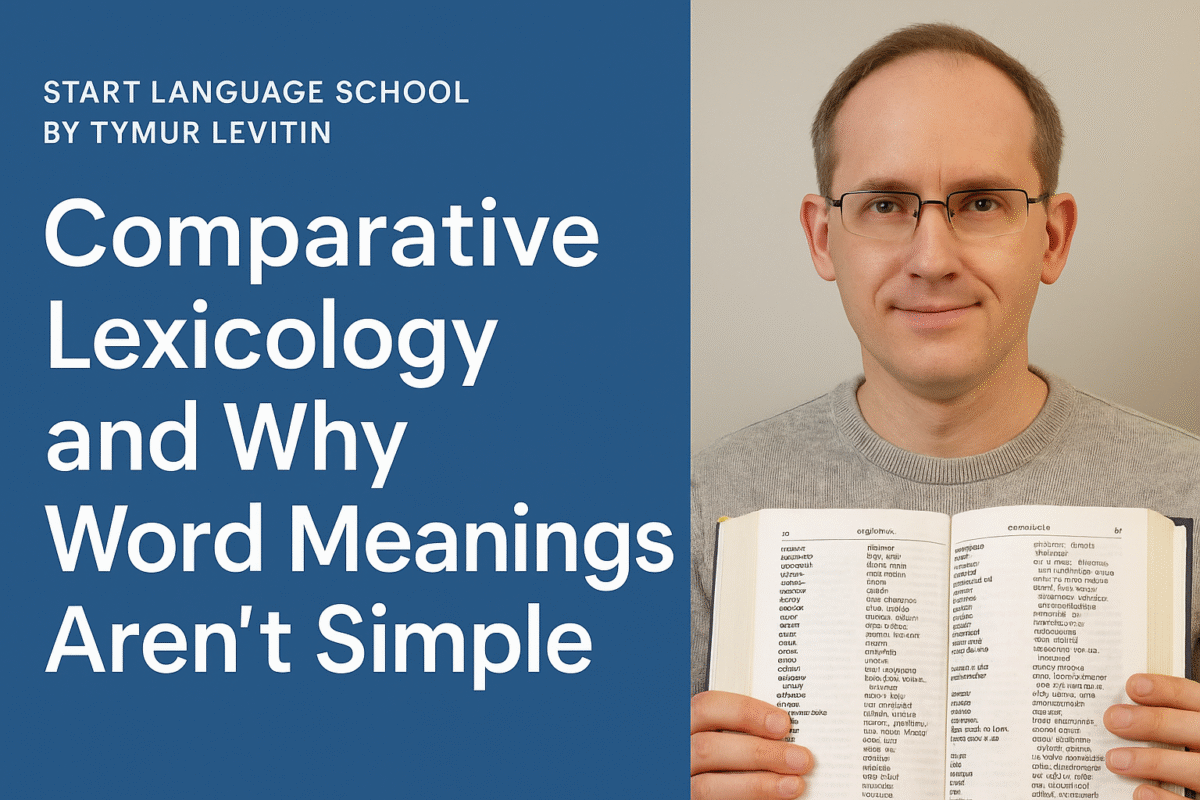
At Start Language School by Tymur Levitin, we don’t just teach languages — we explore the very DNA of words. Comparative lexicology allows us to see how languages connect, differ, and evolve, revealing the unique identity of each tongue. What Is Comparative Lexicology? Comparative lexicology is the study of vocabulary systems across two or more languages, focusing […]

Tymur Levitin | LEVITIN SCHOOL Tymur Levitin
Read more →