
🔗 Choose your language:
👉 Start your journey with us
Why a Song Can Be More Than Just a Song
Some songs don’t just express love — they live it.
Lenny Kravitz’s Again is one of those rare songs that say everything without saying too much.
It’s not just a melody. It’s an emotional system.
But here’s the problem: try translating it — and it disappears.
This article is not about music.
It’s about what this kind of emotional language teaches us about how feelings are shaped by words, by culture, by age — and why “I love you” can never mean the same thing in different languages.
How Grown Men Say “I Love You” (Without Saying It)
Kravitz never screams. He never explains. He never begs.
He simply states the void. The silence between words says more than the words themselves.
That’s not a songwriting technique — that’s a male linguistic pattern across cultures:
- Say less. Mean more.
- Leave the emotion between the lines.
- Let the listener feel it, not just hear it.
Compare this with many songs by younger male artists today — often full of “I need you”, “I can’t live without you”, “You are everything”.
Emotional? Yes.
Accurate? Not always.
Because emotion isn’t volume. It’s depth.
The Problem With “I Love You” in Translation
Let’s try this.
How do you translate “I love you” into…
| Language | Expression | Cultural Meaning |
|---|---|---|
| English | I love you | Broad range: romantic, friendly, sarcastic, or obsessive. |
| Spanish | Te amo / Te quiero | Te amo = deep, romantic; Te quiero = softer, affectionate. |
| German | Ich liebe dich / Ich hab dich gern | Liebe = serious love; gern haben = emotional liking. |
| Ukrainian | Я тебе люблю / Я тебе кохаю | Кохаю = romantic love; люблю = wider: family, friends. |
| Russian | Я тебя люблю / Ты мне нравишься / Ты мне дорог | Often reserved; love is implied, not stated. |
| Arabic | أحبك / حبيبي | Uhibbuk = I love you; Habibi = my beloved, often deeper than “love”. |
Each of these phrases has age, gender, and cultural filters.
No one says them the same way at 20 and 50.
And often, the strongest love is never verbalized at all.
Can You Love Someone in a Language You Don’t Feel In?
Here’s the paradox we often see in language learning:
A student learns to say “I love you” before they learn what love means in that culture.
Because in English, saying “I love you” too early is awkward.
In Spanish, it might be poetic.
In Arabic, it may sound too intimate.
In German, it may take years.
In Ukrainian, shifting from люблю to кохаю changes everything.
And in Russian, the phrase is so charged it often goes unspoken altogether.
So the question becomes: do we feel differently in different languages?
Yes — when we copy phrases without thinking.
No — when we learn to think and feel in the language itself.
That’s what we teach at Levitin Language School.
What We Really Teach at Our School
We don’t teach you to “translate” emotions.
We teach you to understand what your words carry.
Because “I love you” is not a phrase.
It’s a moment.
And saying it in German is not the same as in Spanish.
Understanding that — before you speak — is what makes you a real communicator.
Our teachers are not just instructors.
They are practicing translators, real people, who know what it means when you don’t know what to say — and help you find your own voice.
What’s Next in This Series?
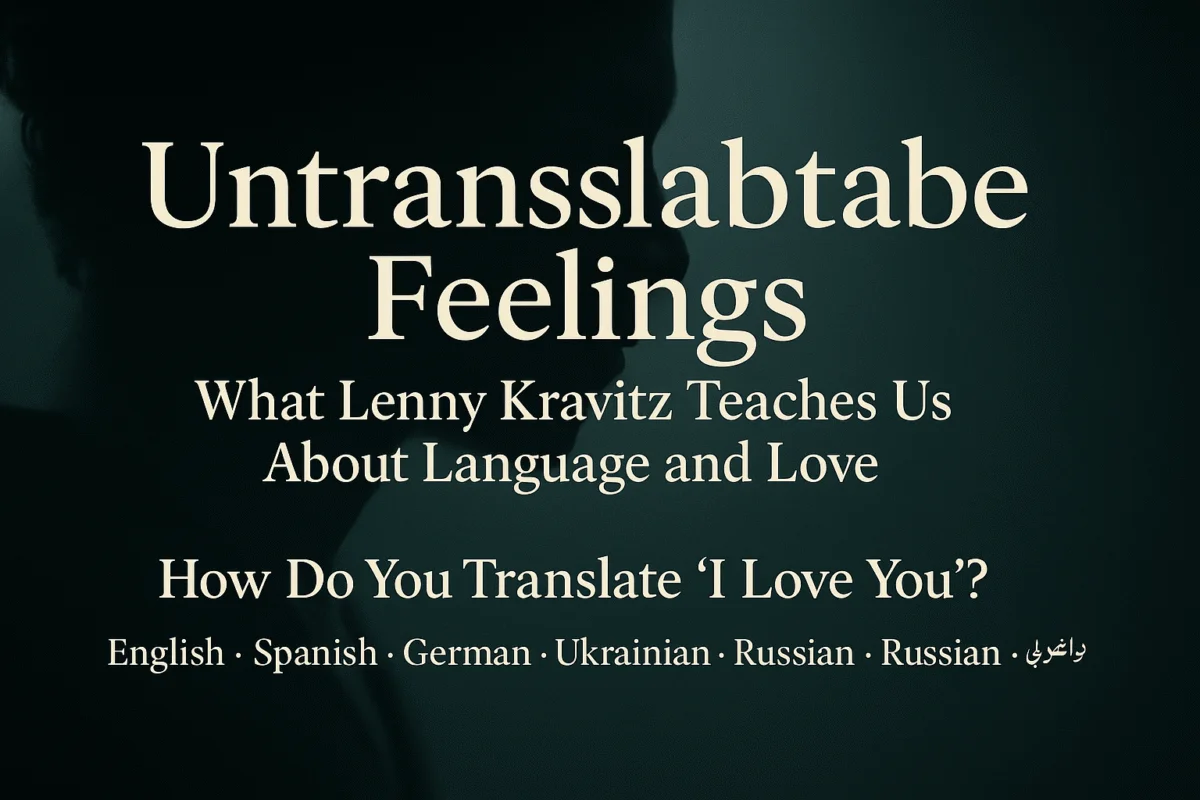
This article is part of our special series “Untranslatable Feelings”.
Next up:
👉 “Do You Really Love Chocolate?” — Why Not Everything You Love Is Liebe.
And soon after that:
👉 “From Boy to Man: How Men Say ‘I Love You’ at Every Age — or Don’t.”
We explore not only language… but the life behind the language.
© Tymur Levitin — Founder, Lead Teacher & Translator
Start Language School by Tymur Levitin / Levitin Language School
🌍 Explore Our Language Pages
- Learn English:
levitinlanguageschool.com/english-study |
languagelearnings.com/english - Learn Spanish:
levitinlanguageschool.com/learning-spanish |
languagelearnings.com/spanish - Learn German:
levitinlanguageschool.com/studying-german-easy |
languagelearnings.com/german - Learn Arabic:
languagelearnings.com/arabic - Blog:
levitinlanguageschool.com/blog |
languagelearnings.com/blog - 👉 Choose your language


