Latest posts

When Students Start Talking Fast — It’s Usually Not Progress | LEVITIN SCHOOL
24.02.2026

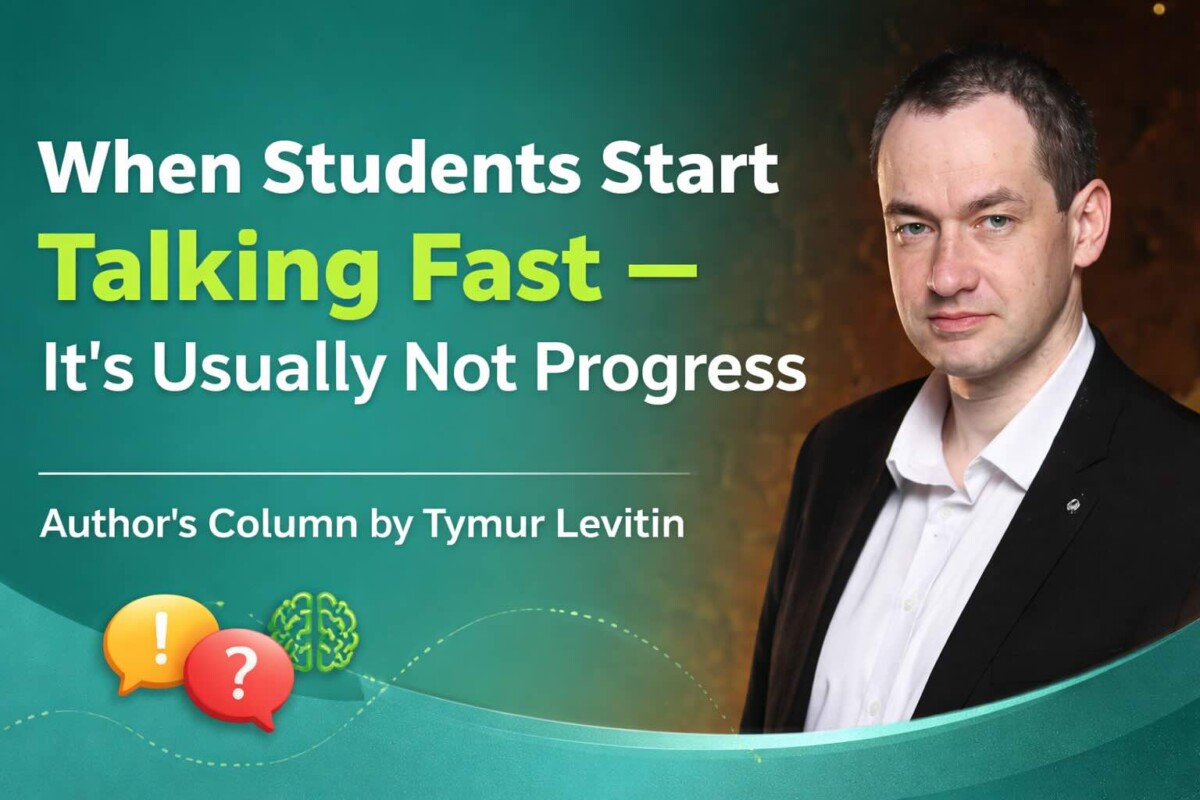
When Students Start Talking Fast — It’s Usually Not Progress

Online Language Learning

Author’s Column by Tymur LevitinLanguage. Identity. Choice. Meaning.© Tymur Levitin What teachers rarely say out loud There is a very specific moment I have learned to notice during lessons. A student who used to speak calmly suddenly begins speaking quickly. At first glance, it looks like improvement.More words. More sentences. More energy. But after many […]

Tymur Levitin | LEVITIN SCHOOL Tymur Levitin
Read more →
Adjectives After Verbs: The English Structures They Never Explained to You | LEVITIN SCHOOL
24.02.2026

Adjectives After Verbs: The English Structures They Never Explained to You

English

If you were taught that verbs require adverbs,this article will feel uncomfortable. If you were told that adjectives describe nouns and adverbs describe verbs,you were given a simplification — not the system. Because English calmly produces structures like: No -ly.No apology.No exception label. And the real question is not “Why is this allowed?”The real question […]

Tymur Levitin | LEVITIN SCHOOL Tymur Levitin
Read more →
The Real Reason Students Plateau After Intermediate Level | LEVITIN SCHOOL
24.02.2026

The Real Reason Students Plateau After Intermediate Level

Online Language Learning

Before choosing a language, first choose your direction:https://levitintymur.com/#languages There is a moment almost every language learner eventually reaches. At first everything moves quickly. You learn basic grammar.You begin to understand simple texts.You can introduce yourself.You recognize words in movies. Progress is visible and encouraging. Then you reach intermediate level. And something strange happens. You continue […]

Tymur Levitin | LEVITIN SCHOOL Tymur Levitin
Read more →
Future Perfect Explained — Why It Is Not Just “Will Have + Past Participle” | LEVITIN SCHOOL
24.02.2026

Future Perfect Explained — Why It Is Not Just “Will Have + Past Participle”

English

When students first encounter Future Perfect, they usually see this formula: will have + past participle And they are told: “It describes an action that will be completed before a certain time in the future.” Technically correct. Structurally incomplete. Because Future Perfect is not about “completion before.” It is about looking back from a future […]

Tymur Levitin | LEVITIN SCHOOL Tymur Levitin
Read more →
German Emotional Minimalism — Why Germans Don’t Overreact in Conversation | LEVITIN SCHOOL
24.02.2026

German Emotional Minimalism — Why Germans Don’t Overreact in Conversation

German

If you come from a language culture where enthusiasm is verbalized, emotions are amplified, and agreement is intensified, German can feel… restrained. You say something exciting. The response is: Interessant.Gut.Ja. And you think: “Is that all?” This article continues our German communication series and explores a subtle but powerful phenomenon: German emotional minimalism — the […]

Tymur Levitin | LEVITIN SCHOOL Tymur Levitin
Read more →
German Agreement Signals — Why “Ja” Doesn’t Always Mean Yes | LEVITIN SCHOOL
24.02.2026

German Agreement Signals — Why “Ja” Doesn’t Always Mean Yes

German

If you are learning German, you have probably been told that ja means “yes.” Technically, that is correct. Functionally, it is often wrong. In real communication, ja can signal agreement, politeness, impatience, acknowledgment, irony, soft contradiction — and sometimes it does not mean agreement at all. This article continues our German communication series and explores […]

Tymur Levitin | LEVITIN SCHOOL Tymur Levitin
Read more →
Future Continuous Explained — Why It Is Not Just “Will Be + Verb-ing” | LEVITIN SCHOOL
24.02.2026

Future Continuous Explained — Why It Is Not Just “Will Be + Verb-ing”

English

When students first see Future Continuous, they usually reduce it to a formula: will be + verb-ing Technically correct. Conceptually insufficient. Because Future Continuous is not about grammar mechanics. It is about viewing the future from inside a specific future moment. That perspective changes everything. The Core Idea: A Future Moment as a Frame Future […]

Tymur Levitin | LEVITIN SCHOOL Tymur Levitin
Read more →
German Directness vs Precision — Why Germans Say Exactly What They Mean (And Nothing More)
23.02.2026

German Directness vs Precision — Why Germans Say Exactly What They Mean (And Nothing More)

German

Author: Tymur LevitinFounder, Director & Senior Instructor — Levitin Language School© Tymur LevitinGlobal Learning. Personal Approach. Why German Sounds “Too Direct” — And Why That’s a Misunderstanding Many learners describe German as rude, cold, or too blunt.Yet native speakers rarely perceive it that way. The problem is not directness.The problem is precision. German does not […]

Tymur Levitin | LEVITIN SCHOOL Tymur Levitin
Read more →
Be Going To Explained — Why It Is Not Just a Future Plan | LEVITIN SCHOOL
23.02.2026

Be Going To Explained — Why It Is Not Just a Future Plan

English

After learning will, students usually hear something simple: “Use going to for plans.” Again — partially correct. But not enough. Because be going to is not just about planning. It is about visible intention and existing direction. The difference is subtle. The impact is structural. The Core Idea: Evidence in the Present Unlike will, which […]

Tymur Levitin | LEVITIN SCHOOL Tymur Levitin
Read more →