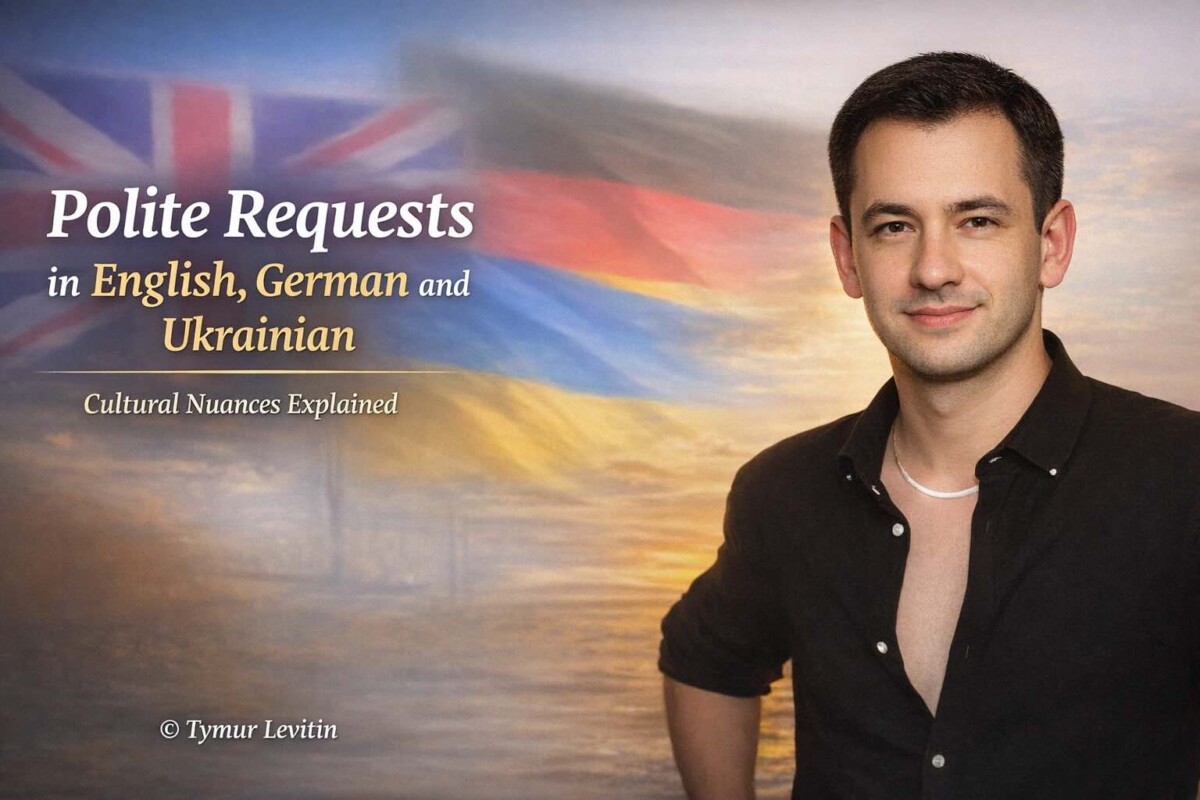

Why Politeness Matters in Language Learning
When learning a foreign language, politeness is one of the first cultural codes students face. A simple “Can you help me?” in English, “Können Sie mir helfen?” in German, or “Ви могли б мені допомогти?” in Ukrainian might sound similar in meaning but reflects different traditions of communication.
At Levitin Language School, we help students not only speak fluently but also communicate with cultural accuracy.
English: Polite but Direct
In English, politeness is often expressed with modal verbs:
- Could you open the window, please?
- Would you mind helping me?
English learners quickly notice that adding please softens almost any request.
German: Formality First
In German, politeness relies on formality. Using Sie instead of du is a core element. Compare:
- Können Sie mir bitte helfen? (formal, polite)
- Kannst du mir helfen? (informal, still polite among friends)
Unlike English, German politeness is often about choosing the right pronoun.
Ukrainian: Respect through Verb Forms
In Ukrainian, respect is shown with verb forms and the polite pronoun Ви. For example:
- Ви могли б допомогти?
- Чи не могли б Ви зачинити вікно?
This structure is very close to German, but softer in intonation.
Russian: Helpful for Comparison
Although Russian is not a primary language of study here, it can help learners notice parallels.
- Вы могли бы помочь?
- Не могли бы Вы закрыть окно?
Russian, like Ukrainian and German, uses a polite plural pronoun. For learners of English, this contrast highlights why “You” in English feels less formal.
Conclusion
Politeness is not just about grammar. It is about understanding the culture behind the words. Learning how to phrase requests correctly in English, German, or Ukrainian opens the door to real communication.
At Levitin Language School, we help students go beyond memorizing phrases — we teach how to use language naturally and respectfully.
Author: Tymur Levitin
Founder, Director & Lead Teacher at Levitin Language School
Comparative Linguistics | Cross-Cultural Communication | Language Strategy
Global Learning. Personal Approach.
© Tymur Levitin, 2026. All rights reserved.


