German

Ukrainian Lexicology: Language, Identity, and Meaning | LEVITIN SCHOOL
17.08.2025

Ukrainian Lexicology: Language, Identity, and Meaning

Author’s Column | Tymur Levitin on Language, Meaning and Respect

Before diving into the details, you can always explore and choose your language. More than Words: Ukrainian as Identity Lexicology is not only about how words are built — it is about how meaning lives inside them.For Ukrainian, this becomes especially important. The language is not just a tool of communication but a code of culture, […]

Tymur Levitin | LEVITIN SCHOOL Tymur Levitin
Read more
Was ist „richtiges“ Deutsch? — Why There’s No Such Thing as One Perfect German | LEVITIN SCHOOL
15.08.2025

Was ist „richtiges“ Deutsch? — Why There’s No Such Thing as One Perfect German

Author’s Column | Tymur Levitin on Language, Meaning and Respect

Choose your language: 🔗 Choose your language Many students ask: “Is this sentence correct?”“Do Germans really say it this way?” And the real answer is often:Yes… but also no. Because German is not just one language.It’s a collection of varieties, registers, dialects, and regional habits.And the idea of “correct” depends on what you’re doing — and where. […]

Tymur Levitin | LEVITIN SCHOOL Tymur Levitin
Read more
Deutsch ist nicht direkt — Why Not Everything Is Said Directly in German | LEVITIN SCHOOL
14.08.2025

Deutsch ist nicht direkt — Why Not Everything Is Said Directly in German

Author’s Column | Tymur Levitin on Language, Meaning and Respect

🔗 Choose your language Not every “no” is a “no.” In many languages, communication is direct. Clear. Immediate.But German isn’t always like that. And that surprises a lot of students. They ask:“Why do Germans say ‘Ich weiß nicht, ob das geht’ instead of just ‘Nein’?”Or:“Why do textbooks use so many ‘vielleicht’, ‘meistens’, ‘normalerweise’, ‘eventuell’?” The answer is simple:Because German is not a direct language — […]

Tymur Levitin | LEVITIN SCHOOL Tymur Levitin
Read more
Meisterschaft ist kein Ziel — Why Mastery Is Not a Destination | LEVITIN SCHOOL
14.08.2025

Meisterschaft ist kein Ziel — Why Mastery Is Not a Destination

Author’s Column | Tymur Levitin on Language, Meaning and Respect

Choose your language: https://levitintymur.com/#languages Mastery is not a level. It’s a path. In language learning, many students ask: “When will I finally become fluent?”“How long until I master the language?” But Meisterschaft in German doesn’t mean reaching the end.It means something more powerful: learning to move with confidence — and flexibility. Because true mastery isn’t a destination.It’s a […]

Tymur Levitin | LEVITIN SCHOOL Tymur Levitin
Read more
Meistens vs Am meisten — What’s the Real Difference? | LEVITIN SCHOOL
11.08.2025

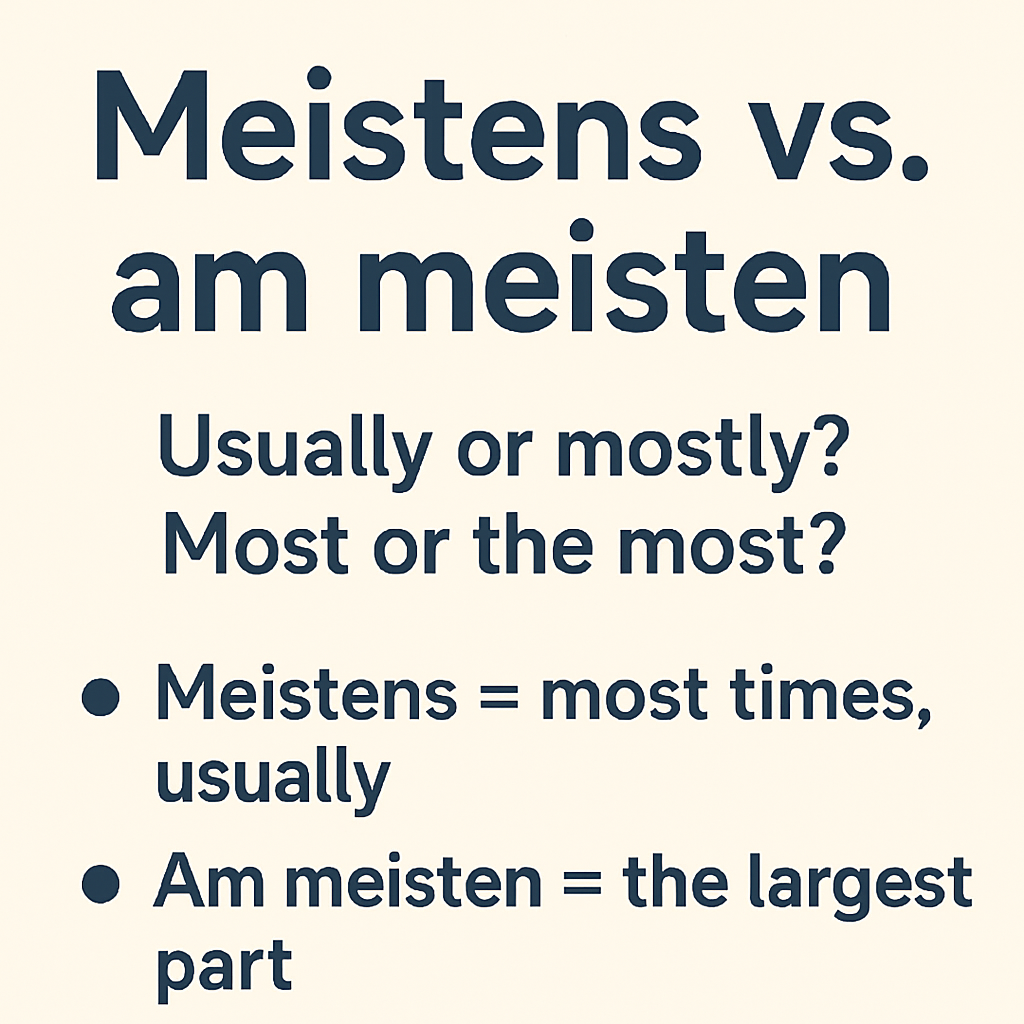
Meistens vs Am meisten — What’s the Real Difference?

Author’s Column | Tymur Levitin on Language, Meaning and Respect

When German learners hear meistens and am meisten, they often assume they mean the same thing. After all, both seem to translate as “mostly” or “most of the time.” But here’s the truth: These two expressions reflect two very different ways of thinking about frequency and quantity. Let’s break it down. 1. Meistens = most often / usually […]

Tymur Levitin | LEVITIN SCHOOL Tymur Levitin
Read more
Why the Subject Comes First (or Doesn’t): Rethinking Sentence Order Across Languages
09.08.2025

Why the Subject Comes First (or Doesn’t): Rethinking Sentence Order Across Languages

Author’s Column | Tymur Levitin on Language, Meaning and Respect

👉 Choose your language 🌍 Read this article in other languages: German version Ukrainian version Russian version At Start Language School by Tymur Levitin, we teach our students to think in full sentences, not fragments — and that means understanding not just what to say, but how to structure it. Many language learners struggle with word order, especially when switching […]

Tymur Levitin | LEVITIN SCHOOL Tymur Levitin
Read more
Warum sagt der Lehrer ‘meistens’? | LEVITIN SCHOOL
07.08.2025

Warum sagt der Lehrer ‘meistens’?

Author’s Column | Tymur Levitin on Language, Meaning and Respect

Why German Grammar Is Always So Careful The strange habit of saying “usually” — even when something is almost always true In most language lessons, students expect clear rules.They want to hear: “This is always true.”But in German, teachers often say something else: “Meistens benutzt man den Dativ.”“Usually, we use the dative case.” Even when the […]

Tymur Levitin | LEVITIN SCHOOL Tymur Levitin
Read more
“Good job!” / “Well done!” / “You’re amazing!” | LEVITIN SCHOOL
06.08.2025

“Good job!” / “Well done!” / “You’re amazing!”

Author’s Column | Tymur Levitin on Language, Meaning and Respect

Words You Know — Meanings You Don’t Three phrases. Five cultures. One big misunderstanding. At Levitin Language School, we teach languages not just through vocabulary — but through logic, emotion, and identity. And praise is one of the most culturally loaded elements in language. What’s the Big Deal? Many students ask: The answers depend on who you […]

Tymur Levitin | LEVITIN SCHOOL Tymur Levitin
Read more
Pause ist nicht Stillstand — Why Rest Is Not the Same as Doing Nothing | LEVITIN SCHOOL
06.08.2025

Pause ist nicht Stillstand — Why Rest Is Not the Same as Doing Nothing

Author’s Column | Tymur Levitin on Language, Meaning and Respect

Pause is not the absence of work — it’s the presence of purpose. In many languages, rest means to stop.To do nothing. To disconnect.But in German, “Pause” is not just absence — it’s a meaningful shift. 1. A Pause is not emptiness. It’s presence. It may look like you’re doing nothing.But in fact, you’re… That’s […]

Tymur Levitin | LEVITIN SCHOOL Tymur Levitin
Read more
Vorsicht ist kein Fehler: Why Caution Is Not a Mistake in German | LEVITIN SCHOOL
05.08.2025

Vorsicht ist kein Fehler: Why Caution Is Not a Mistake in German

Author’s Column | Tymur Levitin on Language, Meaning and Respect

🔗 Choose your language Is it a mistake to be careful? In many languages, caution is often seen as hesitation. Being careful can be interpreted as being afraid, indecisive, or slow. But in German, it’s different. The word „Vorsicht“ doesn’t carry negative weight. In fact, it is often seen as a strength. In German: Caution is not fear For many […]

Tymur Levitin | LEVITIN SCHOOL Tymur Levitin
Read more