German

German Precision Questions — Why Germans Ask for Exact Details (and Not Because They Don’t T...
02.03.2026

German Precision Questions — Why Germans Ask for Exact Details (and Not Because They Don’t Trust You)

German

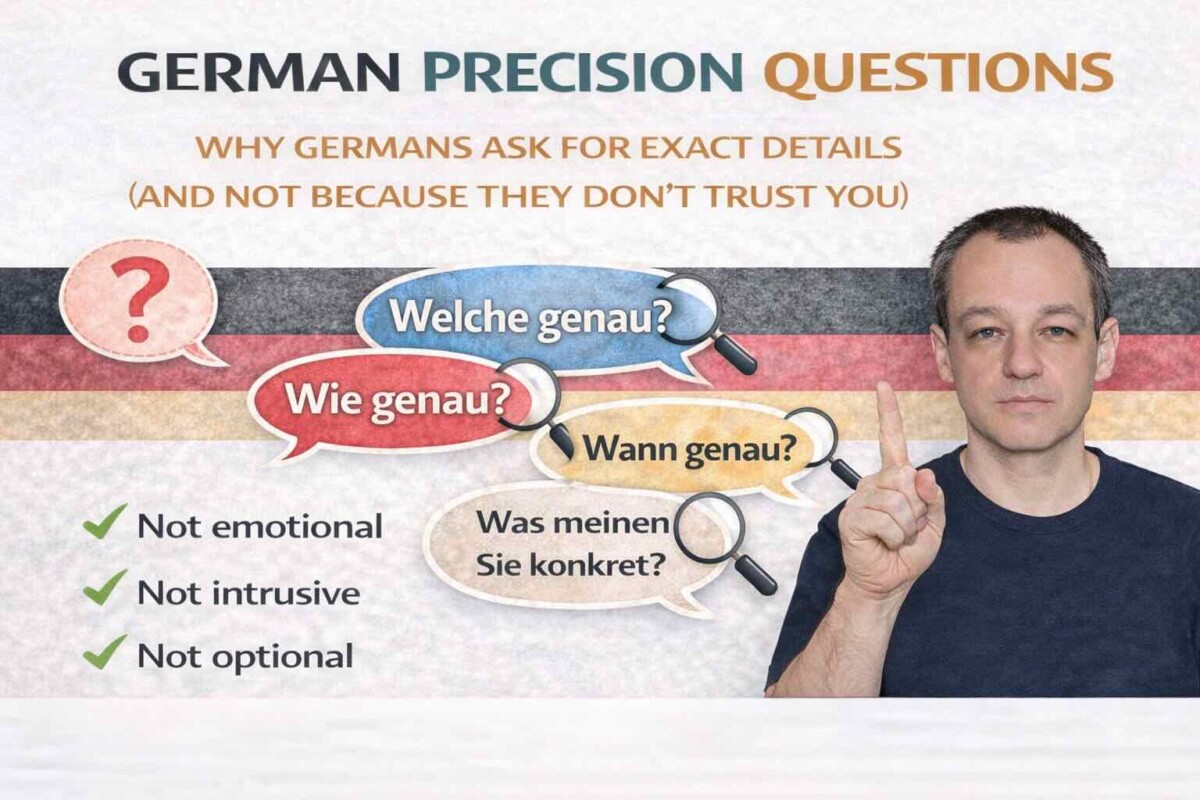
You explain something. You think it is clear. A German listener responds: And suddenly, you feel interrogated. Are they doubting you?Are they challenging you?Are they suspicious? In most cases — no. This article continues our German communication series and explores one of the most misunderstood features of German interaction: precision questioning. The Cultural Reflex Toward […]

Tymur Levitin | LEVITIN SCHOOL Tymur Levitin
Read more
Menschen or Leute? How German Separates Humanity from the Crowd | LEVITIN SCHOOL
01.03.2026

Menschen or Leute? How German Separates Humanity from the Crowd

German

Language never chooses words randomly.When German speakers say Menschen, they are not saying the same thing as when they say Leute. To a beginner, both mean “people.”To a trained ear, they reflect two different ways of seeing human beings. This distinction is not grammatical.It is philosophical. If you are learning German at Levitin Language School, […]

Tymur Levitin | LEVITIN SCHOOL Tymur Levitin
Read more
Maritime German — Speak Professionally at Sea | LEVITIN SCHOOL
25.02.2026

Maritime German — Speak Professionally at Sea

German

🌍 Choose your language: https://levitintymur.com/#languages German for Life at Sea: Clear, Precise, Reliable German is one of the most structured languages in the world — and this structure becomes a powerful tool when you work at sea.From engine room communication to navigation reports, German helps multinational crews operate safely and efficiently. Whether you work on […]

Tymur Levitin | LEVITIN SCHOOL Tymur Levitin
Read more
Why “Katz” Means Hangover — And Why a Cat Is Never Just a Cat | LEVITIN SCHOOL
24.02.2026

Why “Katz” Means Hangover — And Why a Cat Is Never Just a Cat

English

There are words that look simple.And then there are words that open cultural trapdoors. “Katz.”In one language it sounds like a surname.In another — like a cat.In yet another — like the morning after a very bad decision. This is not just a linguistic coincidence. It is a cultural map. And once you see it, […]

Tymur Levitin | LEVITIN SCHOOL Tymur Levitin
Read more
“I Love You” Is Not the Same in Every Language | LEVITIN SCHOOL
24.02.2026

“I Love You” Is Not the Same in Every Language

English

Author’s Column by Tymur LevitinLanguage. Identity. Choice. Meaning. “Love is universal. The way we say it is not.”— Tymur Levitin Most students believe they understand the phrase I love you. They can translate it.They can pronounce it.They know when to say it. But they rarely understand what it actually carries inside different cultures. And this […]

Tymur Levitin | LEVITIN SCHOOL Tymur Levitin
Read more
Red as a Crab, Blue as Drunk, Green as Young | LEVITIN SCHOOL
24.02.2026

Red as a Crab, Blue as Drunk, Green as Young

English

How Colours Reveal the Hidden Logic of Culture We think colours are universal. Red is red.Green is green.Blue is blue. But the moment you step into another language, colour stops being visual — and becomes cultural. And this is where misunderstandings begin. Red Is Not Always Just Red In English, someone embarrassed is “red as […]

Tymur Levitin | LEVITIN SCHOOL Tymur Levitin
Read more
Why Are You Telling Me This? | LEVITIN SCHOOL
24.02.2026

Why Are You Telling Me This?

Beyond Grammar: Real Meaning in Real Speech

Author’s Column by Tymur LevitinLanguage. Identity. Choice. Meaning. There is a moment in communication when grammar stops mattering. The sentence is correct.The structure is clean.The words are neutral. And yet — the atmosphere changes. Let’s take a simple question: Why are you telling me this? On paper, it is harmless. In reality, it can be […]

Tymur Levitin | LEVITIN SCHOOL Tymur Levitin
Read more
German Emotional Minimalism — Why Germans Don’t Overreact in Conversation | LEVITIN SCHOOL
24.02.2026

German Emotional Minimalism — Why Germans Don’t Overreact in Conversation

German

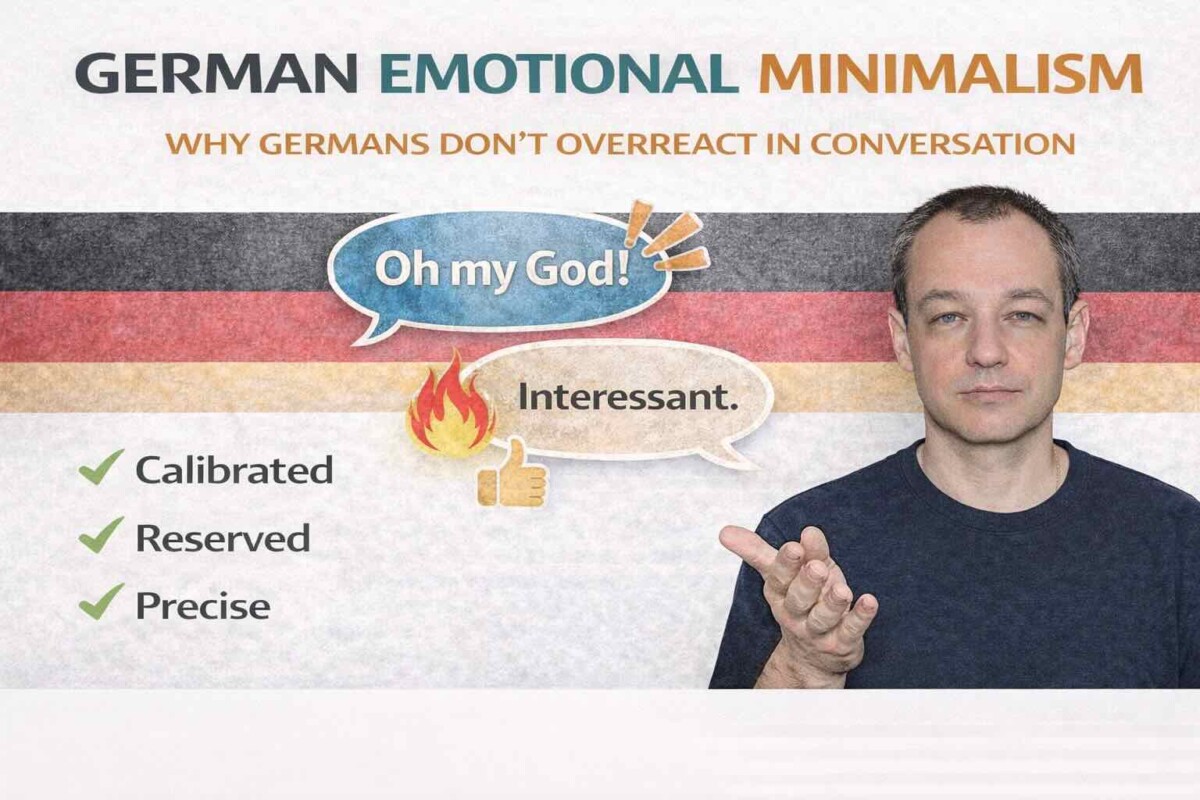
If you come from a language culture where enthusiasm is verbalized, emotions are amplified, and agreement is intensified, German can feel… restrained. You say something exciting. The response is: Interessant.Gut.Ja. And you think: “Is that all?” This article continues our German communication series and explores a subtle but powerful phenomenon: German emotional minimalism — the […]

Tymur Levitin | LEVITIN SCHOOL Tymur Levitin
Read more
German Agreement Signals — Why “Ja” Doesn’t Always Mean Yes | LEVITIN SCHOOL
24.02.2026

German Agreement Signals — Why “Ja” Doesn’t Always Mean Yes

German

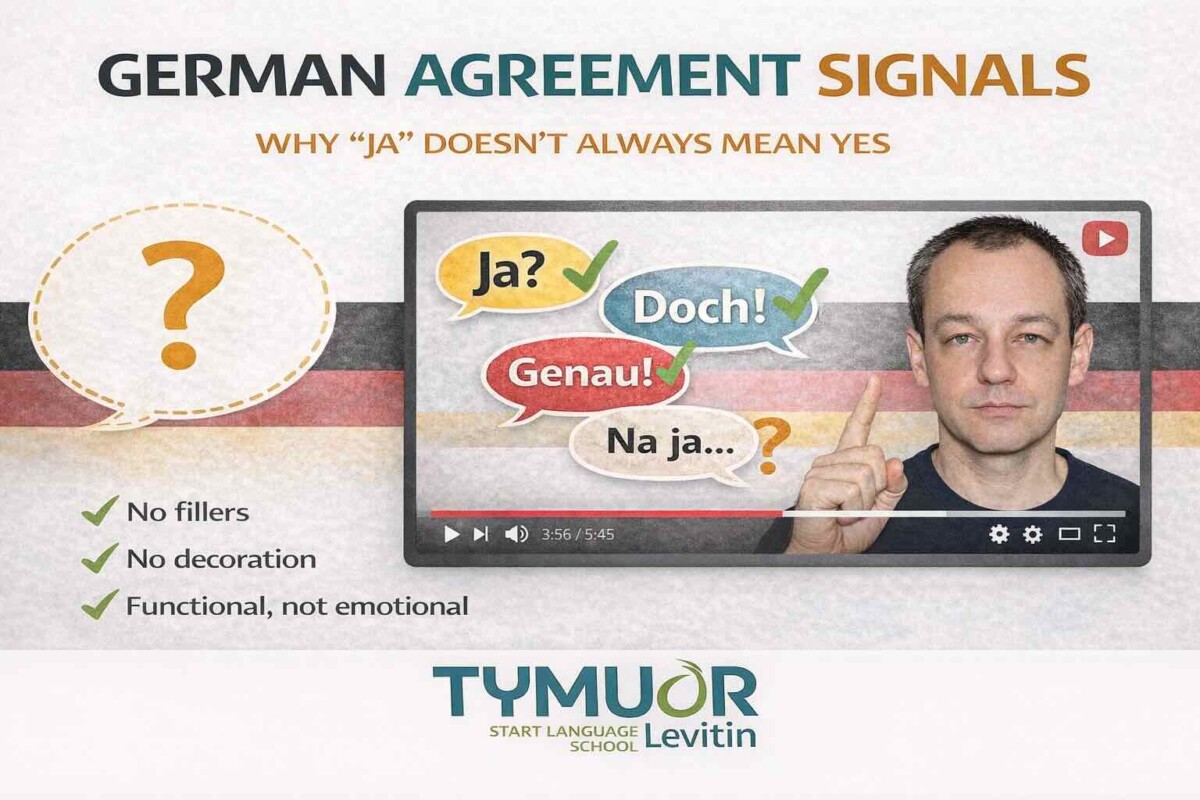
If you are learning German, you have probably been told that ja means “yes.” Technically, that is correct. Functionally, it is often wrong. In real communication, ja can signal agreement, politeness, impatience, acknowledgment, irony, soft contradiction — and sometimes it does not mean agreement at all. This article continues our German communication series and explores […]

Tymur Levitin | LEVITIN SCHOOL Tymur Levitin
Read more
German Directness vs Precision — Why Germans Say Exactly What They Mean (And Nothing More)
23.02.2026

German Directness vs Precision — Why Germans Say Exactly What They Mean (And Nothing More)

German

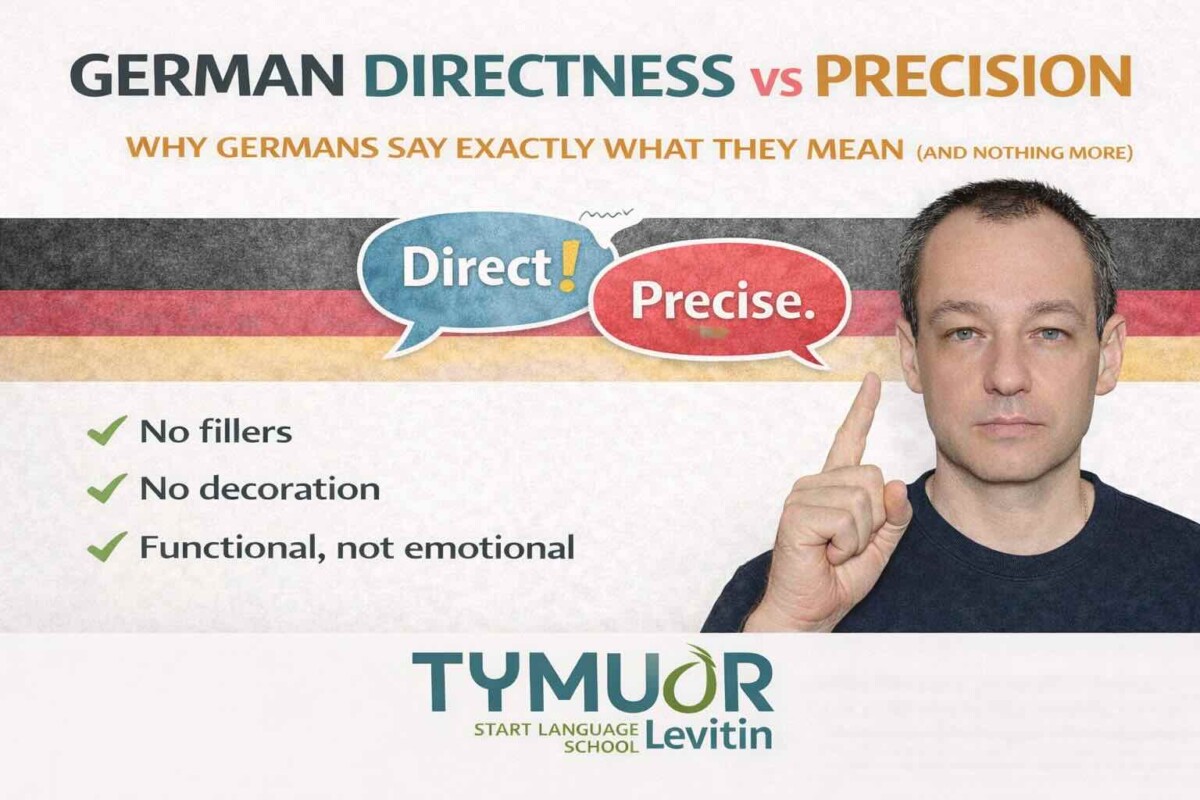
Author: Tymur LevitinFounder, Director & Senior Instructor — Levitin Language School© Tymur LevitinGlobal Learning. Personal Approach. Why German Sounds “Too Direct” — And Why That’s a Misunderstanding Many learners describe German as rude, cold, or too blunt.Yet native speakers rarely perceive it that way. The problem is not directness.The problem is precision. German does not […]

Tymur Levitin | LEVITIN SCHOOL Tymur Levitin
Read more