Skip to content

Online Language Learning

Online Language Learning

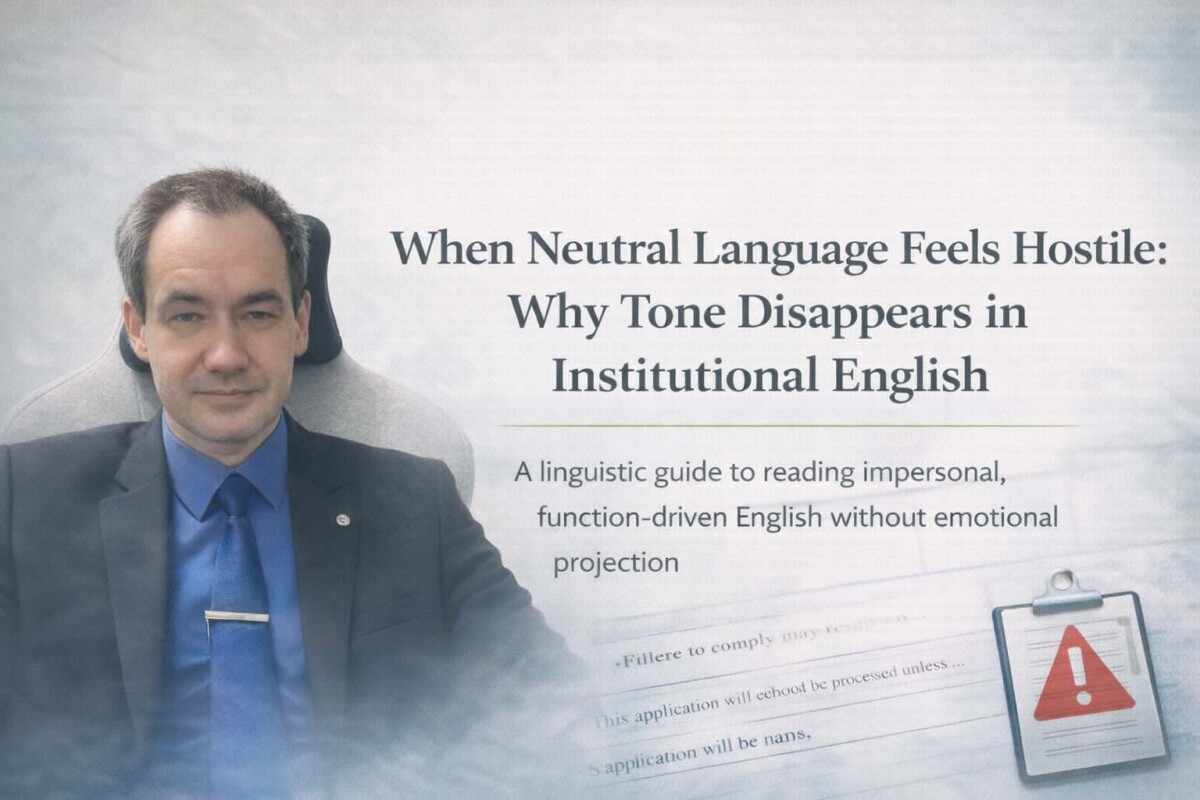
When Neutral Language Feels Hostile: Why Tone Disappears in Institutional English
05.01.2026

When Neutral Language Feels Hostile: Why Tone Disappears in Institutional English

Author’s Column | Tymur Levitin on Language, Meaning and Respect

Author’s Column by Tymur Levitin — Founder, Director, Senior Teacher of Levitin Language School / Start Language School by Tymur LevitinGlobal Learning. Personal Approach. | Speak free! Choose your language: https://levitintymur.com/#languages “Why does this sound so cold?” This question comes up again and again. Students read an email.Applicants read a form.Employees read a policy.Exam candidates […]

Tymur Levitin | LEVITIN SCHOOL Tymur Levitin
Read more →
Still vs Yet vs Already — Same Tense, Different Meaning | LEVITIN SCHOOL
04.01.2026

Still vs Yet vs Already — Same Tense, Different Meaning

English

👉 Choose your language Why These Three Words Cause Confusion Still, yet, and already often appear in the same tense — especially Present Perfect — but they describe very different moments in time. Learners confuse them because grammar books explain rules, not logic. Let’s fix that. Still — A Situation Continues We use still when […]

Tymur Levitin | LEVITIN SCHOOL Tymur Levitin
Read more →
Ever vs Never — Two Small Words, Big Difference | LEVITIN SCHOOL
04.01.2026

Ever vs Never — Two Small Words, Big Difference

English

👉 Choose your language Why Learners Confuse Them The words ever and never both talk about time, but in opposite ways. Mixing them up can completely change the meaning of a sentence. Rule 1: Ever in Questions and Negatives We use ever in questions and negative contexts to mean at any time. 👉 Ever = […]

Tymur Levitin | LEVITIN SCHOOL Tymur Levitin
Read more →
German Word Order in Real Life — Why Correct Sentences Still Sound Wrong | LEVITIN SCHOOL
04.01.2026

German Word Order in Real Life — Why Correct Sentences Still Sound Wrong

German

Before you start:👉 Choose your language: https://levitintymur.com/#languages When Grammar Is Right but Something Feels Off Many learners reach a frustrating stage in German: And still, native speakers react differently than expected. They understand you — but they don’t hear you as natural. This article explains why correct German can still sound wrong — and how […]

Tymur Levitin | LEVITIN SCHOOL Tymur Levitin
Read more →
Present Tenses Explained — Why “Now” Is Not a Moment in English | LEVITIN SCHOOL
04.01.2026

Present Tenses Explained — Why “Now” Is Not a Moment in English

English

Most learners are taught a comforting lie about English tenses:Present means now. Past means before. Future means after. This explanation sounds logical. It is also the main reason people stay confused about English grammar for years. In real English, present tenses are not about time on a clock. They are about how a speaker connects […]

Tymur Levitin | LEVITIN SCHOOL Tymur Levitin
Read more →
Why Adults Struggle More With Language Learning — And It’s Not About Age | LEVITIN SCHOOL
04.01.2026

Why Adults Struggle More With Language Learning — And It’s Not About Age

Author’s Column | Tymur Levitin on Language, Meaning and Respect

It’s often said that children learn languages more easily than adults. This explanation sounds convenient.And it’s mostly wrong. Age is not the main obstacle.Experience is. Adults Don’t Fear Language — They Fear Exposure Children make mistakes freely.They don’t protect an image.They don’t defend competence. Adults do. An adult doesn’t just speak —they represent themselves. Every […]

Tymur Levitin | LEVITIN SCHOOL Tymur Levitin
Read more →
You’re Not Slow at Languages. You’re Thinking in the Wrong Mode. | LEVITIN SCHOOL
04.01.2026

You’re Not Slow at Languages. You’re Thinking in the Wrong Mode.

Author’s Column | Tymur Levitin on Language, Meaning and Respect

Many learners describe themselves as “slow”. Slow to understand.Slow to respond.Slow to speak. They assume the problem is memory, age, or talent. Most of the time, it’s none of that. The real issue is mode. Language Has More Than One Thinking Mode Languages do not operate in a single cognitive mode. There is: Both are […]

Tymur Levitin | LEVITIN SCHOOL Tymur Levitin
Read more →
Thinking in Another Language Is a Skill — Not a Gift | LEVITIN SCHOOL
04.01.2026

Thinking in Another Language Is a Skill — Not a Gift

Author’s Column | Tymur Levitin on Language, Meaning and Respect

(The Tymur Levitin Method in Action, Part 5) 🌍 Choose your language https://levitintymur.com/#languages Introduction “I understand, but I can’t think in the language.”“I don’t have a language brain.”“I’m just not gifted for languages.” These phrases stop more people from learning than any grammar rule ever could.They sound logical. They feel honest.But they are wrong. Thinking […]

Tymur Levitin | LEVITIN SCHOOL Tymur Levitin
Read more →
Why “I Have Come Yesterday” Sounds Right — But Isn’t | LEVITIN SCHOOL
04.01.2026

Why “I Have Come Yesterday” Sounds Right — But Isn’t

Author’s Column | Tymur Levitin on Language, Meaning and Respect

The Hidden Trap of Confused Grammar in Modern English Learning You Have Come Yesterday? It Sounds Good… But It’s Not English. Many English learners — and even experienced speakers — often say: “I have come yesterday.” At first glance, this sentence seems completely logical.It feels elegant, grammatically solid, even polite. So why do native speakers […]

Tymur Levitin | LEVITIN SCHOOL Tymur Levitin
Read more →
Learning Math in English Online: How Numbers Build Real Language Thinking | LEVITIN SCHOOL
04.01.2026

Learning Math in English Online: How Numbers Build Real Language Thinking

Author’s Column | Tymur Levitin on Language, Meaning and Respect

Many people believe that learning a foreign language means memorizing words, rules, and grammar tables. Mathematics proves the opposite. When you study math through English, the language stops being a subject and becomes a working tool. You do not translate formulas. You think, reason, explain, and solve problems directly in the language. This is where […]

Tymur Levitin | LEVITIN SCHOOL Tymur Levitin
Read more →